Rachel Kurzius
 Photo by Mr.TinDC.
In a year where reported hate crimes in D.C. increased by 62 percent, the number of discrimination cases docketed by the D.C. Office of Human Rights in 2016 was down by nearly the exact same amount—61.77 percent.
Stephanie Franklin, OHR policy director and spokesperson, says that the decrease is largely a matter of how the agency is defining “docketed” in this year’s report.
“The difference in numbers is because moving into fiscal year 2016, we cleaned the numbers to count only the cases that were filed in that year,” says Franklin, whereas in previous years, the figures included all cases that were currently winding through the system rather than just those that commenced during that time period.
This year follows a banner 2015 report, which boasted a more than 100 percent increase over the previous year in terms of docketed cases. Franklin attributes that to being the first year that OHR began enforcing D.C.’s “ban the box” law, which prevents employers from asking applicants about their criminal records before extending conditional offers. In 2015, OHR docketed 365 “ban the box” cases, compared to a close 362 such cases in fiscal year 2016.
OHR is the District agency that, for nearly four decades, has been charged with enforcing local and federal civil rights laws. D.C. has one of the most extensive human rights acts in the country, protecting residents from employment, housing, public accommodations, and educational discrimination on the basis of 19 different traits (by way of comparison, the federal government has seven protected traits).
If someone feels like they’ve been discriminated against, they can file a complaint with OHR. According to a new report out from the agency, 2,048 such inquiries were filed in fiscal year 2016, 664 of which were docketed, meaning that OHR determined it had the jurisdiction to proceed.
Here’s how those cases broke down, per OHR:
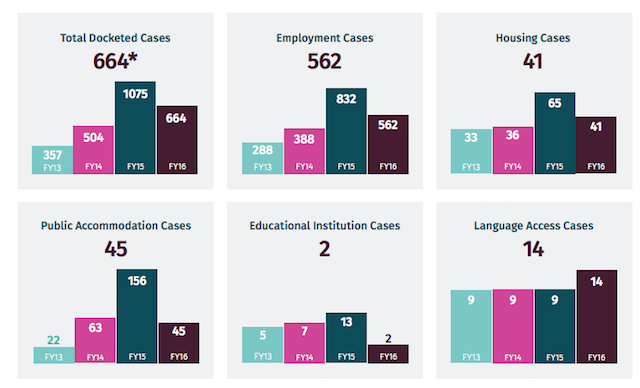 Image via OHR.
And here’s the docketed cases separated by protected trait (note that some cases involved more than one protected trait), with sex as the most frequent:
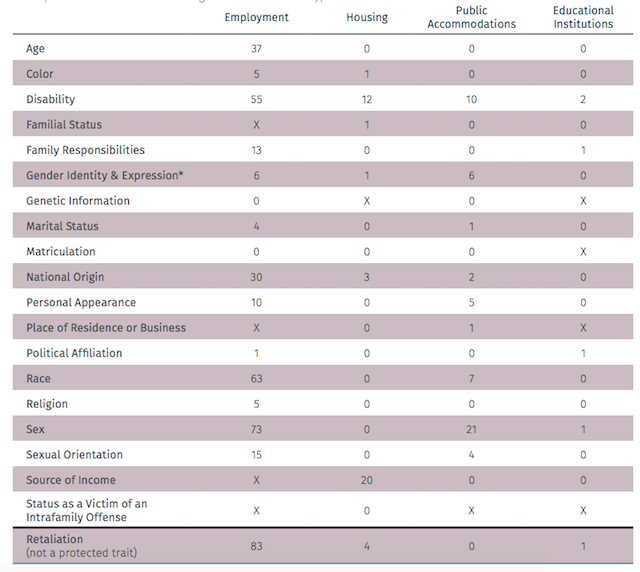 Image via OHR.
Once OHR dockets a case, the involved parties must head to mediation to try and find a “mutually agreeable resolution,” as the agency describes it. In 2016, OHR mediated 776 cases, up from the 634 mediated in 2015. It settled 467 through that process, resulting in $3.89 million in settlement amounts. That too is a boost from 2015, when the agency’s mediation resulted in $3.69 million in settlements. Those numbers reflect all cases mediated in 2016, some of which were filed before the fiscal year began. Additionally, not all settlements have monetary agreements—job reinstatement, changes to business practices, and other agreements could also result from the process.
If mediation doesn’t work in a given case, it can ultimately go to the Commission on Human Rights. A judge will review the situation and make a recommendation to a panel of three mayoral appointments, who either agree with or modify it. In 2016, there were 31 new cases certified to the commission, which ordered $512,000 in penalties.
Come October 1, OHR will start enforcing two new laws. The D.C. Human Rights Act is about to get a twentieth protected trait in the form of credit history, and the logic behind the “ban the box” legislation will be extended to include housing, preventing landlords from asking about a person’s criminal history before making a conditional offer.
Franklin says that OHR has been training business owners and landlords about the soon-to-be implemented laws. “The ways we are trying to get the word out is ever-evolving,” she says.
OHR Annual Report 2016_FINAL_092017 by Rachel Kurzius on Scribd