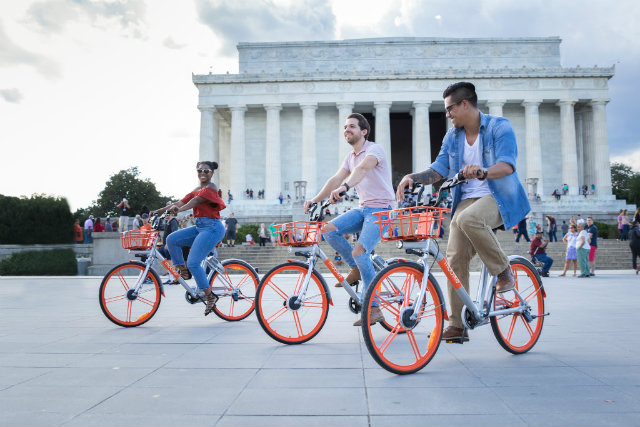
 (Photo courtesy of Mobike)
All of a sudden, hundreds of shiny red, orange, and green bikes have appeared on D.C.’s streets as if some kind of new bikesharing program has exploded onto the cycling scene.
Oh wait, that is what’s happened!
The bikes are part of a D.C. Department of Transportation demonstration period to let District riders test out dockless bikesharing—a system that lets riders park anywhere they would a personal bike as opposed to a designated dock like Capital Bikeshare.
DDOT is allowing companies to pilot up to 400 bikes through April 2018. During that time, officials will be evaluating new system’s benefits and collecting feedback from residents.
For the most part, Mobike, Spin, and LimeBike work the same way: people download an app that provides them with a QR code to unlock the bikes. Cyclists can take 30 minute trips for $1 and leave the bikes at responsible places in the city like on a sidewalk or near a bike rack. At the end of trips, riders can slide a lever to lock the bikes.
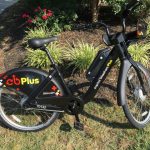
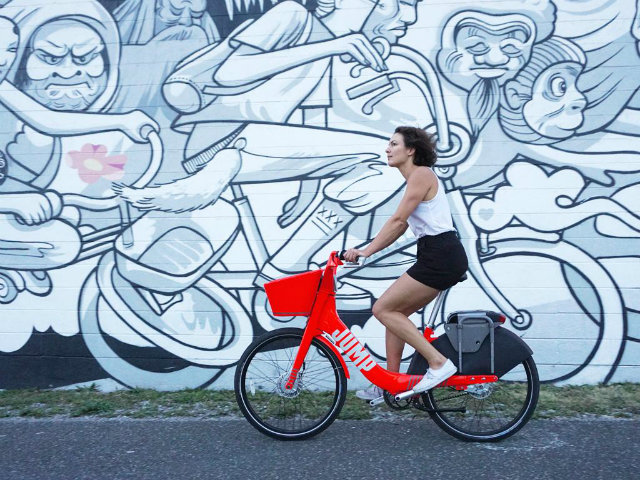
Then, there’s the sole electric-assist bike option: JUMP bikes. They have 250-watt electric motors that boost riders up to 19 mph. The bikes can also be unlocked via an app, but unlike the other three dockless brands, JUMP bikes have to be locked onto a bike rack using a U-lock that’s magnetically held to the bikes’ frames. They cost $2 for 30 minutes.
Across the globe, rolling out the dockless bikesharing model hasn’t been a smooth ride for some companies. Among other issues, cities have contended with abandoned bikes piled up along busy city corridors and sidewalks, as well as lost or stolen two-wheelers.
China-based Mobike, which launched in 2016 and has a presence in 180 global cities (D.C. is its first stop in the U.S.), created GPS technology that tracks the bikes. They have a team that monitors the bikes to make sure they don’t wind up where they shouldn’t be. Florian Bohnert, the head of international expansion at Mobike, told Mashable earlier this year that the company also tries to offer users incentives to take care of the bikes, including ride credits to users for “rescuing stranded bikes.”
New York-based JUMP and California-based LimeBike and Spin have similar tracking technology and on-the-ground teams to monitor their bikes, as well.
Each company also says their teams are able to make sure the bikes reach people who don’t have access to public transit and existing bikeshare options, including Wards 7 and 8 where Capital Bikeshare is trying to step up their presence.
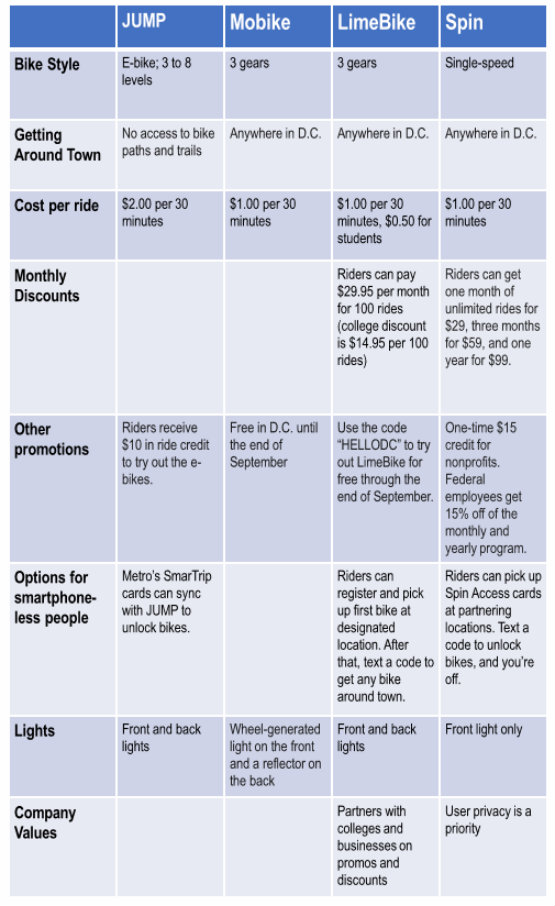
While they all fall under the dockless model, the four companies are also trying to distinguish themselves. JUMP has an advantage because it’s an electric bike. And thanks to its bright color, LimeBike stands apart in terms of appearance. But here are some other small things to consider when choosing a dockless bikeshare brand to take for a whirl (not that you have to pick just one).
 (Photo courtesy of LimeBike)
MONTHY PRICES, DISCOUNTS, AND PROMOTIONS
LimeBike partners with cities as well as some universities. The company offers college discounts for students and faculty at a rate of $0.50 per 30 minutes. LimeBike also has a monthly membership option that’s $29.95 per month for 100 rides, or $14.95 per month with 100 rides with the college discount. Additionally, anyone can use the code “HELLODC” to try out LimeBike for free through the end of September.
Spin offers riders one month of unlimited rides for $29, 3 months of unlimited rides for $59 and one year for $99. For the D.C. launch, they’re also offering a one-time $15 credit for nonprofit employees, and federal employees get 15 percent off one of the unlimited ride options.
Mobikes are free in D.C. until the end of September.
First-time JUMP riders receive $10 in ride credit to try out the e-bikes.
GETTING AROUND TOWN
While JUMP provides an extra boost for riders, there are restrictions on where they can go. The e-bikes are not allowed on off-street bikes paths and trails in the city.
The trails are fair game for cyclists taking Mobike, LimeBike, and Spin.
 (Photo courtesy of JUMP Mobility)
BIKE FEATURES
As mentioned, JUMP is an electric bike. “It’s not a bicycle, it’s not a motorcycle—it’s a new vehicle class,” JUMP Mobility CEO Ryan Rzepecki told DCist. He explains that the bikes are able to sense how how hard a person is pedaling and provides an extra boost during rides. “It measures your body, and the harder you work, the faster you go,” Rzepecki said.
JUMP rolled out 20 bikes on Monday that have eight levels, and it will bring out another 50 in coming weeks with three levels, Rzepecki said.
For people riding long distances or going uphill with the other brands, Mobike and LimeBike’s two-wheelers have three gears. Spin’s bikes have are single-speed.
Mobike spokesperson Jaime Moore told DCist that the company is an outlier because it’s the only company that manufactures it’s own fleets. “This advantage allows Mobike to adapt quickly and have the best possible engineering poured into every bike,” she said.
As far as safety features, JUMP’s Rzepecki and LimeBike CEO and Co-founder Toby Sun said that their bikes have both front and bike lights. Mobikes have a wheel-generated light on the front and a reflector on the back, according to Moore. And Spin bikes only have front lights for now, said spokesperson Kemba Neptune, adding that the bikes are updated based on feedback and terrain so the company may add back lights in the future.
OPTIONS FOR SMARTPHONE-LESS PEOPLE
Spin will be rolling out its Spin Access program that lets riders without smartphones or credit cards purchase custom cards with cash from partnering locations. People can text the code on the card to a dedicated number to sign up. Once registered, they text that same number to unlock a bike.
LimeBike has a similar cash-only option that’s coming to D.C. soon. Right now, people in Seattle take advantage of it by going to LimeBike’s regional headquarters to sign up. There, they can register, get a bike, and pedal away. The next time they want a bike, they can text a code to unlock it.
JUMP bikes can sync with Metro’s SmarTrip cards to let people without smartphones access the bikes.
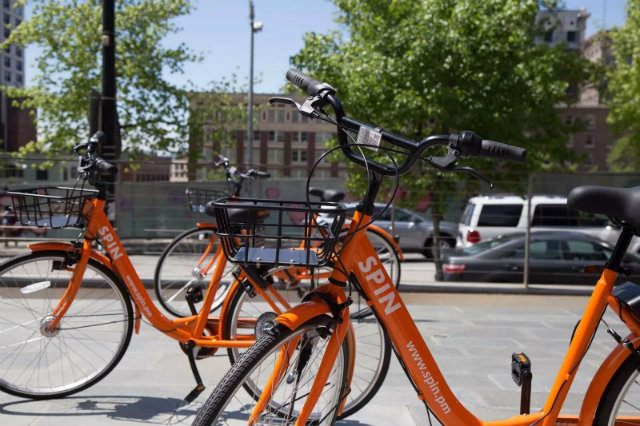 Photo via Spin
COMPANY VALUES
As mentioned earlier, LimeBike categorizes colleges as separate entities. “College is a very different market because students are heavy users and they have different needs based on bikes and pricing,” said LimeBike’s Sun. “Operating in a school environment is very different than a city.”
Sun said that although students can ride wherever they want, company research shows that about 70 percent of students stay on campus riding to dorms, class, etc. And about 30 percent of students take the bike off-campus and on city streets.
He said they’ve reached out to Howard University, Georgetown University, and George Washington University so far in D.C. “We want to make sure the schools know what’s going on what we can and will do to help.”
Sun said he’d also like to form partnerships with local businesses, whether that’s offering incentives a business’ employees to ride the bikes or promotions for patrons who ride the bikes to or from an establishment.
Spin’s CEO Derrick Ko feels particularly strongly about user privacy.
“Spin is ensuring the technology used reflects the company’s commitment to user privacy. We never sell or share customer data with third parties or governments unless required by court order. Our riders are protected by bank-level security and strict internal access controls in place,” Ko said in a statement.
“It’s important to understand exactly how the data from our industry is used, whom it’s shared with, and what governments have access to,” Ko said. “We understand that transportation is an incredibly personal part of our daily lives, and Spin is committed to protecting the privacy of all our riders.”