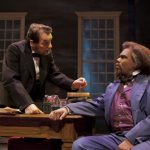
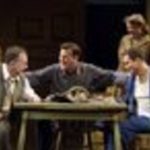
 Kimberly Schraf and Craig Wallace (Carol Rosegg/Ford’s Theatre)
By DCist Contributor Allie Goldstein
We’re all afraid of becoming Willy Loman: someone with heavy regrets and little time left. The centerpiece of Arthur Miller’s 1949 Death of a Salesman, Willy (Craig Wallace) appears on the Ford’s Theatre stage as a man teetering on the edge of his own sanity as his wife Linda (Kimberly Schraf) tries to intercept his downward spiral. In the upstairs bedroom, the Loman’s adult sons Happy and Biff riff about women and moving west, looking oversized in their childhood beds.
Director Stephen Rayne creates a household that is at once claustrophobic and expansive, its occupants at times just feet away from each other but occupying different worlds. Willy’s loneliness and descent into depression (and perhaps dementia) is accentuated by the contrast of a happier past—or at least a past rose-colored by a future once full of possibilities. Wallace seamlessly drifts between the hopeful, commanding Willy of the past and the confused, deteriorating older man.
The set and lighting design, by Tim Mackabee and Pat Collins respectively, provide visual continuity to otherwise slippery transitions between timeframes. The present-day Lomans are bathed in an eerie purple hue, the family home boxed in by walls of windows, while memories are cast in a yellow sunlight that turns Linda’s hair almost blonde and reveals the elm tree that once stood outside the apartment building.
While race is never explicitly addressed in Miller’s script, casting an African-American actor as Willy Loman lends a different interpretation to his struggle. Without directly referring to race, the casting choice has plenty of relevance for 2017. Willy embodies capitalism as a black man cast off by the economic system to which he committed his life.
The play also deals with a particularly timeless breed of alternative facts: the lies that families tell each other to mask betrayal and disappointment. This plays out most acutely between Willy’s two boys, when the ironically named Happy (Danny Gavigan) forces Biff (Thomas Keegan) to twist the story of a failed business deal in an attempt to preserve their father’s barely extant hope.
Is this an act of compassion or deception? It’s hard to tell, as the only person who seems to be truly fighting for Willy’s dignity is Linda, played by Schraf with the poignancy and ferocity of a woman trying to hold her family together. It’s a futile pursuit. Towards the end of the first act, Linda reveals the rubber pipe in the basement that she fears Willy is planning to use to gas himself; by the second act, the pipe is on the table, a kind of Chekhov’s gun. It must go off, one way or another. But the inevitability of the plot doesn’t ruin the surprising punch of emotion that comes with the Lomans’ final reckoning.
Death of a Salesman is at Ford’s Theatre through October 22. $25-$62. Buy tickets here.