By DCist contributor Willona M. Sloan
Mary Lovelace O’Neal’s painting Racism is Like Rain, Either it’s Raining or it’s Gathering Somewhere tells a story in parts. Half of the canvas features bold colors that overlap freely, conveying a sense of joy, rejuvenation and buoyancy. With a palpable sense of foreboding, somber color encroaches on the other half, threatening to devour the happy scene. In this composition, color means everything.
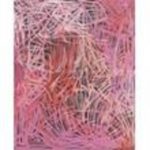
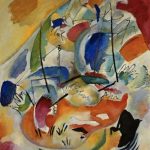
O’Neal is one of 21 Black women artist featured in Magnetic Fields: Expanding American Abstraction, 1960s to Today. The artists represent a range of visual approaches rooted in Abstract Expressionism, Color Field painting, and Minimalism. Co-curated by Melissa Messina and Erin Dziedzic, this is the first U.S. exhibition dedicated exclusively to the presentation of abstraction by an intergenerational group of Black women artists.
Artists like Chakaia Booker, Sylvia Snowden, Alma Woodsey Thomas, and Mavis Pusey spent decades on their art. “Many of them have received a great amount of acclaim and others aren’t really well-known. That is part of the purpose of this exhibition—to expose people to these artists who might not have gotten the recognition they deserved during their lifetime,” says NMWA Associate Curator Virginia Treanor. Magnetic Fields also features the next generation of contemporary artists such as rising stars Brenna Youngblood and Abigail DeVille.
“Highlighting each artist’s individual approach to materials, composition, color, and content creates a context for a lively and visual conversation among these artists,” says NMWA Director Susan Fisher Sterling. The exhibition also charts an untold story of American abstract art that “shifts our attention to key practitioners who have not received their due, fostering a deeper appreciation of their accomplishments and asserting a new parity of value for their work.”
The artists’ impactful use of color creates a unifying theme. “They all have affinity for the use of color in very particular ways,” says Treanor, “Whether it’s bright and bold colors like in the work of Sylvia Snowden or muted and monochromatic colors like in the work of Jennie C. Jones, who does geometric abstraction.”
An example of this dialogue can be found between DeVille’s Harlem Flag, a composite of found objects and work by Mildred Thompson. DeVille “kind of scavenges throughout the city landscape and takes things, and puts them back together,” says Treanor. “Harlem Flag speaks to early works by Mildred Thompson in the 1960s and 1970s called Wood Pictures. She was taking found materials from her environment, like wooden objects, wooden boards, and assembling them and painting them all white.”
The exhibition challenges viewers to discover how the artists may be addressing similar sociopolitical themes using different visual vocabularies.
The work is engaging and varied. Booker’s prickly serpentine sculpture El Gato is haunting and confrontational. Made from rubber tires, the figure twists and splits and ensnares itself in a tangle of reaching appendages. The chaos, while not easy on the eyes, feels oddly balanced. In contrast, Shinique Smith’s Bale Variant No. 0017 is a neatly bundled bale of found clothing assembled to create a soothing gradient of colors.
For viewers to walk away wanting more is really the goal. “I think the discovery factor is really high in this exhibition, and that people will be really blown away by a lot of the work in this exhibition,” says Treanor. “I hope that will get them questioning why that is, why they haven’t heard of these artists.”
This post has been updated.
Magnetic Fields: Expanding American Abstraction, 1960s to Today will be on view at NMWA through January 21, 2018.