 Rachel Sadon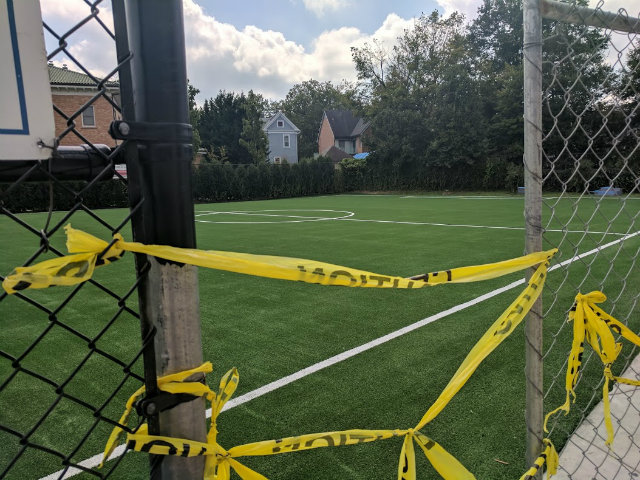
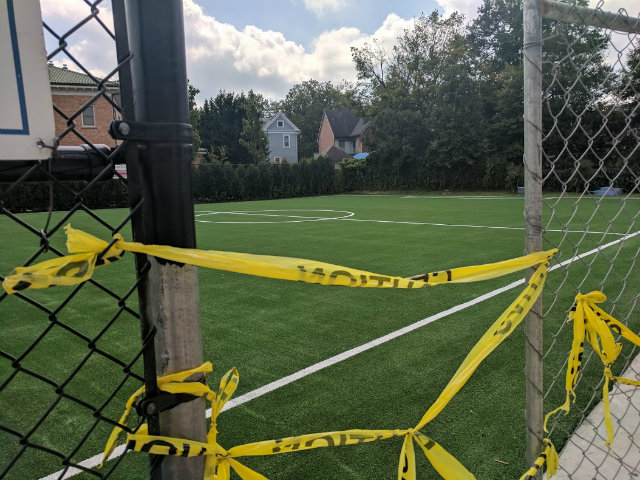 The field at Janney Elementary School was the first to be replaced after a series of hardness test failures. (Photo by Rachel Sadon)
The results of annual and emergency hardness tests on artificial turf tests reveal that seven failed fields were in use for months before the Department of General Services acted to replace them, and one field has not yet been repaired or replaced. The data also shows that if D.C. officials were using a more stringent standard recommended by the industry’s own advocacy group, more than half the city’s fields would be considered failed.
In September, the Department of General Services announced that it was replacing three fields and had repaired or was in the process of repairing 13 more. The announcement was the first time the city publicly acknowledged that more than a fifth of the city’s 52 artificial turf fields had failed hardness tests, several months after the first round of tests were conducted. Officials, however, initially declined to release the results, saying they would only do so once a task force met and could provide “education” around the numbers.
Impact attenuation, or g-max, testing is one of the most straightforward aspects of the much larger debate about the safety and cost of artificial turf that has raged around the country and is now taking root in the District. Essentially, experts recommend testing fields at least once a year to ensure that turf fields—which tend to get harder over time—remain within a safe range.
Testers typically drop cylindrical weights on 10 spots around a field and record how much force the field absorbs. The international standards body ASTM requires that no g-max score on a single test exceed 200g, which is the standard that DGS officials said they use.
While ASTM has been debating using a lower number for years, the industry’s own advocacy group, the Synthetic Turf Council, and most experts say that value should be below 165g (the National Football League uses the equivalent of a slightly lower number on a different testing device). The contractor that DGS has brought in to do field replacements also advises that g-max tests should never exceed 165g.
Records obtained by activists through a FOIA request from activists and subsequently shared by the Department of General Services show that about half the city’s fields had at least one test that exceeded the 165g standard during recent rounds of testing.
But even using the more relaxed ASTM standard of 200g, a total of seven fields failed tests in the spring and efforts to remediate them weren’t undertaken for months, even as kids continued to play on the surfaces.
In the narrative that DGS presented to DCist and the subsequent press conference, it was a single failed g-max score above 200g at Janney Elementary School over the spring that triggered subsequent rounds of testing at all 52 fields across the city.
The data, however, show that in addition to Janney, six other fields failed the annual tests conducted by FieldTurf, or should have been considered failed under the ASTM standard.
The Adams campus of the Oyster-Adams Bilingual School, tested within a few weeks of Janney, came in with an average score of 260—well above the 200g standard. And five other fields, tested between April and June, also had one or more individual test result come in above 200g.
FieldTurf, the manufacturer of most of the fields, appears to have marked those five—the Park View, Riggs, Upshur, and Palisades recreation centers and Eaton Elementary—as passing because the average was below 200g in direct contradiction of the ASTM standard, which states that no single point should be above that number. The company declined to comment about how the test results were presented or how it advised and informed D.C. officials about the failures.
DGS officials says that the agency didn’t receive the score for Adams until after it saw the Janney result and had already begun testing around the city. But that still doesn’t explain why the city didn’t disclose the significant failure at Adams immediately upon learning of it and moving the field to limited use.
The agency acknowledges that it was previously using the average score to determine if a field was safe.
“DGS initially used the ‘average’ standard of 200 as the passing or failing mark.
Upon further research, we learned that each of the (10) locations of inspection
needed to pass in order for the entire field to pass,” a spokesperson said in an emailed statement.
When the entire inventory of fields was tested again as part of a citywide round of emergency testing, a different testing company, Tildora, failed those fields and several others.
Rather than immediately fix the seven fields, which at that point had already failed two tests, and another nine fields that failed the second test, DGS hired yet another testing company, G-Cida, to conduct a third round of testing.
DGS has not responded to a request for comment about the cost of the emergency testing. Procurement documents indicate that the second round of tests alone, conducted by Tildora, cost over $200,000.
After the third set of results came in, the agency finally decided to fully replace three fields—Janney, Eaton, and the Adams campus of Oyster-Adams—and conduct repairs on the remainder. That work was only undertaken several months after the first round of testing showed out-of-compliance scores.
One other field still has yet to be addressed. The Palisades field had an individual test score above 200g in the FieldTurf spring testing. Using the average score, it was marked as passed and not included in subsequent tests.
“This single failing location at Palisades has not been addressed at this time. DGS
is working with a contractor to remediate that one failing location with repairs,” the agency said.
There’s also the matter of the more than 20 fields that have come in with scores about the 165g standard that most experts use.
For clients using the higher number, independent artificial turf maintenance expert Parker Woods says he would advise a more aggressive maintenance regimen when numbers started coming in above 165.
At that point, “maintenance is going to have a better and more long lasting result. The field is probably going to continue to wear and deteriorate, but you’ll slow that process down and the things that you do will have a longer benefit than if you’ve waited until the field has started to have failures,” according to Wood. “When a field reaches the point where it is failing the test, very often the conditions are such that it’s hard to effect any real improvement to the field short of replacing it.”
It is unclear what kind of additional maintenance FieldTurf provided for fields with escalating g-max scores or why it waited to make fixes on surfaces that were clearly out of compliance. The company said in a statement to DCist last month that it had planned to “quickly remediate” the field at Janney, but it didn’t respond to follow-up questions about the long delay or any steps it took at the other fields.
As of now, DGS says it is no longer working with FieldTurf for maintenance, but not because of any failures on the company’s part.
“Their contract has expired, and they are invited to be a part of the procurement process,” the DGS spokesperson said. DGS staffers are now doing the regularly required maintenance themselves, and a new contract will be procured this fall.
“Part of the problem with the fields is that a lot of things were being done and said … but DGS isn’t even giving out consistent information,” says Ward 3 Councilmember Mary Cheh, who has oversight of the agency. “They’re not communicating with the larger public—we already know that’s a problem.”
She is organizing a hearing on Friday that will address the g-max scores, but is also more far-reaching than simply the issue of hardness. After news of the test failures broke, D.C. officials announced they would be creating a task force to study overarching questions about choice of materials, safety, and cost that natural grass advocates have been quietly raising in D.C. for months.
DGS says the task force had its first meeting on October 11, and that a comprehensive turf plan should be implemented by the end of March of 2018. The agency stopped installing crumb rubber in 2016, but does not currently have a policy about alternative materials.
In the meantime, DGS has already replaced three failed fields at D.C. schools, which has left some parents seething at their exclusion from the decision-making process about the replacement materials. The fields at Oyster Adams, Eaton, and Janney were replaced using Envirofill, an acrylic-coated silica sand infill system that a group of parents and advocates argue is unsafe.
“All of this is being done without any response to the communication that Oyster parents have been sending,” says Dan Gordon, a parent with children in both campuses of the school and a former teacher and administrator with D.C. Public Schools. “There needs to be meaningful engagement. The stakes are just too high.”
DGS says that parents will eventually be engaged via the working group of government officials, which will study which crumb rubber alternatives should be used and when fields should be replaced.
“Here you have the city openly admitting that we need to study this more,” Gordon says, “and they’re going right ahead and putting this thing that we need to study beneath our kids feet, in their shoes, and possibly their lungs, and mouths.”
Previously:
D.C. Will Replace Three Failed Fields Ahead Of Citywide Debate On Artificial Turf Policies
D.C. Fields Fail Safety Test As A Local Debate Over Artificial Turf Begins To Heat Up