Rachel Kurzius
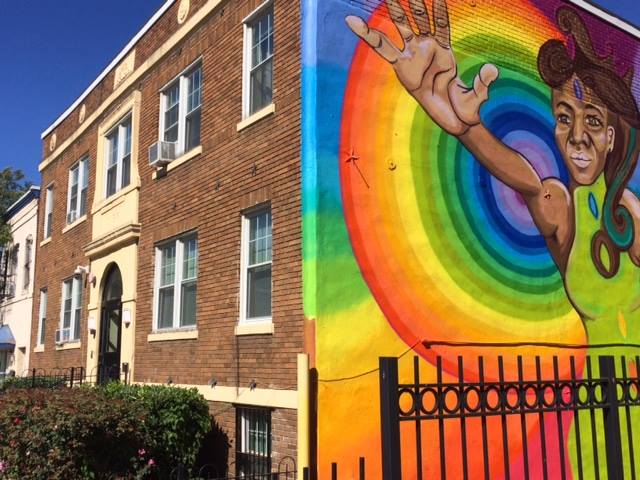 The Open Arms mural in question. (Photo via Open Arms)
After more than 1,300 people signed a petition that accused her of stealing another artist’s idea for a mural, Lisa Marie Thalhammer is pushing back against those claims.
“I created and sketched the original concept drawing for my Open Arms mural application,” says Thalhammer in a statement she sent to DCist. “The artistic expression contained in this artwork is completely mine and my copyright, and while people contributed ideas to the project, I did not intend to work with or collaborate with anyone in drawing this artwork.”
The mural in question depicts a black woman with outstretched arms against a background of concentric colored circles. The D.C. Commission on Arts and Humanities awarded Thalhammer $50,000 to paint it on the side of the Open Arms Housing building on O St NW, near her residence, and it was unveiled earlier this month.
The conflict is that artist Aja Adams, who uses the pronoun they, says that they came up with the idea for the artwork, and that Thalhammer failed to give them due credit or payment, contributing to a larger “pattern of exploitation of communities of color by white artists under the guise of charity and community development,” per the petition, which was first reported in detail by Washington City Paper. Adams is black and Thalhammer is white; both identify as part of the LGBTQ community.
“Lisa Marie presented the Open Arms grant to me as an opportunity for me to collaborate, to be creative with each other and our community,” Adams says on the phone from their current home in Chile. “I’m always for those things.”
Adams and Thalhammer, who had worked together previously on a mural and in other capacities after meeting through a mutual friend, agree that they were both present for the idea’s generation. But what roles they each played depends on who you ask.
In Thalhammer’s telling, she had been in contact with Open Arms about the potential of creating a mural for the exterior wall since 2014, and the non-profit’s executive director called her directly. Adams, she says, was one of many people with whom she brainstormed.
“I used my paints and my sketchbook and drew the figure in my signature style in my sketch book while Aja modeled for me and held her arms out,” says Thalhammer. “After I drew the body, lines and main content for the artwork while Aja modeled, I then began coloring in the drawing with my paints. I then let Aja color a minor section or two of the sketch with my paint under my direct instruction.”
But from Adams’ perspective, it went down differently. “I explained an idea I had for the drawing and we went for it,” they say. The petition describes the initial work as an original sketch by Aja Adams.
Michelle Stearn, Adams’ partner who was present for part of the exchange, says that “it was clear it was a joint work—it was a free-flowing conversation.”
In partially redacted emails provided to DCist by Adams, Thalhammer describes the process this way: “Aja and I did spend about 4/5 hours together drawing and discussing. Then Michelle came home from work, made dinner, and spent about 2 hours with Aja and I that evening.”
Thalhammer wrote up the grant proposal, and Adams says they were “elated” to learn the idea would be awarded $50,000.
Shortly before New Year’s Eve 2016, Adams and Stearn presented Thalhammer with a contract that “could create dialogue about what we expect for copyright and moving forward,” says Adams. The contract would have awarded Adams “100 percent of the copyright because I felt ownership over the idea,” they say.
Thalhammer did not agree to those terms, which afforded her “limited rights” to the work. In a partially redacted email from December 31, 2016, she tells Stearn and Adams, “I feel baffled and am curious to know why you would present me with an agreement that states Aja would have sole ownership of the intellectual property, when our work together has always been collaborative? No where on the first two pages does it clearly explain the project or mention anything about collaboration. Nor does it state my role as the main artist on the project.”
The parties were unable to find a compromise. Adams decided to head to Chile with Stearn, who had been awarded a Fulbright scholarship there, and from there, began corresponding with the D.C. Commission on Arts and Humanities, accusing Thalhammer of copyright infringement and non-payment.
In the redacted emails, Thalhammer in March of this year offered Adams $75 an hour for 16 hours of work—a total of $1,200. As the disagreement continued, in June Thalhammer upped the price, offering a one-time payment of $3,000 to Adams and Stearn. In an email sent to the pair two days later, Thalhammer says that the invoice she received “triple charged me” by including a “design fee and application fee [that] were never discussed nor agreed upon.”
Thalhammer adds in her statement that “every agreement or invoice ever presented to me always requested that I pay a large sum directly to Michelle Stearn’s PayPal account, which I was unwilling to do.”
Adams continued to correspond with DCCAH throughout the summer, alleging that Thalhammer was violating their rights and requests.
In a statement sent to DCist, DCCAH spokesperson Jeffrey Scott said, “We take copyright matters very seriously and after an initial review, we determined that this is a contractual disagreement between the two parties.”
While Thalhammer secured a copyright from the U.S. Copyright Office for the design, Adams contends that the copyrighted image is their brainchild rather than Thalhammer’s.
Their petition calls upon DCCAH to take down the mural if Adams does not receive payment or credit. Scott says that the commission “has no plans to take any further action at this time.”
Stearn says the decision to make the conflict public through the petition is “honestly a last resort. We want to see accountability for this injustice.”
But from Thalhammer’s perspective, since the release of the petition she and her family have been “trolled and cyber-bullied” by people “sending and posting hate mail, spam, and nasty harassing comments.”
She responded to petition-signers by saying, “I hear your frustration as it involved the color of our skin and inequities that are systemically associated to that,” the statement reads. “Love thy neighbor and love thyself and stop allowing people in other countries with an internet connection to continually manipulate us and polarize our communities and country.”