 Rachel Sadon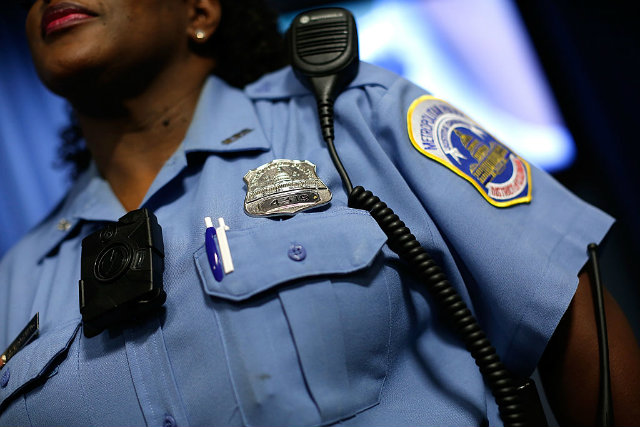
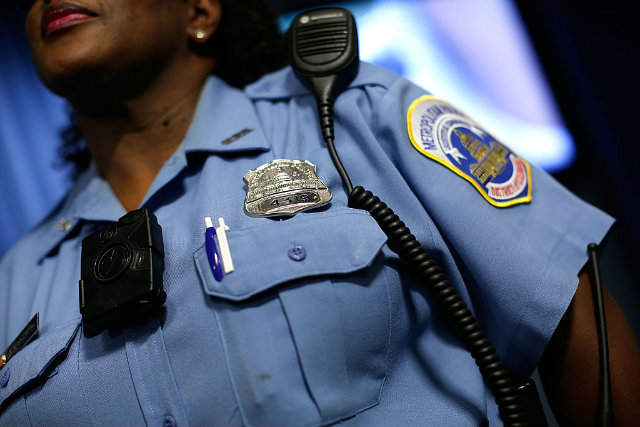 (Photo by in McNamee/Getty Images)
The results of the largest body-worn camera study in the United States contradicts the widespread expectation that constant filming of police officers results in fewer incidents involving force.
A trial with 2,224 Metropolitan Police Department officers, about half of whom were chosen at random to be outfitted with the cameras while the other half worked without them, found no statistical difference between the two groups on use-of-force incidents, civilian complaints, and several other metrics.
“These results suggest that we should recalibrate our expectations of BWCs’ ability to induce large-scale behavioral changes in policing, particularly in contexts similar to Washington, D.C.,” write a team of researchers affiliated with the D.C. government and the D.C. police force.
The District began piloting a small body-worn camera program in 2014. A year later, Mayor Muriel Bowser signed one of the most expansive police body-worn camera programs in the country into law, and an expansive roll-out began.
Researchers used it as an opportunity to quantify the cameras’ effectiveness, with the period of study spanning seven months (the entire force was equipped with the cameras by the end of 2016). They publicly released the planned methodology before starting the research so data couldn’t be analyzed in a more favorable way after it was collected.
Meanwhile, nearly every major police force in the country was in the process of implementing a body camera program, or had already done so, as several smaller studies showed positive results.
The MPD report challenges those findings, and came as a surprise to most people involved in the implementation of the program.
“We’re surprised by the result. I think a lot of people were suggesting that the body-worn cameras would change behavior,” Chief of Police Peter Newsham told NPR. “There was no indication that the cameras changed behavior at all.”
The authors considered various possibilities for the results, or lack thereof. “Perhaps,” they write, “neither the officer nor citizen involved in an interaction are actually aware of the camera, either due to attention being diverted elsewhere or desensitization over time to the presence of the cameras.” But even in the first month and a half of implementation—presumably before officers became accustomed to their presence—there was still no statistical difference in use-of-force incidents or citizen compaints.
The researchers speculated that it is possible that D.C. officers are comparatively better trained than other police forces that had been studied (MPD underwent a Department of Justice review and completed another six years of monitoring in the wake of a Washington Post report that found a pattern of excessive use-of-force incidents), which could account for the differing results.
Newsham, researchers, and other officials suggested the cameras still have other benefits in D.C.
“Not only does it offer greater transparency, it has allowed us to evaluate split-second decisions officers are making to improve our training,” the police chief said in a statement, also arguing that it has helped built trust in the community.
David Yokum, director of the D.C. government research arm that conducted the study, said that “additional research that focuses on how camera footage is used in an evidentiary capacity—such as in court, officer training, and personnel matters—may show that a greater value of this tool exceeds traditional ideas.”
The full results of the study can be found here.