By DCist contributor Deane Madsen
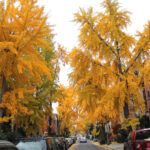
The expansion of the John F. Kennedy Center for the Performing Arts will have a grove of 35 ginkgo trees, befitting a place named for the 35th U.S. president.
“Ginkgoes are an amazing tree,” architect Steven Holl explained at a recent construction tour of the center. “In the fall, they get these golden colors that hang on the trees through the month of November. I have three ginkgo trees that I’ve planted, and I’ve witnessed this, where, in November, suddenly all the leaves decide to fall. I’m hoping that it could happen here on the 22nd of November, which is that fateful day of Kennedy’s removal from the face of the earth. Anyway, that is going to be a beautiful grove. When the leaves drop, it’s like a golden carpet below the trees.”
At last week’s tour, Holl, the founder of Steven Holl Architects, bordered on the lyrical in describing his firm’s work as curving tips of an iceberg connected beneath the surface and likening movement between aboveground and underground spaces to a violinist’s glissando, the slide between two notes.
“Most of the curves are about the connectivity of the underground to these three river pavilions above. That same curve goes all the way down,” Holl said. The expansion will open on September 7, 2019.
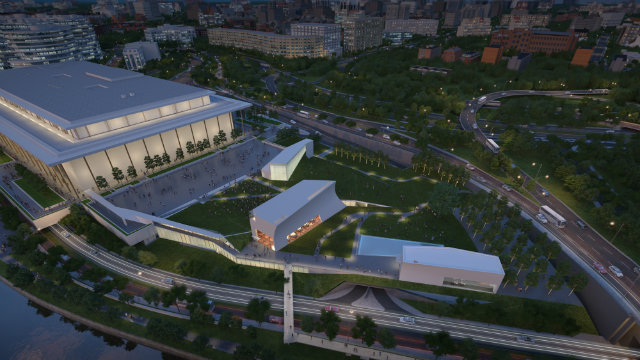
Dubbed the REACH—an acronym that embodies the Kennedy Center’s mission for the new space: to renew, experience, activate, create, and honor Kennedy’s memory—the expansion adds a compelling and necessary update to the existing 1971 Edward Durell Stone building in the form of three pavilions that enclose 72,000 square feet of publicly accessible interior space. The addition fills an awkward plot of land south of the Kennedy Center, between Rock Creek Parkway and various on-ramps to the Theodore Roosevelt Memorial Bridge.
A “welcome pavilion” serves as point of departure from the original building into the new spaces, connecting via covered promenade as well as through the parking garages below. It will include a small café, and serve to filter visitors outward to the rest of the expansion.
The “skylight pavilion,” which includes a generous performance space with 36-foot ceilings, takes its name from several skyward apertures that bring ample natural light inward. A large cut out at the base of the skylight pavilion’s curved southern wall affords views toward the Potomac River, the ginkgo grove, and the memorials beyond.
Lastly, a “river pavilion”—which was initially proposed as a floating performance barge, an idea met with enough opposition to ground it permanently—includes flexible performance spaces and an additional café overlooking the Potomac on one side and a reflecting pool on the other.
“The entire project really is emerging from the landscape, with these three pavilions coming up from below,” Holl says. “I’ve always said that architecture and landscape are deeply connected, and I think in this project, we make a real connection.”
The expansion fulfills several of the Kennedy Center’s desires, chief among which is a shared experience between artists and audiences, while allowing the Center to grow beyond the walls of its original building, which is now 47 years old. “Anything almost 50 years old can use a touch-up,” said Kennedy Center Chairman David M. Rubenstein, a major donor to the REACH.
The addition of the REACH is more like acquiring a complementary masterpiece than touching up the original. The Kennedy Center retains its stately performance halls while gaining several less formal spaces set within a 4.6-acre undulating green landscape that encourages casual encounters.
As the Kennedy Center’s artistic director of jazz, Jason Moran put it, most of what appears at the Kennedy Center is polished performance. Still, many artists find interaction during the creative process to be as inspirational as audiences find it educational. The REACH allows audiences to explore that process via overlooks into rehearsal studios and pathways that foster interaction.
Some of the improvements to the creative process will happen through the use of new materials. The walls of the underground studios, for instance, use an acoustic treatment Holl calls “crinkle concrete.” Developed with architects Chris McVoy and Garrick Ambrose in his office, it embeds non-repeating peaks and valleys onto the walls to enhance acoustic performance.
As strong winds kicked off the Potomac through apertures in the skylight pavilion still awaiting their windows, Moran warmed up the space with a lively piano performance.