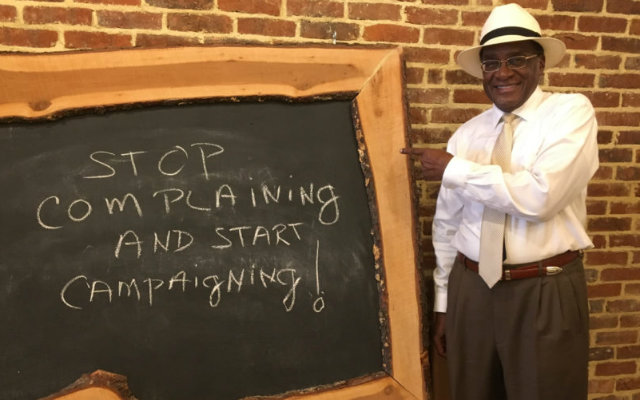
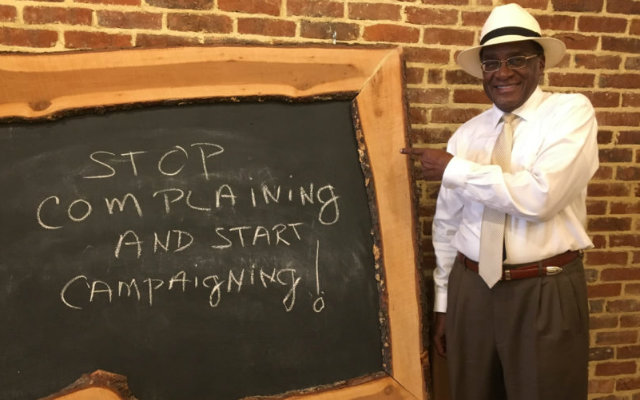
 Ernest Johnson is one of only two people challenging Mayor Muriel Bowser in the city’s Democratic primary. (Photo by Martin Austermuhle/WAMU)
By WAMU’s Martin Austermuhle
Ernest Johnson doesn’t have a lot of money to run a mayoral campaign. He has no paid staff to speak of, not that many yard signs, and no way to pay for campaign mailers. He doesn’t even really have a website.
But he’s not too worried.
“I just think I’m just anointed for this time,” he says, sitting in the former farmers’ market on 14th Street that now serves as his campaign headquarters. “It’s something a little bigger than me at play here.”
Johnson, 68, may be running on faith, but what matters most is that he’ll be on the ballot on Tuesday, June 19. Johnson is one of only two people— the other is James Butler — challenging Mayor Muriel Bowser in D.C.’s Democratic primary which has historically served as the city’s de facto mayoral election.
“I just felt that somebody had to step up,” says Johnson.
That only Johnson and Butler actually stepped up has been a topic of inquiry and conversation in D.C.’s political circles in recent months — even more so as Bowser has faced consistent scandals coming from the District’s public schools, from inflated graduation rates to a chancellor forced to resign after it was revealed that he improperly transferred his daughter from one school to another.
“It was assumed that other people were going to run. It was assumed that Karl Racine was going to make a run for it. It was assumed that Vincent Gray was possibly going to make a run for it. The time came and went and no one filed to run against her. Everyone sort of stayed in their own lane,” says Dorothy Brizill, director of D.C. Watch, a government accountability group.
Bowser also did her best to help dissuade any serious challengers: Polling found her to be generally well-liked across the city, and she was able to take in close to $1.4 million in campaign contributions in just over two months late last year. Through this week, she had raised $2.5 million.
But Johnson — who admits he may only have raised $5,000 for his run — says he’s the right candidate for the right time. He’s a native Washingtonian and a real estate professional, and twice before ran for office — for mayor in 2010 (he got 317 votes, or 0.24 percent) and for a Ward 1 seat on the D.C. Council in 2014 (2,021 votes, or 8.94 percent). He’s lived in Columbia Heights for 51 years, and says there’s pent up resentment in D.C. over gentrification — and that he can capture votes from black residents who feel left behind.
“There’s no reason we have to have an elitist society where everybody lives in $5,000-a-month condominiums, drinks $20 coffee and eats $12 honey buns,” he says. “I think we can do a little better than that.”
Johnson wants a year-long moratorium on rent increases and six-month moratorium on the issuance of building permits. He wants developers held to higher requirements for how much affordable housing they have to build, and says city-provided tax breaks should be more often rescinded if developers don’t meet hiring goals for D.C. residents.
On schools, Johnson says he wants to organize a citywide education summit to figure out how to help underperforming schools, and to retrain police officers in non-lethal tactics.
He also wants to build a local bank where U.S. companies can deposit money they bring back from abroad — which will help fund his plans, without a need for tax hikes or speed camera revenue — and take the $28 million D.C. spends annually on motels for homeless families and instead spend it on getting them jobs and permanent places to live. He thinks the Department of Public Works — responsible for everything from trash pickup to graffiti cleanup — should hire 1,500 more residents.
Johnson says he’d be able to achieve all of this because he’s not beholden to any special interests, something he accuses Bowser of.
“Mayor Bowser is just not a leader,” he says. “This is not a head game, this is a heart game. Because if you coming at it from the head, you’re going to be talked off of it because there’s too much influence around, there’s too much money involved. I’m just committed from the heart, so it’s going to be hard to move me just for a few dollars.”
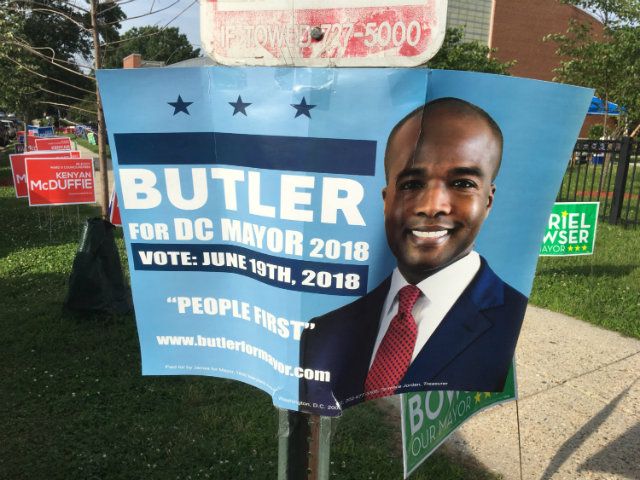 James Butler currently serves as an ANC commissioner in Ward 5, but wants to move on up to the Wilson Building. (Photo by Martin Austermuhle/WAMU)
That populist strain also comes through with Butler, the other mayoral candidate hoping to unseat Bowser. He’s an advisory neighborhood commissioner in Ward 5.
“I believe that another four years in the direction that this city has gone in, the narrative over the last four years has been written by big business and developers, I believe it will necessarily exclude a lot of people,” says Butler, 42.
Butler wants to scrap mayoral control of schools and bring back a more powerful elected school board. He wants non-profit organizations in D.C. to each “adopt” a homeless person, and help them get back on their feet. He wants to improve community policing, and also put more pressure on property owners and developers to keep housing costs down.
“I really do believe it’s gotta be about more income-based housing and rent control, true rent control,” he says.
Butler has raised more money than Johnson, and has more yard signs scattered throughout the city. But he also faces a bigger challenge convincing voters to cast a ballot for him — in 2009 he was disbarred after facing more than 100 complaints of misconduct.
“I made some mistakes in hiring people and I paid a heavy price for that,” he says.
Despite the uphill battle they face, both Butler and Johnson say they are undaunted. As for their chances at victory, Johnson says the many people who dismiss him are the very reason he could win.
“What the media and the developers have tried to do is a coronation of Mayor Bowser. And the resentment behind that and the pushback is what’s going to give me a push,” he says.
And those concerns about gentrification and change in D.C. are playing prominently in other D.C. races, including in a competitive fight for D.C. Council Chairman and an At-Large seat.
But those issues aside, Dorothy Brizill of D.C. Watch doubts either Johnson or Butler have a chance at winning. She guesses that many voters will choose Bowser because it’s who they’re familiar with. On the longer term, Brizill worries that there’s not a deep enough pool of qualified and experienced people who could run for mayor in the city.
“We don’t have a good bench of second-string pitchers to step up to the plate and mount a campaign,” she says.
For the time being. Johnson and Butler will keep working to get their names out to voters. For Bowser, that task will be a little bit easier — she still has $1.5 million dollars in her campaign bank account. And while she will still have to face voters again in November’s general election, no serious candidates have yet stepped up to challenge her.
This story originally appeared on WAMU.