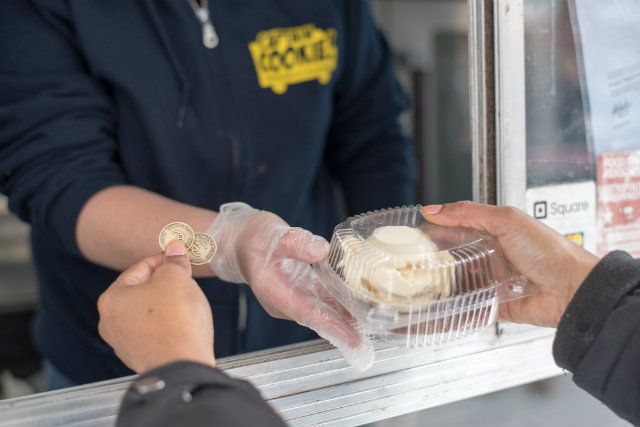
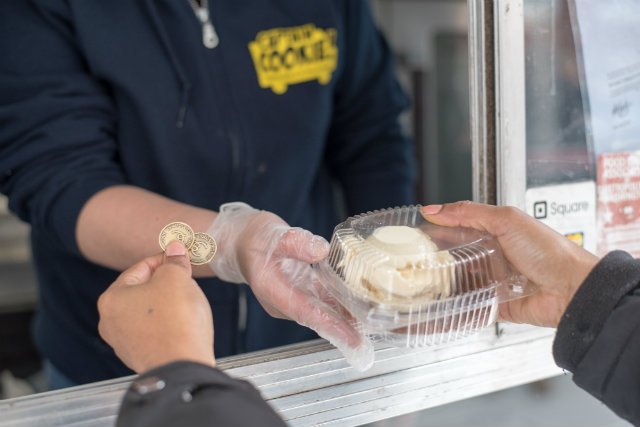
 Breadcoin tokens can be exchanged for food at participating vendors in D.C. (Photo by Yuri Borovsky)
Scott Borger spent a lot of time in the wake of the 2008 financial crisis lamenting the gradual defunding of nonprofits and local governments, and feeling sad about growing inequality in the D.C. area, where he’s now lived for a decade. Volunteering at Central Union Mission, a nonprofit based near Union Station that operates emergency shelters and other social programs, kept his eyes open to the challenges.
So he did what any economist with a Ph.D would do: He pondered theories of economics until he landed on one that served his goal.
The result is Breadcoin, a nonprofit organization that aims to empower the city’s community experiencing homeless. His tokens can be used to purchase food for people living on the street or for donating to churches and nonprofits.
Inspired by the advent of bitcoin and other cryptocurrency, Borger hopes Breadcoin will appreciate in value and help bridge gaps between the city’s wealthy and underprivileged classes. A recent annual survey found that 6,904 people currently experience homelessness in D.C., down from the last two years but up slightly from 2013. Too often, Borger thinks, people don’t know how to help those in need of food, or don’t want to give money for fear of giving an addict access to drugs.
“We want people to use [Breadcoin] themselves, but also to engage those who have needs, to be able to have a conversation, to see that there is not a barrier to giving money,” Borger says.
Here’s how it works: You can purchase Breadcoins online now at $2.50 per coin. (The company plans in the coming months to introduce a membership model that delivers 10 coins for $25 each month.)
Once you receive coins in the mail, you can redeem them yourself for food and drink items at participating locations; give them to people in need; or donate them to a participating nonprofit. Each coin is worth $2.20; the remaining 30 cents goes toward production of the tokens, which cost 70 cents apiece to make. Breadcoin encourages participating food vendors to include items on their menu that align with the $2.20 value of a Breadcoin. When that’s not possible, the customer pays the difference. For a $4.80 purchase, for example, the customer pays two Breadcoin plus $.40.
Breadcoin has quietly been selling its tokens and building its base of nonprofit partners since August 2016, but has begun widely publicizing the work in recent weeks. Approximately 2,800 Breadcoins are already in circulation, Borger says, with 400 to 500 more being redeemed or purchased each month.
In the two years since circulating the first tokens, Breadcoin has reached agreements with two brick-and-mortar eateries (Captain Cookie bakery in Foggy Bottom and Mission Muffins near Union Station) and several food trucks and stands, including Captain Cookie’s truck and Samy’s Food Cart. There’s also a participating vendor in Portland, Ore., which joined in 2016. Those stores accept Breadcoin as a form of payment. Each month, these spots ship the coins they’ve accepted to Breadcoin (or have them picked up by a Breadcoin rep), which returns an equivalent amount ($2.20 per token) via check. After locations exchange their first 100 coins, Breadcoin offers the option to pay back small business loans as well.
For Captain Cookie owner Kirk Francis, partnering with Breadcoin was a no-brainer. He knew one of Breadcoin’s volunteers through an adult recess program they had worked on together in 2012. Francis saw working with Breadcoin as an extension of his company’s existing partnerships with organizations like Capital Food Bank and No Kid Hungry.
All Francis and his team had to do was put up some stickers, enter a special item number on the cash register, and keep the Breadcoin tokens in a box to be picked up each month by a Breadcoin representative.
“I would encourage it for everybody in D.C.,” Francis says. “It’s not very much skin off your nose from a restaurant perspective, and it does a lot of good.”
Breadcoin has an even more extensive partnership with Central Union Mission. Breadcoin lent the organization money to purchase a trailer to house Mission Muffins, a bakery staffed by constituents training to enter the job market. The trailer cost $18,400, according to Borger; Central Union Mission pays back the loan in Breadcoins it receives as payment from customers.
Central Union Mission was eager to partner with Borger on refining the logistics of his vision, according to Sally Cox, the mission’s chief financial officer.
“My sense is that folks that are using it are beginning to see the homeless as a person, not just someone who’s standing there sort of panhandling,” Cox says. “It sort of puts a face and a humanity on someone who is still on the street.”
While bitcoins are circulated virtually through the nebulous online service known as the blockchain (it’s a long story), Borger felt a physical one-inch in diameter token was necessary to create a tangible bond with the organization’s message.
Each person’s first coin purchase comes with an insert that explains how and where to use the token. Borger says he’s found that residents near Union Station experiencing homelessness no longer express surprise or confusion when handed a Breadcoin. He expects the homeless community in downtown D.C. is more aware of how to use Breadcoin than residents further away from the city’s center.
Mission Muffins receives between 150 and 250 Breadcoins each month, according to Borger. During the early days, Captain Cookie would get four to six tokens each month, but that number has dwindled to one or two, according to the store’s manager Crystal Jones. Awareness and usage will spread over time, Borger hopes.
“You’re not just handing them food, but they have a choice of the timing of when they want to use it and where they want to use it, and for which item they want to use it,” Borger says. “We find that that provides the person [with] dignity.”
Borger works part-time on Breadcoin and full-time at the National Credit Union Administration. At Breadcoin he has two full-time colleagues, including his wife Sarah, who runs day-to-day operations, and six part-time volunteers. Borger hopes to continue Breadcoin as a largely volunteer-based venture going forward.
Eventually, Borger hopes to be able to offer loans and extend credit to small businesses who struggle to go through the official process of securing a loan from a bank. He also expects to partner by the end of the year with at least 20 more businesses, through a combination of referrals and word of mouth.
“The difficulty is getting to the decision-maker,” Borger says of early attempts to secure vendor partners. “Once we have an audience with the owner or manager that could make the decision, we walk through a vendor agreement and ask them if they are willing to accept the token.” Only a few vendors have declined the partnership opportunity, according to Borger.
Borger believes using Breadcoin can heighten awareness of the homeless community’s needs while doing demonstrable work to address them.
“We want people…to be able to meet the needs of their city,” he says.
DCist is one of eight D.C.-based news outlets dedicating a portion of our coverage on June 28 to collaborative news coverage about ending homelessness in the nation’s capital. See more at DCHomelessCrisis.Press