 Rachel Sadon
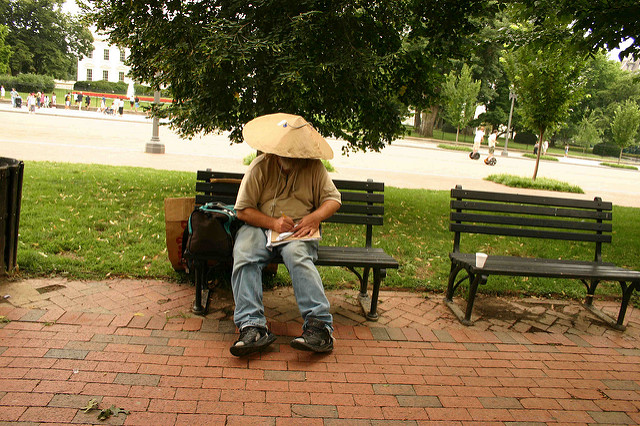 (Photo by Elvert Barnes)
The danger of hypothermia is an obvious one: freezing to death. Hyperthermia, or heat related illness, can be just as dangerous.
“Extreme heat often results in the highest annual number of deaths among all weather-related disasters,” warns the Federal Emergency Management Agency.
But while the frigid winter months often see an increase in resources, support, and awareness for individuals experiencing homelessness, the general public doesn’t pay the same kind of attention to the dangers of relentless heat or the myriad additional hardships of lacking a home in the midst of a sweltering summer.
“People are acutely aware that a person can die if left overnight in very cold weather, but they are less aware of the dangers of heat,” says Ger Skerrett, an outreach and engagement specialist at Miriam’s Kitchen. In addition to dehydration and heat stroke, high temperatures also exacerbate diabetes, heart disease, and other medical conditions.
As the District continues to shatter heat records, the danger is becoming more acute. The non-profit Climate Central found that the District had averaged around seven or eight days with temperatures at or above 95 degrees in 1970; by 2016, that figure was hovering around 15, according to the Washington Post.
In addition to the broiling days, excessively hot nights means that people who are exposed to the elements for 24 hours a day don’t get a chance to really cool down for days at a time.
“We all take it for granted that we’ll get to air-conditioning or be able to sit under a fan,” Skerrett says. “There are times when it is staying above 70 or 80 even through the night. You have days and days of heat. The body has to work really hard to keep itself cool and a person outside all the time doesn’t get to rest from that.”
Unusually hot overnight temperatures now happen five to ten times more frequently in this century than the one prior, according to the Capital Weather Gang.
It’s not just the heat of the days and nights, though. It’s the humidity, which makes it more difficult for the body to cool down (humans lose heat through the evaporation of sweat; with more moisture in the air, it dissipates much more slowly).
Scientists call the combination of air temperature and humidity the “wet-bulb temperature” (similar to the more commonly known heat index). Staying outside at wet-bulb temperatures of 95 degrees for more than a few hours is lethal.
In the District, when the mercury or the heat index hits 95, a series of cooling centers springs into action. They stay open until 6 p.m. or when the temperature drops to a safer level.
“Almost all public facilities operate as cooling centers,” says Department of Health and Human Services senior adviser Carter Hughley. “If you had to guess, if it’s a D.C. government building, you can probably go in.”
The city also operates a hotline (202-399-7093) and will either dispatch help if someone is in heat-related distress or transport them to a cooling center.
Still, representatives at a number of cooling centers seem to be unaware that they are designated as such. On June 18, the first time the District activated its heat emergency plan this year, reporters for Street Sense Media contacted several dozen facilities and found that at least four said they weren’t open for that purpose and a number of others said they weren’t a cooling center but that people were still welcome to come by.
Hughley chalked it up to being the first heat emergency of the season. “If there are kinks in the first one, that’s unfortunate, but not totally unexpected.”
But the lack of public awareness of the resources available during a heat emergency isn’t a new issue.
“In the winter time there’s better communication around what’s going to happen,” homeless advocate Albert Townsend told the Washington City Paper in 2016. Over the summer, “if you look around the city there’s people laying in the parks and on the concrete.”
A bottle of water or gatorade can be a lifeline on such days. So can being on the lookout for the signs of heat exhaustion and heat stroke.
“A person can become very confused. They can be sweating profusely. Their skin can go pale,” says Skerrett. “In the later stage, when it becomes very dangerous, the sweating stops all together. If a person looks like they should be sweating and they’re not, that’s a very real sign that they’re experiencing a medical emergency.”
He says that a bystander shouldn’t hesitate to call for help.
“I would emphasize that hyperthermia is an emergency … it can kill. I would encourage people not to be afraid to call 911 if they see someone who is unconscious or if they appear to have heat stroke,” Skerrett advises.
Aside from the most immediate health dangers, the heat presents a whole range of other complications for people without homes.
“The most difficult part of it all is keeping your belongings dry,” says Joe, who wished to be identified by a pseudonym for privacy reasons, as he perched on an upturned milk crate at the corner of 16th and K streets NW on Wednesday. “It’s going to get all mildewy and moldy with all the humidity.”
It’s also a challenge to keep socks clean, which are critical for staving off foot infections.
Studies have shown that some kinds of medications—diuretics and beta blockers—may put individuals at a greater risk during very hot temperatures.
“It’s actually easier in the winter,” Joe says. “You don’t have to worry about sweating or changing your clothes. When it’s cold, you can try to find a blanket. But there’s nothing you can do in the summer.”
DCist is one of eight D.C.-based news outlets dedicating a portion of our coverage on June 28 to collaborative news coverage about ending homelessness in the nation’s capital. See more at DCHomelessCrisis.Press