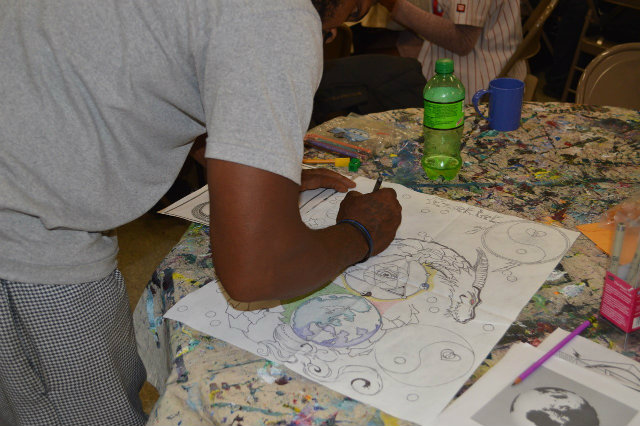
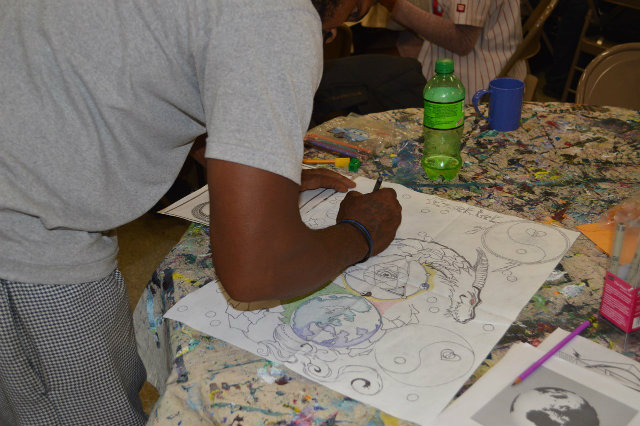
 A guest at Miriam’s Studio works on a piece. (Photo by Christina Smart)
In a nondescript basement in Northwest D.C., people start filing in around mid-afternoon, arranging themselves around various circular tables, getting themselves situated and chatting. With tablecloths laid over each table, and people helping themselves to water and coffee, it looks like any of the numerous seminars or conferences that take place every five minutes in Washington—with a little paint splattered here and there. This is Miriam’s Kitchen, and their guests have arrived to participate in Miriam’s Studio, a therapeutic art program for those experiencing homelessness.
As part of Miriam’s Kitchen, which has been serving meals and providing care for people experiencing homelessness since 1983, Miriam’s Studio sprung from the idea that this community not only needed physical nourishment but emotional sustenance as well. In 2010, former Miriam’s executive director Catherine Crum began bringing art therapy interns from George Washington University to supervise its occasional art classes. The result is Miriam’s Studio, which now offers twice-daily therapy sessions that use a variety of art media (today they’re beading) to help guests work through emotional difficulties or trauma they might have experienced.
“Many programs around the city focus on the survival basics of what people need when they’re experiencing homelessness like food and housing and jobs, [which are] absolutely essential,” says senior art therapist Brittney Washington, who runs the studio. “At [Miriam’s] Studio, we accompany people through a process of feeling safer in this space and having some time—even if it’s just two hours at a time—to not have to think about ‘How am I going to survive?’ and instead focus on ‘How might I practice self-expression?’”
One of their guests, Johnny Q, who has been attending Miriam’s Studio regularly for the last nine months, explains what these sessions mean to him.
“It gives me a sense of just taking my mind off things…and just put it into doing beads or coloring or something that I normally don’t do,” he says.
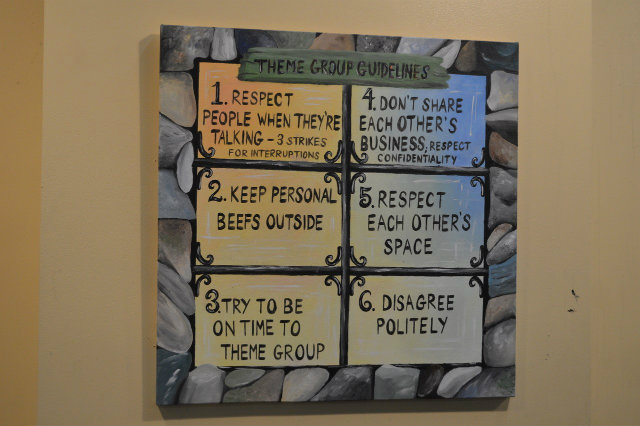 Rules for Miriam’s Studio (Photo by Christina Smart)
Attendance for these art therapy sessions can range from 15-60 guests and while the homeless may be stigmatized with the notion that they’re lazy or suffer from (and won’t get help for) mental illness, that was hardly the case for the people in attendance on Tuesday afternoon.
Victor, who asked that his last name be withheld, has been studying and drawing art in one form or another for most of his life. After studying the French horn at Duke Ellington School of the Arts, Victor attended George Washington University on a scholarship where he graduated with a degree in electrical engineering. After working in that field for years, Victor experienced financial hardship when he became the primary caretaker for his ailing parents.
“I was supposed to get the house and my mother, overmedicated, made a deal with a nefarious character she found in the paper and signed over the house to him,” Victor explains. “He took the $600,000 equity in the house and signed it back to her and she didn’t tell me about it until it was too late. I got her into a nursing home and I came back to a foreclosure notice.”
Victor says he sold everything he had, including his drawing tables and inks, to survive. He began attending Miriam’s Studio three years ago and is now focused on producing a graphic novel using computer programs to create the characters, utilizing his ordeal to benefit his work (some of his work can be seen on his Facebook page).
“The characters I’m creating are more full ’cause I’ve had some experience, and I want to incorporate that,” Victor says.
Others discovered an interest in art that they didn’t know they had. When Sam Ross began attending Miriam’s Studio in 2008, he wasn’t interested in what the program had to offer.
“I called it ‘artsy-craftsy’ and I wasn’t really into it,” Ross says with a laugh. “But they tricked me into doing this. … They had all these beads in front of me so I started picking them up and putting them on the strings and it not only relaxed me but I enjoyed it. I used to be a drug dealer so the time that I spent doing jewelry I was supposed to be out selling drugs. I just traded it for this.”
It clicked for Ross is when he realized he could sell his beaded jewelry. “When I started doing it, that same week … they said they were going to put jewelry out there to sell. So I said, ‘Ok, since I’m trading it for doing drugs I’m going to go ahead and do this too and see if I can sell. My first three pieces sold and I was like ‘Wow! I’d rather do this!’”
Ross now returns to Miriam’s Studio to help with the beading class, showing the guests that it is possible to change your life through art. “Having a creative outlet has been important in his journey to get off the streets, and has helped him find a stable income and home life. He’s quite blunt about where he would be without the classes: “In and out of jail or in somebody’s cemetery,” he says.
As the guests start folding up their tablecloths and return their beads to prepare for their dinner (all donated food, including venison and broccoli stir fry), Washington expressed her thoughts about the future of the program and their current needs.
“[Miriam’s] Studio has been moving in the direction of thinking through how arts can be used for change,” she says. “Things like how helping people learn how to take care of a paint brush then helps them learn how to take care of an apartment. My hope is that we continue to move in that direction and take even more of a community-based, arts-based approach to social change and collective power. What we need to continue to do that are volunteers who are really passionate and can be committed to our mission here.”
For more information on volunteering with Miriam’s Studio, click here.
DCist is one of eight D.C.-based news outlets dedicating a portion of our coverage on June 28 to collaborative news coverage about ending homelessness in the nation’s capital. See more at DCHomelessCrisis.Press
This story has been updated to include the correct location for Miriam’s Studio