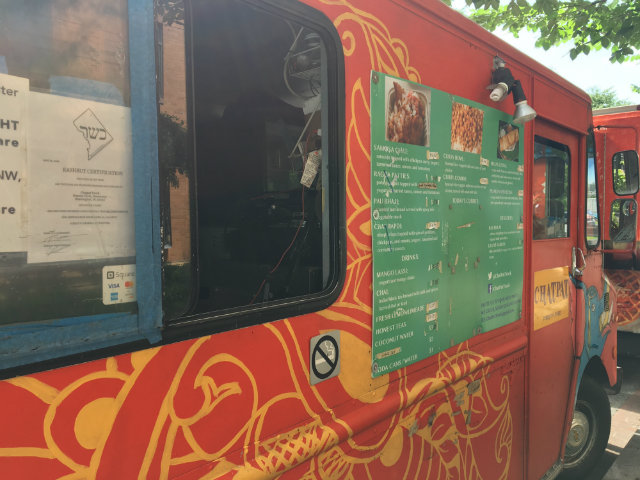
 DC Kosher has certified Chatpat Truck. (Photo by Lauren Landau)
D.C. diners can get gluten-free, nut-free, organic, vegetarian, and just about any other fare their heart or sensitive stomach desires, but for years, kosher food has been either hard to find or severely limited in options. Thanks to the spiritual leaders at a local Orthodox synagogue, dining out is finally getting easier for observant Jews who live in or visit the D.C. area.
Rabbi Shmuel Herzfeld and Maharat Ruth Balinsky Friedman lead the community at Ohev Sholom – The National Synagogue on 16th Street above Rock Creek Park (disclosure: I attend this synagogue). Their new organization DC Kosher, helps existing vegan and vegetarian restaurants in the D.C. area go kosher. Since the organization’s launch in April, DC Kosher has certified two restaurants in Maryland and five in D.C., including a food truck.
Traditionally, restaurants become kosher certified by applying with and being reviewed by an agency, such as the Orthodox Union. (That’s the group responsible for the encircled “U” you see on a lot of products.) In order to keep their certification, restaurants typically employ a staffer tasked with checking the ingredients that come in, and watching how the kitchen and service keep kosher. DC Kosher makes the process easier—and less expensive for restaurants—by relying on volunteers to do routine kosher checks.
“I think it’s really important and more than anything, it’s really needed,” Columbia Heights resident and kosher diner Brett Boren says.
Kashrut, or kosher law, is pretty complicated. But the simplest way to explain it is that there are foods you can’t eat, like pork and shellfish, and food you can eat only if they’re slaughtered, cleaned, cooked, and served in a very specific way. Chicken, lamb, and beef can be kosher, but the animal can’t have been sick or injured, had to be slaughtered quickly, in one even stroke across the neck, had to have all its blood drained, and must be kept separate from dairy during and after its journey to the plate. As DC Kosher notes on its site, the organization deals specifically with vegan and vegetarian restaurants because “they are relatively easy to be made kosher.”
It’s not that the area was a kosher desert before Herzfeld and Friedman began certifying restaurants: The Rabbinical Council of Greater Washington lists 18 certified restaurants in the D.C. area. But 14 of those are in Maryland, and in Washington itself, kosher diners have consistently had only one true sit-down option: traditional NYC deli fare and burgers from Foggy Bottom’s Char Bar, the restaurant formerly known as Eli’s.
Adam Davis, a cantor at Temple Beth Torah in Chantilly, Va., says the new options for dining out present a welcome change. “I think it’s great that when I have more observant friends who come into town or people that I want to go out with, that I have someplace new to take them,” he says.
For 10 years, Dani Klein has been sharing tips, reviews, and kosher food porn on his website Yeah That’s Kosher. He says having more kosher options isn’t just good for residents. It also makes a difference for tourists and visitors who observe Jewish dietary laws.
“Knowing that there are more kosher options for them will make D.C. a more kosher-friendly travel destination,” says Klein, who’s based in New York. And it’s not just the number of options that makes a difference, it’s the diversity.
Making vegan and vegetarian restaurants kosher, Klein says, allows people to expose their taste buds to new things, and to learn about other cultures. “A lot of these restaurants are not cuisines that are typical for the Orthodox community to have experienced more than 15 or 20 years ago,” he says.
With certification from DC Kosher, local diners can enjoy kosher burritos from Vegaritos, curries from Indian Delight or Chatpat Truck, soul food from Sweet & Natural, and raw juice from Khepra’s Raw Food Juice Bar. Even for raw dishes, all ingredients need to be properly sourced and served in order to count as kosher.
“Just because somebody says they’re vegan, it doesn’t mean that by Jewish law that’s sufficient,” Herzfeld says. First, DC Kosher checks every ingredient in every product a restaurant is using to ensure there are no animal products where there shouldn’t be. The second big task is to make sure fruits and vegetables are being thoroughly cleaned, and that no teeny, tiny bugs are hitching a ride from your broccoli to your plate.
Baruch Ben-Yehudah owns three restaurants that are newly kosher certified, thanks to DC Kosher: Evolve, Vegaritos, and Everlasting Life. He’s been a vegan for 41 years, and wouldn’t dream of serving animal products, let alone mixing meat and dairy. But converting his kitchens was still a process.
“The biggest challenge that we ran into was some of the ingredients we needed to change,” Ben-Yehudah says. The restaurants had to swap out some sodas, plus their soy and cashew milks, for certified kosher varieties.
The rules also extend to the bar. “We wanted to make sure that they weren’t using [non-kosher] wine in their store or wine vinegar or other wine products in any of their ingredients,” Herzfeld says.
Ben-Yehudah did have to swap out the wine at his restaurants, along with a few liquors, but he says the process wasn’t difficult. Now that the restaurants are certified kosher, volunteers make sure it stays that way. Typically, supervising a kosher kitchen is a paid position. But DC Kosher relies on volunteers to keep things in order. As a result, restaurants don’t have to sign on for any financial commitment to get kosher, unlike with most other certification programs.
At least for now, Herzfeld says the volunteer-based system works. It helps that there are only a handful of restaurants to supervise, and that they’re all either vegetarian or vegan.
Hannah Tsimmerman is the “mashgicha,” or kosher supervisor, at Khepra’s Raw Food Juice Bar on H Street. She visits the location once a week, and says it’s usually a short visit.
“It’s very hard for them to do anything wrong, since all the ingredients that are coming in are mostly just some packaged stuff,” she says. “When I go, all I have to do is check the vegetables, make sure there are no new menu options, and just make sure the operation is running as it was before.”
She says Khepra’s is particularly easy, because as a raw vegan restaurant, there’s no actual cooking involved. At restaurants that serve hot food, a Jewish person needs to light the stove.
Tsimmerman says she’s happy to provide the service for her community. “I feel like it’s important for people that want to keep kosher to be able to keep kosher, and I feel like there’s such a lack of this in D.C. that I’m just motivated to go and do this myself,” she says.
It’s not just good for the kosher community, but for veggie lovers as well. D.C. resident Laura Itzkowitz is a vegetarian, or “kosher by default.” She says she wants to see more vegan and vegetarian restaurants in the area, and to keep the ones she already loves open.
“Making them kosher will draw a bigger market of people looking for food, and will make them stronger business ventures and more sustainable,” she says.
Ben-Yehudah said he has seen a lot of new faces at his restaurants since going kosher. “But we’re a vegan soul food restaurant,” he says. “We see new faces every day.” In addition to individual customers, however, the new status is also bringing in large catering orders from area synagogues. “That’s been a big plus for us.”
Not everyone is excited about the effort. A quick glance at the comments section on Klein’s recent post about the newly kosher D.C. restaurants reveals divisions within the Orthodox community. Some object to Friedman’s role as a female clergy member, a particularly progressive appointment for an Orthodox synagogue. Others say that volunteers aren’t able to effectively monitor kitchens for kosher status, and that non-kosher items could slip through the cracks.
Keeping kosher doesn’t mean the same thing for everyone, and Klein gets that. “I’m sensitive to the fact that not everybody has the same standards as each other,” Klein says. “In fact, I almost expect everyone to have their own level of what they deem to be kosher and not kosher.”
He’ll list any certification on his website that comes from an Orthodox standpoint, and he’s also sure to list who that certifier is. While some argue that DC Kosher-certified restaurants shouldn’t be listed on his site at all, Klein says, “they may not be kosher for you, but that does not make them treyf,” or certifiably not kosher.
Rabbi Levi Shemtov is executive vice president of the American Friends of Lubavitch, and the spiritual leader at TheShul in Dupont Circle. A Chabad rabbi, Shemtov says he respects that Herzfeld recommends the restaurants for his own community. However, he won’t be chowing down on Evolve’s vegan mac and cheese anytime soon.
“I would find it hard to tell people it’s not kosher,” he says, “but I’m not sure it actually is at the level where I would myself partake or recommend it.”
Herzfeld, for his part, is fine with that. “Our purpose is to provide certification for the members of our congregation, and the members of our community to eat,” he says. “We’re not trying to force people to eat there.”
Herzfeld says DC Kosher is in talks with a handful of other local establishments to get them certified, and says the organization recently certified local vegan pork rind producers Snacklins (they’re made from mushrooms), expanding options for packaged kosher foods. He encourages the owners of meat-free restaurants to reach out if they want to learn more about the process.
“It’s not always doable,” he says, “but we think that it’s something that’s a wonderful service to the community, and you’ll get some loyal customers out of it.”