Rachel Kurzius
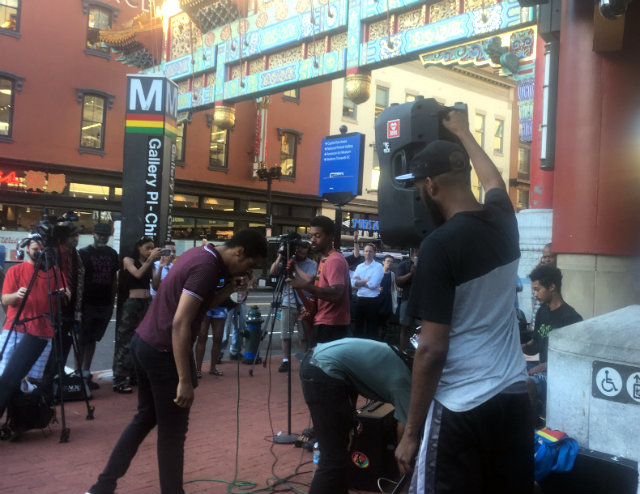 Musicians perform in protest of the Amplified Noise Amendment Act on July 9. (Photo by Rachel Kurzius)
Turns out, the D.C. Council won’t be voting on an emergency bill to regulate amplified noise in the city after all.
Before heading out on summer recess, councilmembers were set to vote on the Amplified Noise Amendment Act of 2018, which would bar playing music through amplified devices audible from more than 100 feet away and prohibit gas generators in public spaces. Those who continued to play their music after a verbal warning from law enforcement would be subject to a fine of up to $300.
Before pulling the bill from the agenda, Chairman Phil Mendelson explained some of its provisions from the dais, saying that much of the criticism of the bill came from misunderstanding.
“This bill does not affect playing music on our streets,” said Mendelson. Bucket drumming, for instance, would be allowed. Even amplified noise wouldn’t necessarily be barred, so long as it can’t be heard from more than 100 feet.
He added that, for more than a year, the council has heard “scores” of complaints from residents, business tenants, and people at George Washington University Hospital about amplified sound. With that, he pulled the bill from the council’s agenda.
The bill pitted people in D.C.’s arts communities against many who live and work in downtown areas often filled with street performers using noise amplifiers to play music.
For now, the musicians have won the day.
“I feel absolutely fantastic,” says Aaron Myers, a D.C. jazz musician who has been organizing against the bill. “The system does work when we’re able to participate.”
Musicians gathered in Chinatown on Monday to oppose the measure and took to the John A. Wilson Building this week to lobby councilmembers. They’ve argued that the bill would make D.C. a more sterile place and hurt musicians.
They weren’t the only ones looking to sway legislators, though. Proponents of the bill, who called themselves the “Turn It Down” Coalition, were also at the Wilson Building, passing out testimonials from GW Hospital, residents, and workers who say the noise has led to headaches, anxiety, and a loss of concentration.
John Greesh has lived in Chinatown for more than four years and “moved there because I wanted more of a city environment,” he says. While he likes the musicians in the neighborhood, “I live on the 9th floor and I can hear them over the TV. It’s like someone having a loudspeaker in your home at 10 p.m. I don’t understand why they can’t just turn it down.”
Greesh wishes there was a different outcome for the bill. “It’s disappointing,” he says. “It feels like we were not heard.”
The measure, originally introduced by At-large Councilmember Anita Bonds, Ward 2 Councilmember Jack Evans, and Ward 3 Councilmember Mary Cheh, was proposed as an emergency bill to address the issue before the council’s summer recess.
Emergency legislation has a much shorter road to enaction than other types of bills the council can pass, but it requires nine “yes” votes rather than seven. It also only remains in place for 90 days at most.
The “Turn It Down” Coalition said in a statement that it looks forward to working with the council and street performers to find “a balanced solution.” The council will return for its next legislative meeting on September 18.
Myers says that when they look to tackle the issue of noise from street performers, “we want people living downtown not to look at the upcoming legislation as pest control. Most street performers are residents, too.”
Amplified Noise Emergency Amendment Act by Rachel Kurzius on Scribd
More:
New Noise Bill: Relief For Long-Suffering Residents Or An Attack On D.C.’s Music Community?