 (Photo courtesy of the Homeless Children’s Playtime Project)
By WAMU’s Martin Austermuhle
Two years ago the D.C. Council approved Mayor Muriel Bowser’s plan to close the long-troubled D.C. General family homeless shelter by the end of 2018, drawing plaudits from homeless advocates and elected officials who said the six neighborhood-based shelters that would replace it would be smaller, cleaner and more humane.
But now homeless advocates and some Council members are arguing that Bowser may be moving too fast with her plan to shutter D.C. General by the fall, especially as the city has experienced delays in building two of the three replacement shelters expected to be done this year. They’re also standing behind an emergency bill the Council could consider on Tuesday that would place new conditions on the mayor’s plan to close the shelter, potentially pushing the planned closure beyond this year. With the Council’s summer recess approaching, this legislation could be their last chance to delay D.C. General’s closure.
Here’s a rundown of the long saga to close D.C. General, and where it stands today.
Bring me up to speed on D.C. General.
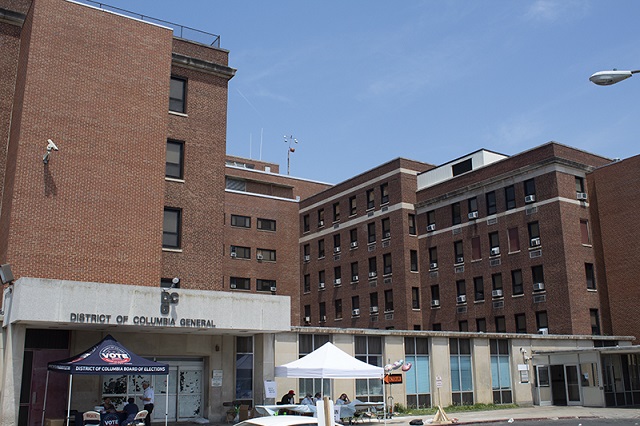
D.C. General is a former public hospital on the east end of Capitol Hill that was closed in 2001. But it wasn’t long before it was repurposed to serve as a shelter for the city’s homeless families, who under D.C. law are legally entitled to shelter when the temperatures fall below freezing. D.C. General replaced D.C. Village, a former nursing home that was used to house homeless families before it was closed in 2007 because of concerns over “inhumane” conditions there.
It didn’t take long for city officials and homeless advocates to realize that D.C. General was too big and too old to properly serve as a homeless shelter. With a capacity of roughly 270 families, more than 1,000 people could be living in the facility at a single time, making it a challenge to offer appropriate services and provide adequate security.
While there had been numerous problems at D.C. General over the years, it was the 2014 disappearance of 8-year-old Relisha Rudd from the shelter that spurred city officials to act on the long-standing calls for the shelter to be closed.
What was Bowser’s proposal for D.C. General, and how did the Council change it?
In early 2016, Bowser unveiled the plan she said would fulfill her campaign promise to shutter the shelter: replace it with six “smaller, dignified” facilities for homeless families located across the city. Each shelter would have between 35 and 50 units, and be located on either D.C.-owned land or in buildings leased from private owners. And she set a timeline for the shelter’s closing: the end of 2018.
But the location of some of the new shelters — including one in an industrial area of Ward 5 — and concerns over the cost of leasing led the Council to make a number of changes to Bowser’s plan, largely by moving the proposed sites in Wards 3, 5 and 6 from private to city-owned land. The Council ultimately approved the amended plan to close D.C. General — drawing cheers of celebration from many homeless advocates — but in so doing pushed the likely deadline out beyond what Bowser had initially hoped for.
“What they proposed will put the timeline out,” she said at the time, likely into 2019 or as late as 2020.
At Bowser’s urging, the Council passed two other bills related to the city’s shelter system: one that would limit the number of private bathrooms built in the new shelters that will replace D.C. General, and another that tightened eligibility requirements for getting into emergency shelter to begin with.
Didn’t Bowser say this year that D.C. General will close anyhow?
Despite Bowser’s initial criticism that the Council’s changes would delay the closure of D.C. General beyond 2018, in January of this year she made a surprise announcement: D.C. General would close in the fall as originally scheduled, despite the fact that only three of the six planned replacement shelters were scheduled to be ready for use. City officials said they would be able to meet Bowser’s initial timeline because of other improvements in the overall way D.C. handles homeless families:
“We’re making a lot of progress across the system,” said Kristy Greenwalt, the director of the city’s Interagency Council on Homelessness. “Our strategy isn’t just about replacing the shelter capacity. More importantly, it’s about making sure that we’re preventing homelessness whenever possible and we’re helping people exit to permanent housing more quickly. All of those things help reduce our shelter census and reduce out shelter footprint.”
Since 2016, the number of homeless families in D.C. has decreased by 40 percent, according to the annual Point-in-Time count of the homeless.
But more pointedly, Bowser made clear that D.C. General, like D.C. Village before it, was a bad enough place that closing it sooner rather than later would serve the greater good.
“I know some people think that we’re moving too quickly, or that we’re only trying to free up land,” she said in her 2018 State of the District Address, responding in part to criticisms that she was moving to open up land for the city’s bid for Amazon’s HQ2. “But let me say this and let me be clear, when it comes to closing D.C. General, we cannot move fast enough. That shelter is an embarrassment to our city, and I will not be the mayor who passes up on the opportunity to demolish it. That has been my plan since Day One and that is my plan still.”
D.C. stopped moving new families into D.C. General in May of this year.
What concerns have homeless advocates expressed about closing D.C. General this year?
Homeless advocates across the city were the first to demand that D.C. General be closed, but they are now in the strange place of advocating that Bowser not rush to close it in 2018.
“There was always a plan to close D.C. General, but that plan was always to close it when we had the replacement shelters in place for families to go where they would have a stable and a safe place to live,” said Kathy Zeisel, a supervising attorney at the Children’s Law Center. “So advocates are asking for that pause button to be pushed.”
The advocates have expressed two main concerns with the current plan: that not enough replacement shelters will be ready to handle any of the families currently at D.C. General (roughly 155 as of last week), and that Bowser wants demolition work to start on portions of the campus before all the families are moved out.
“If D.C. General is closed in a way that risks the health and safety of the families who live there and other families who need shelter in D.C., then the injustice of placing families there in the first place will be compounded, not alleviated,” said Amber Harding, a staff attorney with the Washington Legal Clinic for the Homeless, at a Council hearing in March.
The advocates’ criticisms have grown louder in the last month, after the Washington City Paper reported that two of the three replacement shelters expected to open this year — the one in Ward 7 and the one in Ward 8 — could be facing construction delays that would push back their opening dates. (The shelter in Ward 4 is on track to open in the fall; the three shelters would have a combined capacity of 130 units.) That has raised fears that D.C. would resort to placing families from D.C. General into motels, something it has done in the past when shelters have been at capacity.
“It seems that D.C. General may be, sadly, more dignified and more safe for families than the hotel sites,” says Councilmember Robert White (D-At Large), referring to improvements in how D.C. General is managed and problems that have been reported at various motels used by the city.
There’s also a broader fight underlying the current battle over the fate of D.C. General: many homeless advocacy groups worry that D.C. is putting too many families in rapid rehousing, a program that heavily subsidizes rents for at least a year but then expects the individual or family to cover the full cost themselves. The groups say the program is ineffective as it’s currently being used, and have pushed to curtail it. But city officials insist it has met its goal of providing families with a place to live outside of a shelter where they can find their footing and get out of homelessness altogether.
What is the Council planning on doing about D.C. General?
Last month, a Council committee held an oversight hearing where it demanded specific answers from senior city officials on the construction delays at the two replacement shelters and how they may impact the closing of D.C. General.
On Tuesday, the Council may take more concrete action. A bill circulated last week by Council member Trayon White (D-Ward 8) would prohibit any further demolition work on the campus until all the families are moved out and would require that all families currently at D.C. General be provided safe and stable housing options before the shelter is closed — i.e., not motels.
But the bill was the subject of feverish lobbying on Monday, with a broad coalition of homeless advocacy groups saying they supported White’s measure and senior city officials pleading with Council members not to pass any legislation that would tie their hands with respect to closing D.C. General. White told WAMU he still intends on introducing the bill at the last Council session before the two-month summer recess — but did not disclose the exact details of what would be in the bill.
How is Bowser responding to a possible delay in her plan to close D.C. General?
This certainly isn’t the first clash between Bowser and some Council members over her plan to close D.C. General — she fought the Council’s changes to her original plan — and like before, she and her top staffers are pushing back.
“I was committed to D.C. General being closed in 2015,” said Bowser at a recent press conference. “And anyone who is families with D.C. General should share that commitment.”
Bowser additionally said that the status of the six replacement shelters should be irrelevant to whether or not D.C. General can be closed this year.
“You go to shelter, and then you go to housing. That’s the idea,” she said. “Not to go from shelter to shelter to shelter. So our team is very focused on how to make sure there are exit plans for any family that is still at D.C. General.”
According to D.C. officials, that process is already underway, and in recent weeks, 35 families at the shelter have signed leases for apartments.
In an interview with WAMU, Laura Zeilinger, the head of the D.C. Department of Human Services, also said she’s surprised to see some Council members and advocates malign the use of motel rooms as temporary housing for homeless families.
“When we had D.C. General, people advocated for us to use more hotels. So the fact that people are saying maybe you shouldn’t be using hotels, you should be trying to keep D.C. General open feels really inconsistent with what advocacy was when the District was taking a different approach,” she said.
Finally, Zeilinger and other city officials say the delays at the two replacement shelters are simply par for the course for construction projects, and that changes had been made to ensure that things go smoothly over the next few months. But on a recent tour of the Ward 8 shelter one official admitted that any more hiccups — even small ones — could make it very difficult for it to be completed by Oct. 1 as promised. (D.C. has also asked the Council for more money to finish the shelters in Ward 7 and Ward 8.)
More broadly, Zeilinger told WAMU she is unhappily surprised with some of what she has heard from homeless advocates and Council members asking that the closure of D.C. General be delayed.
“I find that shocking,” she said. “We have all been of one mind that we can do better than D.C. General for our families.”
She also says the homeless advocacy groups pushing to delay the closure of D.C. General have a broader agenda they’re not being fully open about.
“It’s an end run to create a right to housing. If that’s the intent, that should be taken up on the merits,” she said during a meeting with Chairman Phil Mendelson in the Wilson Building yesterday. “There are advocates whose agenda at all costs is a right to housing.”
What’s next for D.C. General?
It depends in part on what the D.C. Council does on Tuesday. Since the Council won’t be back in session until September, any bill it considers would have to be on emergency — which means it would need nine votes to pass, not the usual seven. And it of course depends on what the final bill says.
If nothing happens legislatively, Bowser will push ahead with her plan to close and demolish D.C. General this fall. But Councilmember Brianne Nadeau (D-Ward 1), who chairs the Council committee that deals with homeless services, says she will still be keeping a close eye on how construction proceeds on the two delayed shelters and what D.C. does to move families from D.C. General to more stable housing alternatives.
“We may pass legislation, or we may not. But either way, my oversight continues into the summer,” she said. “I’m confident that we’re going to have the data we need all [summer] long about what’s happening which each family and each facility so that the public can feel comfortable, so the families can feel comfortable, so the Council can feel comfortable about how we are moving forward with this plan.”
Either way, homeless advocates say they will continue pressing to make sure the remaining families in D.C. General are moved into stable housing before the shelter is closed.
“We want it to be done in a way that ensures the health and safety of the families and in a way that’s thoughtful so the families have a known next place to go where they can plan for their kids’ school, their kids’ doctors, their jobs,” said Zeisel.
This story originally appeared on WAMU