 Rachel Sadon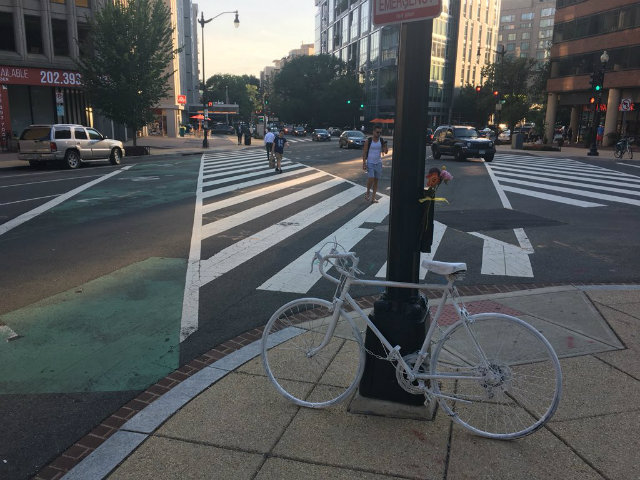
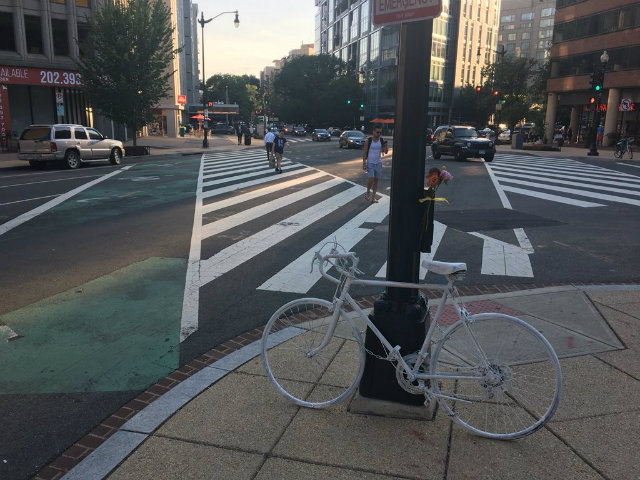 A ghost bike has been installed at the intersection where cyclist Jeffrey Long was killed over the weekend. (Photo courtesy of Matthew Sampson)
The spot where a cyclist was killed over the weekend in the West End neighborhood is now marked by a memorial “ghost bike,” and members of the biking community in D.C. are planning a silent group ride on Thursday to honor his memory.
“It’s going to be a slow ride. People need to see that we’re there,” says Rachel Maisler, who serves as the Ward 4 representative on D.C.’s Bicycle Advisory Council and is organizing the memorial. She is asking that attendees wear white. “It’s an important statement first to honor the memory of someone who was just going from Point A to Point B like the rest of us and senselessly lost his life, and also to remind drivers and pedestrians that the roads and the sidewalks are for all of us.”
Jeffrey Hammond Long was struck by a truck making a right-hand turn at the intersection of M Street and New Hampshire Avenue NW on Saturday afternoon. He succumbed to his injuries the following day.
Maisler and a number of other advocates argue that the intersection where Long was killed is unsafe and have called on the D.C. Department of Transportation to make changes there and elsewhere.
“Almost every cyclist I know has been injured by somebody in a car, myself included,” she says. “Enough is enough.”
DDOT installed a protected bike lane in 2014 that runs from M Street NW from Thomas Circle to 28th Street NW. But cyclists say they have long been frustrated by the design.
One video from 2016—entitled “Another DDOT ‘Chute of Death’ Bike Lane”—shows a truck making a right turn and cutting off a cyclist at the exact same intersection where Long was killed.
“M Street is chaotic on a quiet Saturday at best, and unbearable during the week,” Maisler says. “It’s not a safe corridor to traverse as a cyclist.”
Cyclists say that they frequently have to bike around cars parked in the bike lane, forcing them to swerve into a lane of traffic, and that drivers often make right-hand turns even in intersections where they are banned.
In addition to stepping up enforcement of illegal behaviors, some argue that DDOT should make physical changes to the intersection where Long was killed.
“The intersection geometry and bikeway design in this location likely contributed to this crash, and DDOT should make fixes as soon as practicable,” writes Matt Johnson, an urban planner who lives in the neighborhood, in Greater Greater Washington. He explains the peculiar dangers of the block:
Like many of the state-named avenues, New Hampshire Avenue cuts across the city’s street grid on an axis roughly 45 degrees diagonal to the rectilinear streets. But this intersection is made even sharper because M Street jogs to the south between its intersection with 21st Street and its intersection with New Hampshire Avenue.
This makes the right turn from M Street, which is one-way westbound, onto New Hampshire Avenue very sharp. If 21st Street were not one-way southbound, most of these turns would likely use that street.
Another oddity exists here too. A mixing zone exists everywhere a vehicle is permitted to turn right across the M Street protected bikeway, which was installed in 2014. Along the block, the bikeway is otherwise protected from moving vehicles by a buffer and parked cars…
There are two exceptions to this. At 22nd Street, cyclists stay against the curb. Right turns are regulated by a right turn arrow, and cyclists proceed through the intersection with a green bike signal while the right turn arrow is red.
The other exception is one half block east, at New Hampshire Avenue where Long was killed. There, right turns are permitted, but the bike lane stays against the curb. It’s screened visually from vehicles by parked cars.
Johnson has previously called on DDOT to construct a curb extension and prohibit right-hand turns. In lieu of that, he says that the agency could consider changing the design in a way that would make cyclists more visible or changing the signals such that cars couldn’t make a right-hand turn when cyclists and pedestrians are crossing the block.
DDOT director Jeff Marootian says the agency is evaluating the circumstances of the crash to see if changes should be made.
“We are devastated by this loss of life. Our team went out to this site to look at whether there are opportunities to make safety improvements,” he tells DCist. “We are still working with the Metropolitan Police Department to determine the exact circumstances of this crash.”
Some of the improvements that DDOT might consider making include “things like sight lines, signage, and light timing,” Marootian says. “We are looking systemically at a number of intersections and these types of improvements. I expect that, as we evaluate this specific location, if there are improvements to be made we will make them quickly and we will also look to implement them at other similar locations as well.”
The District launched an ambitious effort, dubbed Vision Zero, to eliminate all traffic fatalities by 2024 two years ago. A year later, the city actually registered an increase in fatalities. And data from the Metropolitan Police Department puts the city on track to see another increase this year. There have been 19 traffic fatalities in 2018, in comparison to 18 at the same time last year.
“It’s important to note that Vision Zero is about taking each tragic loss of life and making adjustments to prevent future issues and looking at how we can make systemic changes to improve safety across our entire city,” Marootian says.
Bicycle and pedestrian advocates say it can’t come soon enough, particularly for the intersection of M Street and New Hampshire Avenue NW.
“I bike past there all the time, and I think that could be me or my friends,” says Matthew Sampson, a graduate student of urban planning at Georgetown University, about Long’s death. “It just feels like a train wreck that we see coming.”
Sampson placed a ghost bike—a bicycle painted white—at the site to honor Long last night. As he was biking home, Sampson says had to swerve around three cars that were parked in the bike lane within just two blocks of the intersection where Long died.
This afternoon, Sampson was also finishing up the final coats of paint on a second bike to honor another cyclist who was killed recently.
Malik Habib died on June 23 after his bike wheel got stuck in the streetcar rail on H Street NE and he fell into the path of a charter bus.
The ghost bikes serve as “a stark reminder that someone died here,” says Sampson. “I hope that people see it and see a person. It’s not just a cyclist…it was someone who had a family.”
The silent group ride will take place on Thursday at 5:15 p.m., starting at 1156 15th St. NW and ending in a moment of silence at the crash site. For more details, see the event page.