Rachel Kurzius
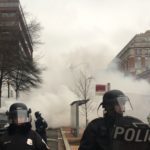
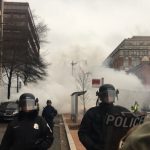
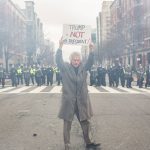
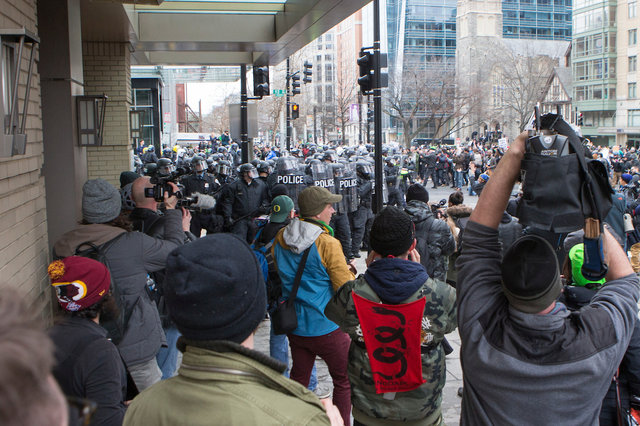 Riot police and protesters on Inauguration Day. (Photo by Alex Edelman)
Metropolitan Police Department officers were overworked and undertrained for the protests on Inauguration Day 2017, and some deployed nonlethal munitions against groups of people who posed no immediate threat, according to an independent report released this week.
The report from the Police Foundation focused largely on the handling of a particular unpermitted protest that became violent in downtown D.C. near Franklin Square.
The Police Foundation critiqued MPD for failing to stop disorderly demonstrators, taking unnecessary actions against other demonstrators, and a lack of coordination when it came to processing the arrests of more than 230 people, many of whom were not responsible for illegal behavior.
A city agency contracted the Police Foundation to conduct an investigation into police conduct on Inauguration Day. On the whole, report says officers acted professionally and balanced public safety with First Amendment rights during at least 20 separate permitted and unpermitted demonstrations that day.
But officers on the ground had been working extended hours and did not receive specialized training for crowd management beyond watching instructional videos, according to the report. One officer testified in court that he “personally did not feel prepared for the situation that was in front of us.”
That officer, Bryan Adelmeyer, was working undercover to learn about a group organized under the banner of “DisruptJ20.” That particular protest resulted in indictments for more than 230 arrestees and a slew of civil lawsuits against the city for the police’s response, including one from the American Civil Liberties Union of D.C. Just last week, the U.S. Attorney’s Office of D.C. dismissed felony charges against remaining defandants after prosecutors were unable to secure any guilty verdicts during two jury trials.
On the morning of January 20, 2017, hundreds of anti-fascist protesters clad in black marched from Logan Circle towards Franklin Square as part of DisruptJ20. As they made their way downtown, some people in the group smashed windows and otherwise destroyed property.
Shortly thereafter, MPD Commander Keith Deville determined that the demonstration was a riot, authorizing officers to use OC spray and sting balls. He did not issue a dispersal order first, as the standing operating procedure mandates.
One officer was recorded on a body-worn camera saying, “We hit them with the sting balls, we hit them with the 40 mils, we hit them with all that, everything in our arsenal,” the report found.
According to the Police Foundation report:
MPD officers were issued and used MK46 and MK9 OC canisters, sting ball grenades, 40 mm stingers, 40 mm foam batons, and 40 mm exact impact munitions. These less lethal devices were at times used inappropriately, such as when sting ball grenades were thrown overhand instead of in the underhand motion taught in training. Less lethal munitions, specifically chemical agents, were seen to be deployed into groups of people that posed no immediate threat to those who were observing the demonstrations … The inappropriate and extensive use of less lethal munitions suggests the need for increased supervision of officers during mass demonstrations as well as additional training regarding the appropriate circumstances and methods for deploying these tools.
This directly contradicts what MPD said after Inauguration Day. “All we deployed was pepper spray and sting balls,” spokesperson Sean Hickman told DCist on January 21, 2017. MPD has not replied to requests for comment about the discrepancy.
Police surrounded a large group of protesters near 12th and L streets NW by forming police lines, and began the process of mass arresting the people caught in between. This was the department’s first major mass arrest since the Pershing Park demonstrations in 2002, which courts ultimately ruled were unconstitutional, resulting in expensive settlements for the city.
The Police Foundation says that, while many of the people arrested on Inauguration Day posed no threat to public safety, MPD’s actions “likely prevented the destruction of additional property.”
On the evening of January 20, 2017, MPD Chief Peter Newsham said that he was “very, very pleased” by the way his officers handled the protests that day.
The Police Foundation report illuminates the challenges that officers were facing that day. Many of them had been working for shifts much longer than 12 hours, and were assigned to parts of the city in which they had little prior experience, making it difficult for them to get in front of demonstrators. They also felt outnumbered by the protesters. One MPD officer later testified that, “One, there were too many of them. Two, I mean, there weren’t enough of us.”
The Office of Police Complaints requested an independent investigation of MPD conduct that day. In a report the following month, the agency said its monitors observed the indiscriminate use of nonlethal weapons like pepper spray without warning and had other concerns about police not following their own procedures.
The D.C. Council included $150,000 in its 2018 budget for this review, and OPC hired the Police Foundation to conduct it. Some civil rights advocates have questioned whether the foundation’s ties to law enforcement are too close for a truly independent audit.
The Police Foundation used more than 100 videos and 1,108 pictures from OPC and testimony from the first trial of Inauguration protesters in its investigation. Citing ongoing litigation, MPD declined to make Newsham, members of command staff, or other officers available for comment, though it did provide more than 550 videos from officer body-worn cameras and copies of its standard operating procedure and other materials.
Scott Michelman, a senior attorney at the ACLU of D.C., says the report “confirms many of our allegations” in the lawsuit against the city, including excessive force and unlawful arrests.
The city has moved to dismiss the case, and the briefing on that motion should conclude by the end of July, says Michelman.
MPD Commander Deville said at the first Inauguration protester trial that convictions in the case “would perhaps limit our civil liability in the matter.”
So does the dismissal of the charges strengthen the ACLU’s case?
“It avoids weakening it,” says Michelman. “Our case is that the police conduct on the ground on Inauguration Day was wrong, and that could still be true even if some individuals are convicted, but it’s much easier to make the case after all these charges have been dismissed.”
Ward 6 Councilmember Charles Allen, the chair of the Judiciary and Public Safety Committee, says that the report “highlighted the use of nonlethal tools without appropriate warnings …. [and] issues around many of our officers who were working longer shifts than expected. That helps us inform staffing decisions and training.”
He says that during the D.C. Council recess, which begins this weekend, the committee will take a closer look at the report and MPD’s response.
“We’re the nation’s capital,” says Allen. “More than inaugurations, we’re going to host major protests, major events. We always want to be looking for how to improve.”
Police Foundation DC Inauguration Report by Rachel Kurzius on Scribd