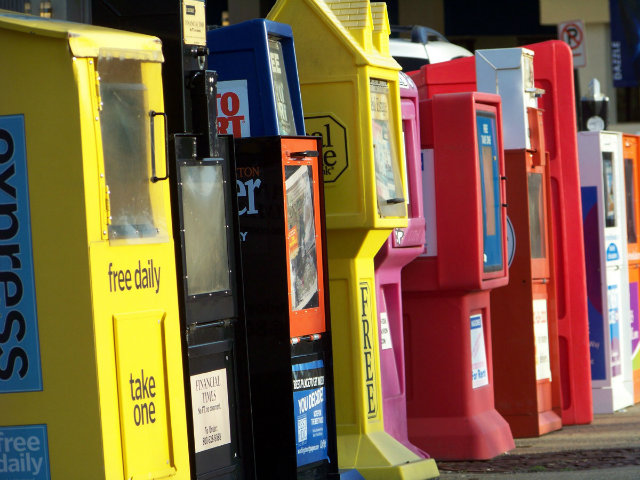
 (Photo by Barbara Krawcowicz)
By The Kojo Nnamdi Show producer Julie Depenbrock
“Uneasy, unsafe.”
“Rattled for sure”
“Fatigued.”
“Sad, vulnerable.”
“Heartbroken.”
Many Washington area journalists feel safe at work, but emotionally they’re anxious and sad, according to an informal survey conducted after a mass shooting in an Annapolis newsroom.
More than 150 responded to The Kojo Nnamdi Show survey in the wake of the attack on The Capital Gazette in Annapolis, which left five employees dead: Rebecca Smith, Rob Hiaasen, Wendi Winters, Gerald Fischman, and John McNamara.
For those closest to the situation, the feelings of unease and disbelief are magnified.
“When I wake up, sometimes I have to look at the Friday edition of the paper to remind myself that it actually did happen,” said Chase Cook, a political reporter for The Capital Gazette who had the day off when the shooting occurred. “You just feel like you’re moving through life a minute at a time. It’s hard to remember some things because your mind is going in so many directions.”
Cook has written several stories for the paper since the June 28 shooting, including a profile of the gunman who stormed the newspaper’s office. He said it was helpful to talk to a grief therapist, but that doing his job is how he copes.
“It feels better to do work,” Cook said. “I don’t know if that’s good or bad.”
Respondents to the survey were divided over whether the Annapolis shooting represents a shift in the attitude toward those who cover the news, or whether it’s no different from other mass shootings in America.
“Journalism—and journalists—have become so polarizing,” wrote Emily Tate, a journalist at EdScoop who responded to the survey. “The rhetoric around ‘the media’ has turned so many Americans against us, but in reality, the vast majority of journalists are not the ones reporting on the White House or Congress—we’re the ones covering local communities and just trying to tell stories that matter to our readers. That’s what the Gazette reporters were doing, and that’s what I do.”
Paul Farhi, a media reporter for The Washington Post, said in recent years journalists have reported an increase in threats and harassment as candidate and then President Donald Trump cast the media as “fake” and incompetent.
“There are plenty of people who feel emboldened by this culture of journalists as enemies of the people,” Farhi said. “I’m not going to say he unleashed this guy with a shotgun. But the president sets the tone, and the tone has been really ugly.”
Other reporters who answered the survey felt the focus on journalists’ safety and mental health was blowing a one-off tragedy out of proportion.
“Plenty of things impact my mental health on a daily basis more than a fear of being killed at work,” wrote Martin Austermuhle, a reporter for WAMU 88.5. “As tragic as The Capital Gazette incident was, we shouldn’t overreact to it.”
Scroll over for detail (graphic by Ruth Tam)
Courtney Radsch, who serves as advocacy director for the Committee to Protect Journalists, sees what happened in Annapolis as a wakeup call for the press to pay better attention to security.
“I think every journalist, every newsroom needs to be thinking about this,” Radsch said.
For smaller, hyper-local publications like The Washington Informer, which serves communities grappling with higher crime rates east of the Anacostia River, the danger isn’t felt in the newsroom in particular, but rather in the daily shoe-leather work of reporting.
“We’re in Ward 8. Stuff happens. We’ve seen young people—students, children—being shot outside our building,” said Denise Rolark Barnes, owner and publisher of The Washington Informer. “We write about it, we report on it, and then we become victims.”
Charnice Milton, a 27-year-old reporter for Capital Community News, got caught in the crossfire on her way back from an assignment in 2015. She died of a gunshot wound, a bullet which police said was meant for someone else.
“She wasn’t killed because she was a journalist,” said Andrew Lightman, who served as Milton’s editor at Capital Community News.
The killing of domestic journalists is extremely rare. Only 14 journalists have been killed in the United States since 1992, according to the Committee to Protect Journalists. Eight of those were targeted murders, including the five shot in the newsroom of The Capital Gazette.
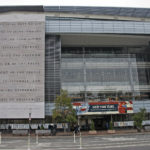
“This will be an anomaly, tragic as it is,” said Gene Policinski, president of the Freedom Forum Institute at the Newseum. “It’s more dangerous by far to be a journalist in Mexico or Brazil.”
Policinski said journalists should not be held out as an especially vulnerable group — not in a country where school children are being killed in their classrooms.
“What Annapolis shows us is, as much as journalists are at risk, workplaces are at risk. Schools, churches, movie theaters, concerts. Any place that has visibility seems to be a place where someone can carry out a politically motivated attack, or a grudge,” Policinski said. “We were simply the latest to be a victim of this kind of gun violence.”
For more, listen to The Kojo Nnamdi Show conversation on journalists’ security and mental health with reporters Chase Cook, Denise Rolark Barnes, and Paul Farhi.