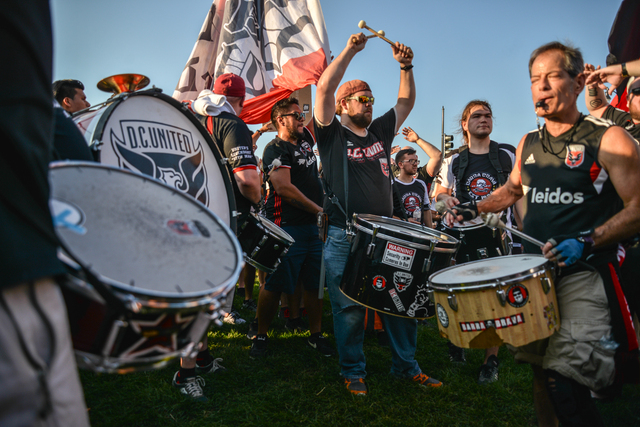
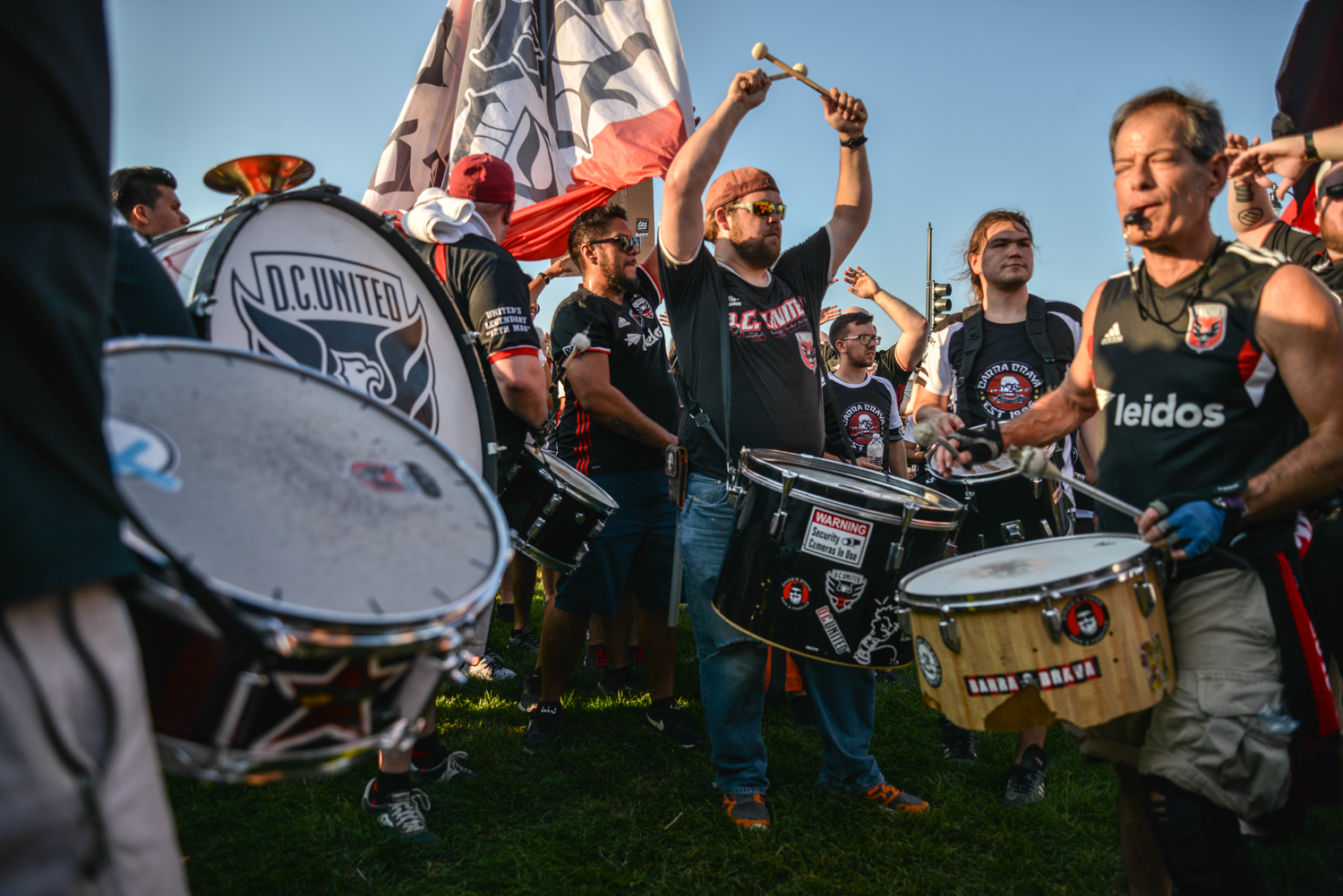
 Protestors gather outside of Audi Field prior to D.C. United’s inaugural match there. (Photo by Pablo Iglesias Maurer)
D.C. United did its best to leave its former home at RFK Stadium behind this weekend.
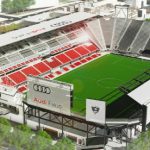
The club made its debut at Audi Field on Saturday, christening its $400 million home on Buzzard Point with a rousing, 3-1 victory over the Vancouver Whitecaps. There was pomp and circumstance, and shiny new seating areas and walkways. Fans clogged concourses to sample food curated by José Andrés, while others took the match in from luxury suites that go for as much as $125,000 a year.
RFK, though, would not go down easily.
It made its presence known in falling debris and in wireless internet that was barely functional. In the press box, where journalists scrambled to tether to cell phones to file match reports, one media member asked, in jest, “Did they bring the router from the old spot?”
There were long waits at concession stands, too, and issues with mobile ticketing that led to some fans storming off in anger. There were also a hundred or so of United’s die-hard supporters assembled just outside the stadium to protest what they view as mistreatment by the club’s front office.
Yes, RFK was alive and well on Saturday. (There were no raccoons, though.)
It wasn’t all bad. On the field, former Manchester United legend Wayne Rooney made his debut, putting in about a half hour’s worth of work and looking quite lively.
The bulk of those in attendance were likely oblivious to issues with the supporters outside the stadium. There were many fans sporting freshly purchased Rooney jerseys, probably a good sign for a club eager to expand its fanbase.
And it took a while, but the noise and atmosphere in the place, especially toward the end of the match, at least showed glimpses of what the facility promises to be: a fearsome place for opponents to visit.
Things got off to a bumpy start before the team even took the field, though. Construction crews had worked furiously to get the venue ready for its big reveal on Saturday, sometimes working as late as 11 p.m. in the weeks leading up to the match. As late as last Monday, cherrypickers and construction equipment trundled around the east grandstand.
Some of that workmanship, it seems, may not have been quite up to par. During her pre-game work as United’s sideline reporter, Lindsay Simpson, who also serves as the team’s communications director, was struck in the shoulder by a falling handrail, which narrowly missed her head. A club spokesperson later said that her injuries would keep her from returning to the broadcast.
Think it was this pic.twitter.com/9iYQKRVJKA
— Phil Baki (@bakiBalboa) July 15, 2018
On the other side of the stadium, staff used duct tape to secure other similarly-designed handrails, eager to avoid another accident.
So they’ve had a couple of incidents here at the stadium where sections of railing have fallen – in one incident someone got struck by falling debris. They’ve resorted to duct tape as a temp fix. pic.twitter.com/mgPtckTL4x
— Pablo Maurer (@MLSist) July 15, 2018
Outside, some of United’s most ardent supporters were in full voice. Rather than a joyous occasion, they were out in protest, hoisting banners and signs overhead. It stemmed from a long-running feud between two of United’s official supporters’ groups—La Barra Brava and District Ultras—and the front office, who this year chose to partner exclusively with the Screaming Eagles, United’s other long-standing fan group.
Supporters groups typically buy tickets en masse from the club at a discount, turning around and selling tickets to individual members at a small mark-up, which pays for pre-game tailgates, gear, and in-stadium displays and banners. Amidst rumors of profiteering by La Barra, United chose to offer that privilege exclusively to the Eagles this year.
Outside of @AudiField, the @DistrictUltrasX and @Barra_Brava are protesting – vibe very reminiscent of the concourse at RFK at halftime. Very unique. pic.twitter.com/nU2HwZmT3D
— Pablo Maurer (@MLSist) July 14, 2018
That did not sit well with supporters, many of whom feel betrayed by the club. There are also accusations from scorned supporters that the team is “white-washing” their fanbase. The Eagles skew whiter and older, while La Barra has historically been largely Hispanic. The rhetoric has at times been hyperbolic and emotional.
Some fans intent on getting inside had their own issues.
The wireless internet at the stadium, which crews finished installing the day before the match, was frequently non-functional. Cell networks in the area were overloaded as well, leading to a uniquely modern problem: some people found themselves struggling to load mobile tickets, staggering around the perimeter of the stadium, their cell phones hoisted aloft in search of a signal. Among those shut out on Saturday was Undefeated and ESPN columnist Clinton Yates, who took to Twitter to express his frustration:
D.C. United can’t get out of their own way. They got a far too large amount of people waiting outside the stadium bc their mobile tickets would not load. Mobile tickets are required. I was one of them and I just bounced on the home opener as a result. This franchise is a mess
— Fungo Velo (@clintonyates) July 15, 2018
Struggles like this are not unique in new stadiums. In MLS, Orlando City Stadium, home of Orlando City SC, faced huge issues with entry points during its opening. Bathrooms and other features of the stadium weren’t even completed by opening day. All of those issues, naturally, were eventually ironed out.
United’s in-game experience, too, was a far cry from RFK’s. This is by design, of course, and probably sets them more in-line with other modern franchises. In a welcome change, the DJ handled the pre-game music.
The club also employed an MC with a wireless mic to roam the pitch and hype up the crowd before the match. The hype man, though, struggled to connect. Many in the audience didn’t respond to his call to action.
Later in the evening, after United put the game away with their third goal, Rooney turned towards the west sideline and —without much fanfare at all—waved his hands in a “everybody get up” motion. The crowd erupted immediately. Most fans in attendance, it seemed, were by that point just hungry for a connection with the evening’s actual master of ceremonies.
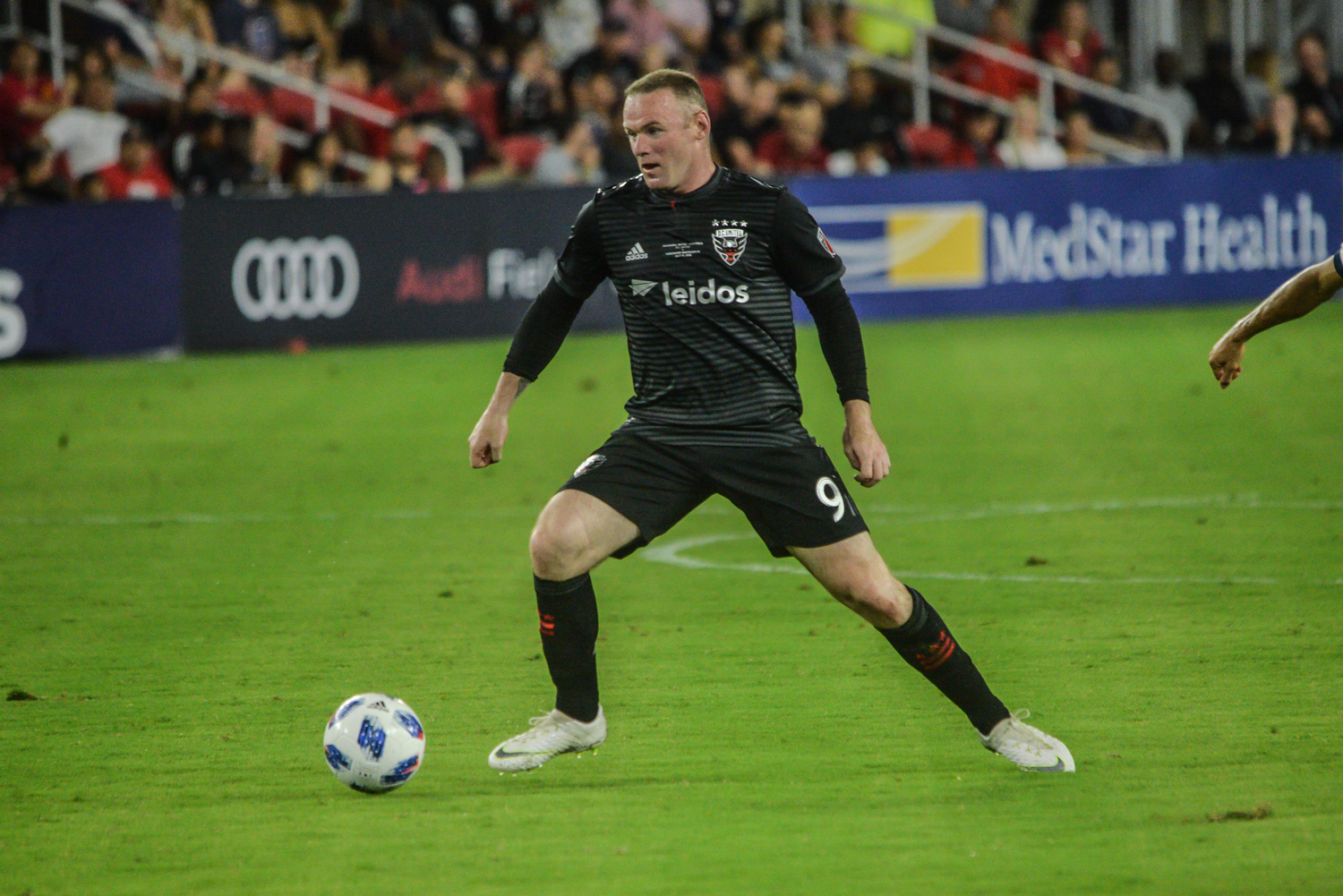 D.C. United forward Wayne Rooney during second-half action on Saturday. (Photo by Pablo Iglesias Maurer)
This story has been updated to reflect that the final score was 3-1.