Rachel Kurzius
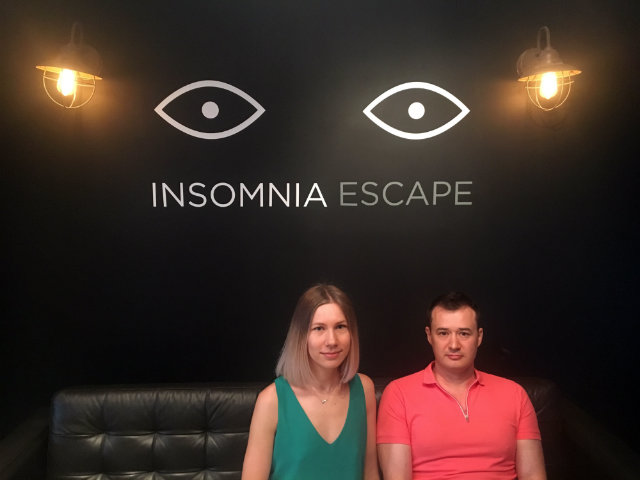 Insomnia Escape co-owners Damira Gerasimova and Alex Gerasimov. (Photo by Rachel Kurzius)
You’re trapped in a well-appointed room filled with clues. They’re hidden in books or only visible with a black light, and they will lead you to more puzzles inside of secret boxes or trap doors and ultimately, to a key you can use to emerge. Good luck—you’ve got an hour.
Are you the hero of a Dan Brown novel? No, you’re just playing an escape room.
Over the past few years, the D.C. area has seen a boom in places offering Sherlock- or espionage- or Jurassic Park-themed mysteries to unravel for the sake of entertainment or as a team-building exercise.
“We want this to be storytelling,” says Alex Gerasimov, who, along with his wife Damira Gerasimova, opened Insomnia Escape in Glover Park three years ago. The two of them design the escape rooms together, with the intent that each clue works as part of a larger narrative.
The process begins with a general idea for the story: one of their rooms is mafia-themed, another is set in a mystical library, and their newest room, The Patient, is a thriller that takes place in a mental institution a few decades ago, with accompanying cells and an electroshock machine. It opened to the public this week and, like the other rooms, the price varies based on the time and number of participants.
They choose themes based on their interests and on the rooms they have to work with. “Our job is to make people believe,” says Gerasimov. “We’ll never build a White House in the small room in the basement. Some people try, and they mostly fail.”
After they determine the gist of the room, they fill it with decorations that often serve as holders of clues, easter eggs, or red herrings. Gerasimov’s background in IT means he can help wire the complex systems that will cause an attendee’s actions to trigger a new clue, though they also outsource some of the work to engineers. But most of that machinery is hidden because the stories take place long before those electronics were invented.
The technology aspect means that it’s immediately apparent when a person solves the puzzle correctly, an increasingly rare feeling as we get older.
“You come to an escape room to feel smart. The outcome should be very, very visible,” he says. “You need proof you did it right, especially at the beginning of the game, when you need to warm up.”
For Gerasimov and Gerasimova, one key to designing escape rooms is making them accessible, even for first-timers.
“It’s extremely easy to make a hard room that no one will solve,” says Gerasimov. “A lot of times escape room owners brag about, ‘Our escape room is unsolvable, our escape rate is 1 percent.’ I think this is bad. People should really work hard, but escape, and see everything. We don’t want people to see only half the story and struggle.”
That’s why the gamemasters (they have between five to eight employees) offer to give hints to customers who get stuck. They’re watching as people try to solve the puzzles, ready to guide them if prompted with a frantic wave in the camera’s direction. (Failure is still an option, though. As part of the waiver, participants must accept “the possibility of failure to escape the room in the allotted time.”)
Gerasimova says that being a gamemaster affords a fascinating perspective on group dynamics. During the testing period for The Patient, one group worked as a team, solving each puzzle together, while, during another, “each [player] took a piece of paper and went into a different corner of the room.” The first group escaped more quickly.
They say that one demographic that tends to do well is teenagers, who often come prepared with research on the time period they’re entering.
The couple moved to the area about seven years ago from Perm, a city in Russia near the Ural Mountains. During a visit four years ago, everyone there was talking about escape rooms.
When they returned to D.C., they tried out a few locally and Gerasimova says they thought, “We can make it better.” Thus began Insomnia Escape.
Now, they say tens of thousands of people have made their way through their rooms (they declined to provide a more specific number), each of which requires a slightly different kind of problem-solving. Their alchemist-themed room has a bent towards cryptography, the mafia room is more mechanical, and The Patient’s main feature is good, old fashioned detective work in figuring out which of the characters players can trust.
For all of the rooms, players need to make similar determinations when it comes to their own team.
Gerasimov says that a frequent mistake groups make is listening to the loudest person, who might not necessarily have the correct answer. “They abandon the right way and they follow the leader to failure,” he says. “It’s so, so common.”