Natalie Delgadillo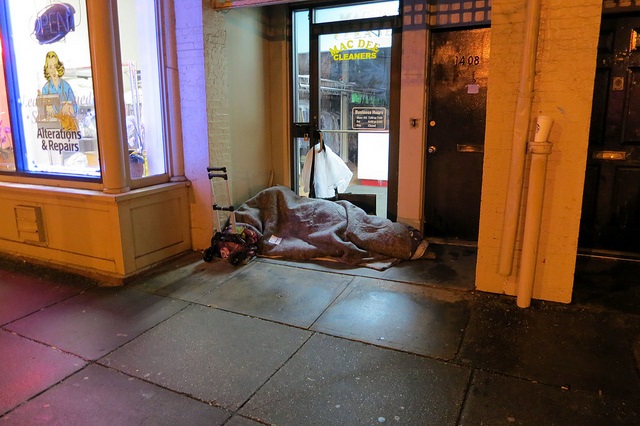
 (
(
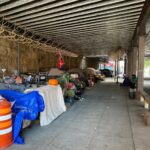
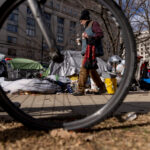
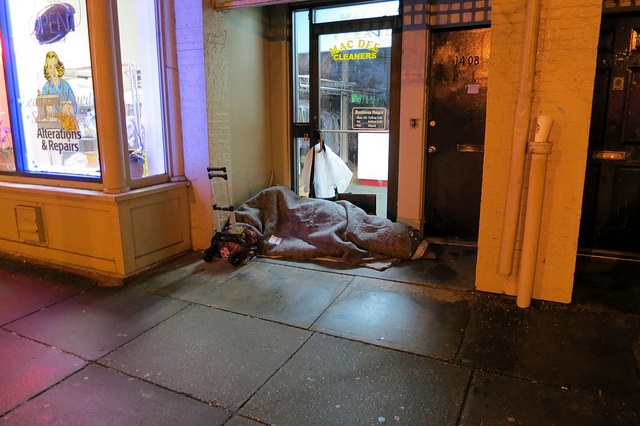
Most nights, José Rodriguez sleeps in Rock Creek Park. He has a tent for when it rains, but usually he sleeps in the open air, where he can see the thick tree canopy and some stars.
“I like to sleep in places where I can be alone,” he says. “The streets are dangerous. There can be dangerous people. I’m not a dangerous person.”
Rodriguez is 57 years old, a father to five children with a wife in El Salvador whom he hasn’t seen in 14 years. He does not have documentation and, his tent notwithstanding, he does not have a place to sleep.
Homelessness is particularly dangerous for people like Rodriguez, who live in dread of being rounded up by Immigrations and Customs Enforcement officers as they try to get by on the street.
The Metropolitan Police Department does not ask residents about immigration status and limits its cooperation with ICE in jails, but ICE has been known to target homeless shelters. Last year, ICE agents arrested at least two men coming out of an Alexandria church shelter after sleeping there under hypothermia conditions. Agents reportedly waited across the street from the shelter and jumped out to question the Latino men as they exited the facility.
“Think about it: They’re coming here to keep from freezing to death. They’re coming here to find support and help. By sweeping them up after they left here, [ICE is] putting fear into other people. There may be folks now that may be afraid to come in out of the cold,” Keary Kincannon, the church’s reverend, told The Intercept shortly after the sweep happened. “It’s real cruelty.”
ICE has a “sensitive location” policy, adopted in 2011, that prevents agents from making arrests in places like schools, churches, and hospitals without prior approval from high-ranking ICE officials (homeless shelters are not considered a sensitive location). At the time of these arrests, ICE emphasized that this policy had been followed, telling NBC4 that the agents arrested the men across the street from the church.
For undocumented people living on the street, such assurances provide little comfort.
Rodriguez is one of an unknown number of undocumented homeless people residing in the District of Columbia. Counts are difficult to complete, because undocumented people are less likely than other homeless residents to seek city services, and D.C. does not count the total number of undocumented people seeking homeless services to begin with.
“The District does not inquire about residency/U.S. citizenship during the annual Point in Time Count, nor does the District inquire about immigration status during intake assessment [for homeless services],” says Lauren Kinard, a spokesperson for the D.C. Department of Human Services.The District does include questions about citizenship status in its needs assessment for unaccompanied adult clients, Kinard clarifies, but they’re meant to help direct people toward appropriate services and are entirely voluntary to fill out.
The total homeless population in D.C. was counted at about 6,904 people in 2018, while the number of undocumented people is around 20,000, according to a 2016 city estimate.
Before coming to the U.S., Rodriguez was a member of the Salvadoran army. Poverty and gang violence pushed him to travel north with one of his sons, leaving his wife and other children back home. He arrived in 2005, working in a restaurant and living in his brother’s place on 14th Street until 2009, when a serious back and leg injury forced him to stop working. His brother moved to New York City, he says, and he couldn’t keep up the payments on the apartment. Eventually, he was left without a place to go.
“I couldn’t lift trays or boxes anymore [at a restaurant job],” Rodriguez says. “I spent a long time just resting and hanging out at a gas station.”
Gradually, as Rodriguez began to heal from his injury, he was able to start working a few hours a day. Most mornings, he makes his way over to a local parking lot with a gaggle of other day laborers, looking for jobs that will last a few hours. But he’s never been able to get back to his previous level of health—he says he can only work a couple of hours before he starts feeling pain, and that couple of hours never earns him enough to get housing back.
The adult son who came over with him, Rodriguez says, is also homeless.
They are both part of a shadow population of homeless people in the District, people for whom it’s even harder to get access to services that might help them get housed them again. Undocumented immigrants do not qualify for services that require federal dollars, like federal housing subsidies, food stamps, or—a service which would be particularly useful to someone like Rodriguez—disability benefits.
Services funded by city money, however, are available to District residents regardless of their citizenship status, Kinard says. Individuals have access to low-barrier shelters whether they’re documented or not, and locally funded organizations and ministries are also able to provide undocumented homeless people with any services they might offer.
Kinard says undocumented families can apply for services through the Virginia Williams Family Resource Center, the same as documented families. “To apply for services, families are encouraged to provide vital documents if available; but documents related to immigration status are not required,” Kinard says.
But advocates say there are serious hurdles to getting their undocumented clients even the services they qualify for. Among these is reluctance from undocumented people to seek help where they’re directly in contact with city officials.
“Undocumented people continue to go to places where they feel safe. They get their health care at Mary’s Center or at La Clinica del Pueblo. They get services through their church. They don’t go to mainstream services,” according to Janethe Peña, the executive director of DC Doors, an organization that provides transitional and permanent housing and employment to low-income Latinos in the District. Peña says her clients’ reluctance to make contact with city services has only increased since Donald Trump took the presidency, as anxiety has taken hold that any wrong move can lead to deportation.
That fear has been palpable in the District for more than a year now. Shortly after Trump’s inauguration last year, Councilmember Brianne Nadeau organized a ‘know your rights’ forum where hundreds of immigrants packed an auditorium trying to learn how they might be able to protect themselves from deportation. “The new presidential administration has raised fears in our immigrant community. It’s difficult as an elected official who supports you all to calm the fears because they’re very real,” Nadeau said at the time.
Beyond that, though, are the difficulties attendant with lacking documentation or identification. Often, Peña and other advocates say, undocumented people don’t have any way to prove their identities, and this can create hurdles when they’re trying to access services.
Undocumented immigrants have been able to obtain a “limited-purpose” drivers license or identification card since 2014, but advocates say they are nearly impossible to obtain for people who are also experiencing homelessness.
“We haven’t been able to get them for anyone because they require original documents from the country you came from,” says Eliot Gold, a case manager with Miriam’s Kitchen, a D.C. organization that provides resources to homeless residents. “When you’re living on the streets and you’re undocumented, you don’t have the original copy of your birth certificate from Honduras…your stuff gets wet, you get robbed. People don’t have the documents to make that program helpful.”
Gold says it’s difficult to access permanent housing for his clients when they don’t have identification—most landlords ask for ID in their housing applications, and it can be difficult, though not impossible, to work around. “We’ve developed relationships with certain landlords that are a little more lax, and we’ve been able to get undocumented people into housing with those landlords,” he says.
Peña agrees that it’s often a challenge to get her clients ID and other documents and, therefore, access to services through the Virginia Williams Family Resource Center. Late last year, the D.C. Council tightened rules around proving D.C. residency for families to gain access to shelter, which added additional complications.
“Often, [undocumented people] never had a fixed address to prove they were a resident,” says Peña. “[Also], if you ask an individual to provide some kind of documentation to prove they were evicted, for the most part, undocumented people are subleasing. So that’s going to be hard.”
Peña says she thinks that the problem is there are no specific guidelines for city employees outlining how best to help undocumented people, given their variable situations; some have original documents from their place of birth while some do not, some have city IDs while some do not, and some can establish residency fairly easily while others cannot.
“You have to have frontline staff (at the city) who know how to help you specifically if you are undocumented,” Peña says. “Getting shelter can be difficult for any family, but there’s another layer you have to navigate [when you’re undocumented].”
There also aren’t any city-run programs specifically meant for undocumented homeless people, Peña says. Kinard also did not name any specific programs for undocumented homeless people, though she emphasized none exclude them on the basis of their citizenship status.
The mayor has also created a legal fund that helps undocumented D.C. residents get legal representation, which can be helpful to them in gaining documentation.
Rodriguez says he has tried to consult with lawyers at D.C. organizations, but has found there is no avenue open to him to get permanent residency or citizenship. He also hasn’t been able to find an avenue into housing through any city services, though he tends to avoid them, sleeping away from other people as often as he can, despite finding the occasional snake slithering by his head when he wakes up in the morning.
Still, he’s able to get a few hours of work some days. Each day, he wakes up in the park, finds somewhere to brush his teeth or maybe bathe, grabs breakfast at one of the church food pantries, and then tries to find a bit of work. He cannot house himself or his adult son here, but he says he has never, not for any stretch of time, stopped sending money back home to his wife in El Salvador.