Matt Blitz
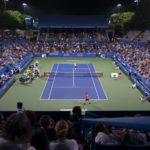
 Milos Raonic plays in the 2017 Citi Open. (Photo by Keith Allison)
In 1968, months before his historic U.S. Open win, Arthur Ashe was driving around D.C. with his friend Donald Dell. The tennis star proposed an idea.
“He said to me, ‘why don’t we do a tournament here?,’” Dell tells DCist. ‘“I’d like to play in it, but it has to be in an integrated neighborhood.’”
Dell recommended tennis courts at the corner of 16th and Kennedy streets Northwest in Rock Creek Park, in Ward 4’s affluent African-American neighborhood known as the “Gold Coast.” Ashe agreed and committed to be in it every year, as long as “black faces come out and watch the tennis.”
The following year, the Washington Star International tipped off and D.C.’s professional tennis tournament was born.
Fifty tournaments later, the annual event, now called the Citi Open, is still being played in the same location, the Rock Creek Park Tennis Center, and attracting some of the best players in the world.
Founded by Dell and John Harris, it’s the second-oldest professional tennis tournament in the country behind only the venerated U.S. Open in New York. It’s played in a national park and the tournament’s owner and sole beneficiary is the Washington Tennis & Education Foundation, an organization that provides athletic and academic assistance to lower-income children in the city, particularly in Wards 5, 6, and 7.
“This is a hometown event,” says Keely O’Brien, the tennis tournament’s director. “It has always been inclusive and welcoming. That’s been our mission since the very beginning.”
For that, we can thank the late, great tennis legend—and civil rights activist—Arthur Ashe.
Hailing from Richmond, Ashe would often play in the same junior tennis tournaments as his D.C. counterparts. Willis Thomas, who grew up in Northwest and now lives in Southeast, was Ashe’s doubles partner during those early years in the 1950s and is now WTEF’s longtime program director. The two would often talk about their shared experiences as some of the few African-American players.
“He had these insights that other kids … didn’t have. It’s something special that comes along in people every now and then,” Thomas recalls. “He thought of himself as not only as a tennis player, but also a scholar.”
Dell also met Ashe at these tournaments when they both were kids. They went on to become Davis Cup teammates and lifelong friends. For decades, Dell was Ashe’s manager. He remembers Ashe being one of the youngest and best players, but the reality of race still hung over him. “He was very sensitive about being black in a white man’s sport,” Dell says.
Some of what Ashe endured was overt—like being bombarded with racial slurs by white parents as they watched their kids lose to Ashe—but some were more subtle, like being denied entrance into a tournament due to his application supposedly arriving late or editors choosing only white competitors to be featured in local newspaper stories.
Often times, Dell’s father would drive Ashe back home from these far-flung competitions. “We would leave Oglebay [Tennis Center] in Wheeling, West Virginia and drive all night. We all knew that if we stopped, Arthur and I couldn’t stay in the same motel,” Dell remembers. “We never spoke or made a big deal about it, though.”
There were several precursors to the Washington Star International in D.C., including Davis Cup exhibitions against the formidable Australian tennis team. But none captured the public’s attention quite like a 1967 match held in the streets near Lincoln Park in Northeast.
The exhibition was part of the newly-conceived “Summer in the Parks” program and featured a doubles match played in the middle of the street between Dell and Charles Pasarell, the No. 2 ranked player in the country at the time, against Ashe and Senator Bobby Kennedy. People came from across the city to watch the country’s greatest tennis players and a senator volley back and forth. “We had 4000 people watching us … in the inner city,” says Dell, “It was wonderful.”
Thomas was there watching too, excited to see his sport being played by a black man in his hometown. “It was huge. To see it in the city, right there on the street,” Thomas says. “That all sounds like Arthur.”
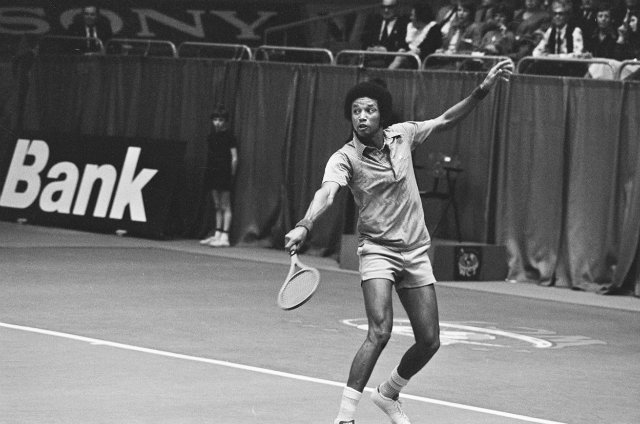 Arthur Ashe plays at the 1975 World Tennis Tournament in Rotterdam. (Photo by Rob Bogaerts, courtesy of the Nationaal Archief Fotocollectie Anefo)
By 1968, Ashe was regarded as one of the greatest tennis players in the country. He had won a NCAA title at UCLA, appeared in Sports Illustrated, and became the first African American to be a member of the U.S. Davis Cup Team. He was also finding his voice as an activist.
It was in March of that year at the Church of the Redeemer, Presbyterian in Northeast D.C. when Ashe first spoke out publicly regarding his role as a black athlete in America. Admitting later he was more nervous about this speech than any tennis match, he cited black athletes Bill Russell and Jackie Robinson as ones he sought to emulate for their self-confidence and commitment to helping their community. He told the audience said that one didn’t have to be famous to make a difference and the results may not be immediate. As Ashe wrote in his memoir about this speech, “‘We must forget ourselves’ and work for others … even if “what we do today may or may not bear fruit until two or three generations”
In the summer of 1969, Dell and Harris, with Ashe’s support, got permission from tennis’s governing body and established one of the first open professional tournaments in the United States (only a year earlier, tennis went “open,” meaning amateurs and pros could compete together). It was held from July 7-13 and had a $25,000 purse.
But that first tournament in the Gold Coast was a struggle, even with Ashe and U.S. Open doubles champion Stan Smith on board to play. The Washington Post declined to be the sponsor, so D.C.’s second newspaper, the Washington Star, stepped in at the last minute. The grandstands could only hold 500 people, so they had to add bleachers that brought that number to more than 2,500. And the facilities at the tennis center were not prepared to accommodate a professional tournament (“There were no locker rooms and there were no showers “We got changed in tents,” Dell says).
Still, it was a success. Ashe made it to the finals in the singles tournament before losing to the Brazilian Thomaz Koch. Both white and black fans from all over the city packed the house and the proceeds went to the Washington Area Tennis Patrons Foundation, an organization that provided Washington D.C. children with equipment, instruction, and financial means to play tennis.
The tournament was held the next year and Ashe played again (also losing in the finals). He would end up playing the tournament eleven times and winning the whole thing in 1973. In 1972, Dell and Harris donated the tournament charter to the Washington Area Tennis Patrons Foundation, making it the sole owner and charity benefactor. Years later, the organization was renamed the Washington Tennis & Education Foundation.
The five-decade old tournament has gone through several name changes (including the Sovran Bank Classic, the Nations Bank Classic, and the Legg Mason Tennis Classic) and a women’s tournament was (finally) added in 2012. Through it all it has continuously been a huge source of funding, promotion, and support for the WTEF.
Today, the Citi Open raises million dollars each year for the WTEF, which serves approximately 900 kids during the school year. In 2012, the foundation opened a $10 million dollar, state-of-the-art tennis center in Ward 7 to teach the sport . The foundation also runs the Arthur Ashe Children’s Program, aimed providing academic and tennis opportunities to at-risk students after school, in 23 public schools (as of this summer) across Northeast and Southeast D.C. And, this year, WTEF and the Citi Open will unveil a mural painted by local artist Aniekan Udofia (the muralist also created the mural outside of Ben’s Chili Bowl) featuring Ashe and the scores of children who are impacted by the tennis star’s work.
Thomas, who is retiring this summer after 25 years as WTEF’s program director, knows that Ashe would have been proud of the impact that the WTEF and Citi Open are making in the lives of D.C. youth.
“Arthur always believed tennis and education went together. He believed that [the tournament] needed to be at a [public] park, not at a country club,” Thomas says. “He wanted to have the tournament in Washington to be open to everybody, especially children.”
Arthur Ashe died on February 6th, 1993 from pneumonia, a complication related to AIDS. He was mourned by many across the world for not only being one of the greatest players to ever step on the tennis court, but for being a humanitarian, an activist, and a voice for those who weren’t given a chance to talk.
“I know I could never forgive myself if I elected to live without human purpose,” Ashe wrote in his memoir, finished only days before his death, “without trying to help the poor and unfortunate, without recognizing that perhaps the purest joy in life comes with trying to help others.”
It’s on the tennis court at the corner of 16th and Kennedy streets where Ashe’s D.C. legacy looms largest.
The program from 1969 , courtesy of the Citi Open Tennis Tournament by Rachel Sadon on Scribd