Rachel Kurzius
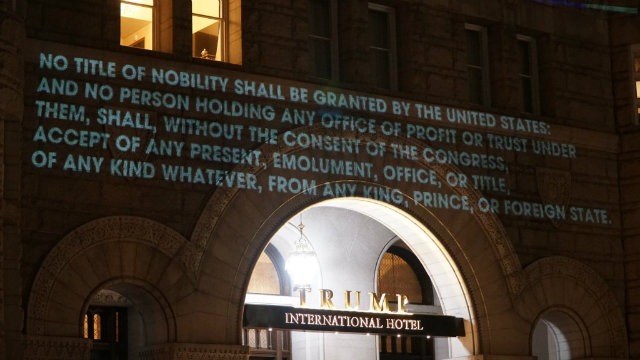 D.C. artist Robin Bell projected the emoluments clause onto the Trump hotel on May 15. (Photo by Liz Gorman)
D.C. Attorney General Karl Racine says he is “just ecstatic” by a ruling that will keep alive a lawsuit against President Donald Trump and move it to the discovery process, where he is seeking access to the Trump International Hotel’s business records.
Racine and Maryland Attorney General Brian Frosh announced in June 2017 they were suing Trump for violating the Constitution’s anti-corruption clause, alleging that the president continues to enrich himself over foreign and domestic payments to his sprawling business interests, from which he has not divested.
This week, U.S. District Judge Peter Messitte ruled for the second time that the case could move forward, rejecting the Department of Justice’s call to dismiss the case, which centers upon the Trump International Hotel in D.C.
Racine says that the so-called Emoluments Clause of the Constitution (“no Person holding any Office of Profit or Trust under them, shall, without the Consent of the Congress, accept of any present, Emolument, Office, or Title, of any kind whatever, from any King, Prince, or foreign State”) is the country’s oldest anti-corruption law, even though courts have never sussed out what, exactly, the word “emoluments” means.
In his decision, Messitte agreed with the attorneys general of D.C. and Maryland that “emoluments” are any “profit,” “gain,” or “advantage,” rather than the DOJ’s more specific definition as a “payment made in connection with a particular employment over and above one’s salary.”
Racine calls it “a historic decision that is indeed precedent-setting,” though he acknowledges that “it will likely end up being decided by higher courts.”
Messite writes that “Since the president’s election, a number of foreign governments or their instrumentalities have patronized or have expressed a definite intention to patronize the [D.C.] Hotel, some of which have indicated that they are doing so precisely because of the president’s association with it.”
Frosh and Racine also allege that the hotel has received an emolument in the form of a benefit from the General Services Administration lease granted to the Trump Organization in 2013. The lease states that “No member or delegate to Congress, or elected official of the government of the United States … shall be admitted to any share or part of this lease, or to any benefit that may arise therefrom,” but the GSA determined that switching management to the president’s son, Donald Jr., brought them into “full compliance.” (The attorneys general of D.C. and Maryland disagree.)
After the ruling, Frosh and Racine have 21 days to work with the Department of Justice to determine a path forward for discovery.
Racine says they’ll be seeking “the business records of the Trump hotel, the kinds of clients and sources of payments, the extent of those payments, the actions the Trump hotel took to garner that kind of business. We’re really interested in establishing firmly the manner in which the president actually received the emoluments.”
The DOJ can request a protective order to keep some or all of that information private, and Racine says he and Frosh will fight that. “We believe that the information that we seek should be public.”
It’s possible that the DOJ will appeal Messitte’s decision. “We continue to maintain that this case should be dismissed, a position that was shared by a New York court in a related case,” DOJ spokesperson Andy Reuss said in a statement. “The Justice Department is reviewing the order and determining next steps.”
The cases in New York, one brought by Citizens for Responsibility and Ethics and another by an individual attorney on behalf of the public, were dismissed for a lack of standing, but Racine says that’s not a problem for his and Frosh’s case.
“The reason why we brought this case is because literally blocks away from the office of the A.G., the president is actively soliciting business from foreign sovereigns and domestic sovereigns,” he says.
The Trump hotel in D.C. is also facing a lawsuit from Cork Wine Bar, which is suing the president over unfair competition. Separately, a complaint from a group of religious leaders and retired or inactive judges calls on the the D.C. Alcoholic Beverage Regulation Administration to take away the hotel’s liquor license, citing a law that requires establishment owners to be “of good character.”
Previously:
D.C. And Maryland Are Suing Trump Over ‘Flagrantly’ Violating Constitution
Trump Emoluments Case Opinion July 25 by Rachel Kurzius on Scribd