Natalie Delgadillo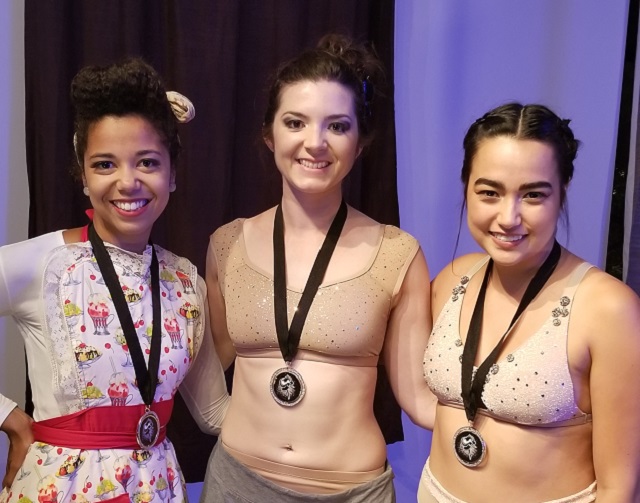
 All the performers at Saturday’s Pole Pressure Championship. (Courtesy of Pole Pressure DC)
I walk into the Pole Pressure DC studio, above a Popeye’s on 14th Street NW, and within thirty seconds an incredibly fit-looking woman has flung off her pants and dropped down into a forward bend, her stomach flush against her thighs. The women around her, also in various states of undress, glance in my direction and continue their warm-ups. It doesn’t appear to bother anyone that a stranger has just shown up to gawk at them as they stretch.
These women—and all of them, this time, are women, though men do teach and take classes at the studio—are preparing to perform original routines at Pole Pressure’s pole dancing championship. It’s an hour and a half before the show, and people are warming up in an outer room while, in another room with two poles at the front, one woman at a time practices her routine to music. This is where I first understand that pole dancing apparently requires you to defy gravity. They are upside down and then right side up, they are spinning, they are walking on the air. It looks utterly impossible.
“It’s actually really scary. I’m afraid of heights, so being twelve feet off the ground hanging upside down is scary,” says Sarah, who talks to me while doing back-bendy stretching exercises. Sarah (who only uses her first name when she pole dances) is a classically trained ballet dancer who’s been pole dancing for four years. She’s competing at Pole Level Trix, which is the highest possible level. Ten women in total are pole dancing or aerial hoop dancing at the show: seven of them competing for a title and another three presenting showcases.
When I watch Sarah practice her routine inside (which is set to Hozier’s “Take Me to Church”), she does not look scared. She looks like she’s floating.
A Pole Pressure instructor, via Instagram
It’s hard to describe what very skillful pole dancers are actually doing, because it all looks like one fluid movement that is constantly changing. First, they’re walking around the pole, then they’ve climbed up it, then they’re upside down, then they’re spinning and their legs are in a split. It all looks like it takes Simone Biles-level core strength to successfully complete.
Still though, in a place that might be intimidating or competitive, I sense that people are relaxed and happy. They’re helping one another stretch and chatting and watching each other’s routines. It’s friendly.
Sarah confirms my sense of the place when I ask her what her favorite part of pole dancing is. “The ballet world is very competitive. Pole is so supportive. People are really, genuinely excited for one another. There’s camaraderie,” she says. She tells me that people mostly make up their own routines for the championship, with lots of help from the Pole Pressure teachers and other students.
Pole Pressure’s D.C. studio (there are additional locations in Woodbridge, Va., and Richmond) welcomes about 11 students each to between three and five classes per day, ranging in difficulty level from beginner to Trix. Pole Pressure owner Devon Williams, who has been pole dancing since she used a Groupon to take her first class in 2011, says the studio creates a community for the people who dance there.
“Once people find pole, it’s like the thing that was missing from their life,” she says. “It’s for everyone. We have younger people, older people, men, trans people, every size and religion and background.” This was completely borne out by my experience at the championship, where performers were all ages and races.
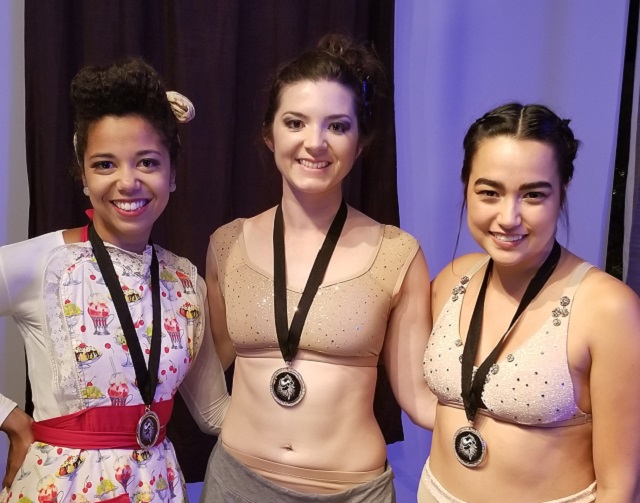 Championship winners (from left) Masha, Sarah, and Natalia. (Photo Courtesy of Pole Pressure)
It’s obvious from watching the most advanced dancers that this is an athletic pursuit you have to practice a lot. But it also looks like fun: The performers dramatically shimmy around and interact with the audience during their routines (the aerial hoop performer, Masha, very kindly and flirtatiously dusted my face with her prop feather duster before starting her routine).
This carries over into the the studio’s other events across the year, which include regional competitions and something called a “poleusical” (pole musical). This year’s poleusical, which takes place in late October, will be a pole dancing version of Little Shop of Horrors.
In the end, Sarah won the Trix Level competition, a competitor named Natalia Thiemi took home Level 3 (an intermediate level), and Masha took home the prize for Hoop. I left in awe, pretty certain my body could never learn how to hang upside down on a pole in a full split. But in a room as encouraging as that one, I also had a feeling I could find the courage to try.