 Jordan Pascale
 (Photo by Elvert Barnes)
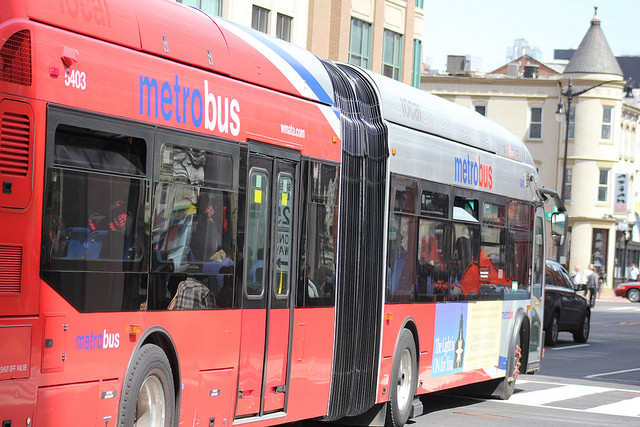
Bus travel times on 16th Street NW could be shaved by 2 to 3 minutes when the District Department of Transportation implements dedicated bus lanes in the corridor by 2020.
The goal is to bring faster, more reliable bus service to a 2.7-mile stretch from H Street to Arkansas Avenue. The lanes would be in effect during peak periods from 7-10 a.m. and 4-7:30 p.m.
More than 20,000 bus riders travel on the thoroughfare — accounting for half of the people on the road during rush hour between the White House and Silver Spring.
DDOT’s Sam Zimbabwe says it’s a complicated street.
“There are very legitimate questions about how a change like this would happen,” Zimbabwe said. “A lot of this project is about balancing the needs of a busy corridor.”
Current riders describe the route as congested, slow, unreliable and inefficient. DDOT has been working on a solution for years.
“WMATA has pretty much done as much as they can with the corridor by adding more buses and adding the S9 limited,” DDOT transportation planner Megan Kanagy told DCist in 2015. “Now we have come together and started to look seriously at what other options are out there.”
It would be among the first permanent bus lanes in the District, following a similar project on Georgia Avenue (DDOT has also put in place a temporary bus lane along Rhode Island Avenue during the 45-day Metro shutdown, which it might make permanent). Alexandria and Arlington have some dedicated bus lanes and Montgomery County is studying the idea.
After three different studies, the District committed to putting in a 16th Street bus lane in 2016 and has been working on designs since then. DDOT hosted an open house to share the final plans at the Mt. Pleasant Library Monday evening.
More than 50 people showed up to learn about the project and voice their concerns from specific design issues on their block to the removal of parking and bus stop elimination. They also wanted to know how much time the bus lanes would save.
The lanes would be intermittent through the nearly 3-mile stretch.
Five bus stops will be eliminated to speed the route. Southbound stops will be eliminated at Lamont Street NW and V Street NW. Northbound stops will be eliminated at L, Q, V and Lamont streets NW.
About 30 parking spots will be removed to make way for more room for buses to pull over. More bus shelters will be added in some spots. Left turn restrictions will also be in place in some areas.
Additional features like bus queue jumps and transit traffic signal priority, which put buses in front of the line of traffic, will add to the speed of the routes.
Plans for off-board payment and all-door boarding, which can add significant time savings remain under consideration.
As for the design of the dedicated lanes, they will mostly be identified with signs along the street and strips of red paint through the lane to occasionally identify it as a bus lane.
DDOT didn’t want to paint them completely red since they are only dedicated bus lanes during peak hours.
“Close to 20,000 people ride the bus a day here, but there’s lots of east-west travel demand … walking, biking and driving along the whole corridor,” Zimbabwe said.
A full presentation and detailed map can be found on 16thstreetnwbus.com.
16th Street NW Bus Lanes Project Online Open House July 2018 from Kimley-Horn on Vimeo.
Previously:
16th Street Is Getting A Bus Lane, But It Will Still Take A Few Years
Years Of Study, Advocacy May Result In A 16th Street Bus Lane