 Jordan Pascale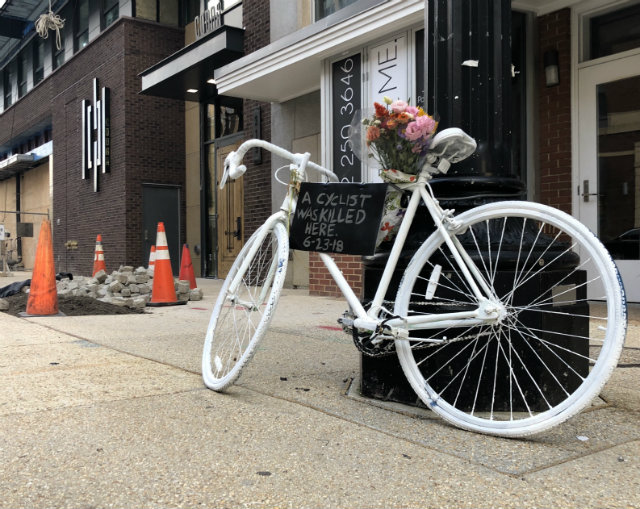
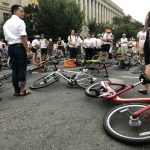
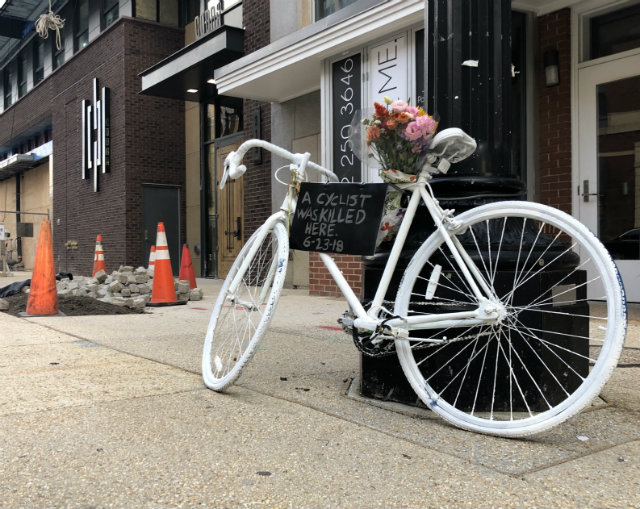 Cyclists rode for Malik Habib, who was killed on H Street in June. (Photo by Jordan Pascale/WAMU)
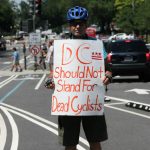
More than 60 cyclists wearing white held a silent bike ride for Malik Habib on Tuesday evening.
They rode to remember the 19-year-old Northern Virginia Community College student and former football player who was killed while riding home on H Street with his brother on June 23.
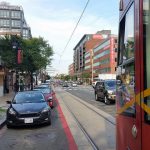
His bike tire got lodged in the streetcar track near 3rd and H streets NE. He fell and was struck by a bus and later died at the hospital.
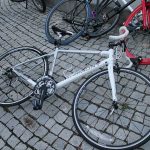
The group rode a mile and a half route that ended near the crash site. They put down their bikes at the intersection, which angered some drivers, and stood silently for nearly 10 minutes.
They also demanded change. And they might get it.
Rachel Maisler, who helped organize the ride, asked DDOT to install rubber flaps that cover the tracks to prevent the same thing from happening again, and for better speed enforcement on the busy street.
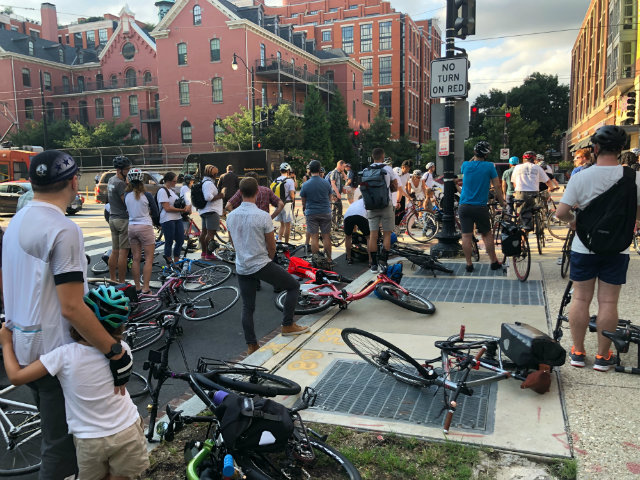 District Department of Transportation officials say they will evaluate ideas to prevent bike tires from getting stuck in the H Street streetcar tracks after a 19-year-old was killed in June. (Photo by Jordan Pascale/WAMU)
DDOT Director Jeff Marootian attended the memorial and said he shares the same sense of urgency to fix the problem.
“This is a tragedy and we’re taking time to evaluate [what to do],” Marootian said. “We need to make sure H Street and the adjoining streets are as safe as possible.”
He said DDOT is committed to testing and evaluating different products to make the tracks more cyclist friendly.
In other cities, rubber flanges fill or cover the gap in train tracks. Cyclists aren’t heavy enough to push the rubber down, but streetcars are.
This video from researchers at the University of Tennessee shows how easy it can be for cyclists to get lodged in track.
Some say DDOT is making improvements, others say it lacks commitment
When Jeffrey Long was killed by a right-turning truck at M Street and New Hampshire Street NW in July, DDOT removed parking that blocked the sightline for drivers and added plastic pylons. When people kept parking there, they added even more pylons.
It’s this kind of response that has endeared DDOT to some riders like Adam Gould, a cyclist who rode in the memorial. He still wants change on H Street.
“We’re not going to forget about these kinds of incidents and tragedies and we just have to keep the pressure on to make sure that things can move forward to more safety,” Gould said.
Others say the District is only giving lip service to Vision Zero, the 2016 initiative that aims to eliminate fatalities and serious injuries on roads by 2024.
Maisler said she thinks the District isn’t really committed to that goal.
“I find the political will behind Vision Zero is a smoke and mirrors campaign at the moment,” she said.
Traffic fatalities have increased in recent years. There were 26 deaths in 2015, 30 in 2016 and 21 deaths so far in 2018. That’s three more than during the same time last year.
Marootian said achieving Vision Zero will take time and DDOT is doing as many projects as it can to quickly address dangerous areas.
H Street has never been a haven for cyclists
DDOT once aimed to ban bikes on H Street because of safety concerns.
It’s a main route out of the District, but a complicated one, with plenty of pedestrian traffic and the streetcar.
Kurt Sherman lives in the area and said people drive too fast over the bridge. He agreed with cyclists that the speed limit needs to be lowered or there need to be speed cameras or police enforcement.
“People come flying down the hill,” Sherman said. “It was a needless tragedy.”
DDOT has recommended alternate routes to H Street and if riders do need to cross tracks, they should do it at a 90-degree angle. Riding parallel near the tracks can be dangerous.
Since 2016, H Street NE has had 480 crashes with 11 involving bikes and 31 involving pedestrians. Three people, including Habib, have been killed in the area.
This story originally appeared on WAMU