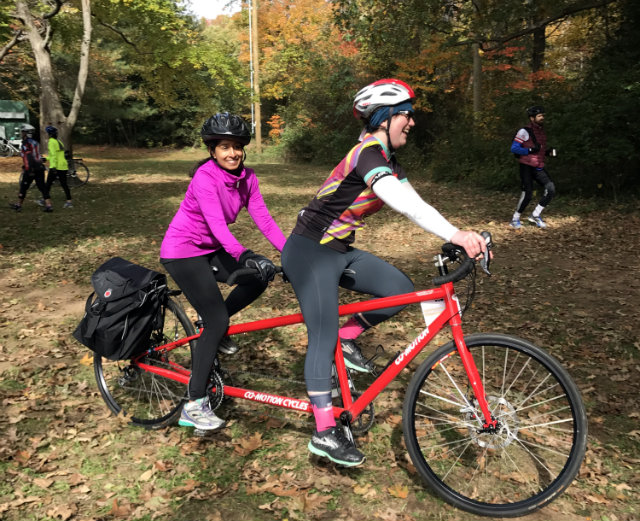
 Qudsiya Naqui and Shira Gordon pair up on a tandem bicycle for WABA’s Cider Ride last fall. (Photo courtesy of Shira Gordon)
By DCist contributor Helen Wieffering
On a recent Thursday evening, a group of tandem cyclists rode out from Eastern Market to the Anacostia River. The air was heavy from a week of rain, but a cool breeze picked up over the 11th Street Bridge and followed the riders down to the Anacostia Riverwalk Trail, rippling over the water and through the trees. One tandem sped away over a hill.
“Riding with the elephants, as we like to call it,” says Tajuan Farmer. “With these bikes, the gravitational pull takes over and they’re gone.”
Tandem bikes are a rare enough sight on the streets of D.C. to draw smiles and friendly hellos from people along the way. But what fellow riders might not catch in passing is that half this group of cyclists cannot see. Each tandem pairs a sighted captain with another rider who is blind or visually impaired.
These weekly rides are organized by Karla Gilbride, who serves as the acting president of the Metro Washington Association of Blind Athletes. Riders meet every Thursday from the Eastern Market or Bethesda Metro stations and journey ten to twenty miles along the nearby trails on tandem bikes.
Riding in sync as a tandem pair requires some practice for the uninitiated. The tandem’s captain sits upfront to steer the handlebars, shift the gears, and apply the brakes. Seated close behind is the stoker, who listens for the captain’s cues and gives further power to the bike by pedaling. It takes time to learn this “tandem philosophy,” says Farmer, who rides with the group as a blind stoker and serves on MWABA’s board.
Stopping and starting the bike as a team are perhaps the most crucial moments of every ride. Communication is key, especially since the stoker can’t see an approaching stop sign or a steep hill.
“A good captain will tell you when to stop pedaling, when they’ve changed gears, so you’re in sync on these things,” said Carole Nathan Metzger, a visually impaired stoker who rides with the group.
At 72, Metzger is one of the group’s eldest members. She’d given up recreational cycling when she began losing her peripheral vision as an adult. Riding as a stoker with MWABA last summer marked her first time on a bicycle in 35 years. “I thought oh, I can do this,” she recalled of her first Thursday riding tandem.
Metzger later wrote an essay reflecting on that night. “I did not see much on the ride,” she wrote, but “I did get to feel the wind in my face, enjoy the fresh smells of the vegetation alongside, and know the exhilaration of speed.”
The tandem program began in earnest in the spring of 2017 as a joint effort between Gilbride and Farmer, and it has quickly become one of MWABA’s most popular athletic offerings. Gilbride began riding tandem while living in California and was motivated to begin a similar program for blind athletes in D.C. “I got hooked,” she says—a commonly heard phrase among this group of cyclists.
Farmer, meanwhile, had been riding with a tandem group out of Alexandria before deciding to invest in his own bicycle. It was Farmer who petitioned Metro to build lockers large enough to accommodate tandem bicycles at the Eastern Market and Bethesda stations, a process that took about a year, he says. Another hurdle in the program’s initial stages was acquiring a fleet of tandem bikes. MWABA currently has six tandems to share on a weekly basis, each intimately familiar to riders for their various quirks and claims to speed.
Gilbride says the tandem cycling program serves blind and visually impaired athletes of all abilities, whether they’ve been blind since birth or are entering adaptive sports due to vision loss at a later stage. MWABA offers a range of recreational and competitive sports, from yoga to judo. “People come to us at all levels of experience,” she says. The tandem program welcomes new riders—stokers and captains alike—and helps ease them into their first ride.
Each tandem bicycle makes for a collaborative balancing act between the two riders on board. The sighted captain, in sole control of steering the bike, is responsible for keeping the pair out of harm’s way. The generous flow of trust between riders often paves the way for new friendships, and the pair’s physical closeness on the bike makes for easy conversation as they ride.
“You’re not complete unless you have a stoker,” says Qudsiya Naqui, a visually impaired stoker who rides regularly from Bethesda and Eastern Market. Single bikes are affectionately known as “half bikes” among the group.
In addition to tandem cycling, Gilbride is active in nearly every program MWABA has to offer and is training for a triathlon in her spare time. She hopes to expand the athletic association into further sports in the coming years, including distance running and adaptive cross-country skiing. In the end, “it’s all about camaraderie,” she says.
For Farmer, who often rode a single bike in his childhood before losing his vision, learning to ride tandem has offered the chance to reconnect with biking and the thrills of the trail. MWABA’s stokers aren’t simply along for the ride; they’re immersed in every aspect of it. Once the tandem falls into its familiar rhythm, “then you can focus on your environment.”
“You can listen to the sound of nature, feel the sun and the wind, and hear the description of what plants and flowers and animal life is around you.” Farmer goes on, still musing: “It’s truly an experience.”
MWABA’s tandem rides happen every Thursday at 6 p.m. from April to October. The location alternates between the Eastern Market and Bethesda Metro stations. Learn more at MWABA or e-mail karla.gilbride@gmail.com for details about getting involved.