 Mikaela Lefrak
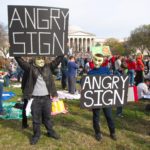
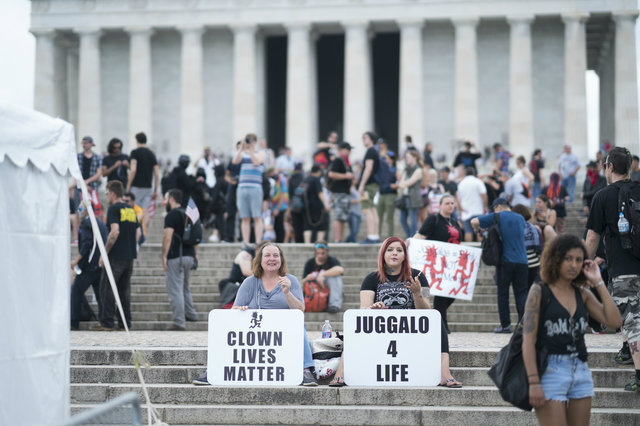 Juggalos protested on the National Mall on September 16, 2017. (Photo by Mark Hoelscher)
The National Park Service is looking into modifying the rules that govern free speech demonstrations and special events in Washington.
NPS oversees more than 1,000 acres of parkland and public spaces in the District, including the National Mall, White House, and triangles and circles around the city. Individuals and organizations who want to hold an event at one of those spaces must apply for and receive a federal permit.
On Tuesday, NPS released a list of 14 proposed rule changes to the permitting process. One of the new rules under consideration is a requirement for permit applicants to pay fees for free speech demonstrations, to help NPS recover some of the costs of managing the events and providing security. NPS already requires people to pay for special event permits.
“The federal government and taxpayers shouldn’t be required to underwrite the cost of somebody’s special event, whether it’s a concert, wedding, or gathering of some sort,” said NPS spokesman Mike Litterst. “We’re just asking the question,” he said of the proposal to apply the same reasoning to demonstrations. He said there has been no discussion yet of what the fees would be.
The Park Service said the “volume and complexity” of permit requests for the National Mall and White House have increased over the years. NPS issues around 750 permits for First Amendment demonstrations and an additional 1,500 permits for special events in and around D.C. each year.
The last time the permitting rules for free speech demonstrations were updated was in 2008. Since then, the physical landscape of the National Mall and the country’s political landscape have changed.
“There is an enormous cost to putting on or assisting with some of these larger First Amendment demonstrations,” Litterst said. In 2018 his department has managed events ranging from the March for Our Lives to the upcoming “Unite the Right 2.”
Another new rule would require permits for any structure larger than a lecture, even if the event itself does not require a permit. The proposed change partly is in response to the Occupy movement in 2011. Protesters set up tents and other structures in McPherson Square that some deemed unsafe or unhealthy (the area’s rat population exploded, for example). “It was a safety hazard, not only to the people who were in them, but to the people in the area,” Litterst said.
Other proposed changes simply codify safety regulations that have already been in place for a while, like creating a permanent security zone around the White House that the Secret Service has already implemented.
Another proposal would remove some parks that are outside D.C. from the centralized permitting process, to lighten the department’s load. Those parks would handle their permit requests directly. They include Manassas Battlefield, Prince William Forest Park, Wolf Trap National Park for the Performing Arts, and the portions of the C&O Canal outside of D.C. and Montgomery County.
A public comment period for the proposed rule changes will begin on Aug. 14 and stay open for 60 days. Earlier this year, public comments played a major role in the NPS reversing course on a proposal to dramatically increase entrance fees to national parks around the country during periods of high traffic.
“I want to thank the American people who made their voices heard through the public comment process on the original fee proposal,” Interior Secretary Ryan Zinke said in a statement following the decision. “Your input has helped us develop a balanced plan that focuses on modest increases at the 117 fee-charging parks as opposed to larger increases proposed for 17 highly visited national parks.”
After the public comment period for this proposal ends in October, the NPS will review the comments and then determine whether to implement, modify, or withdraw the proposal. Comments can be made electronically at Regulations.gov.
This story originally appeared on WAMU.