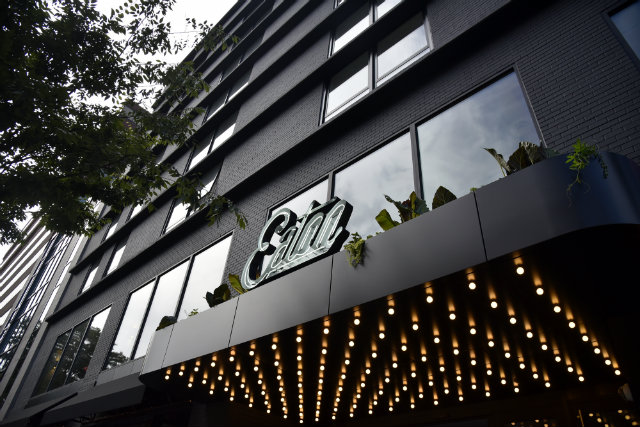
 (Photo by Getty Images, courtesy of Eaton Workshop)
By DCist contributor Leigh Giangreco
At a preview for D.C.’s Eaton Workshop earlier this month, founder Katherine Lo pitched the new hotel, opening this summer near Franklin Square. She told the crowd that Eaton D.C. is less of a hotel and more of a social justice space where each guest will automatically become a patron of the arts and can explore its library and artist studios.
“All these things are under one roof and we hope to have it be a resource for people in D.C.,” said Lo, scion of the Langham Hospitality Group. “It’s actually all in disguise as a hotel.”
Set to have its soft opening on August 27 followed by a grand opening in late September, Eaton D.C. has bigger plans than providing lodging: According to the millennial-focused word salad announcing its premiere in the District, Eaton D.C. will host “an inclusive tribe of changemakers and creatives,” with plans including a coworking space adjacent to the hotel known as Eaton House, a spa, a cinema, and eventually an artist residency program.
The K Street location will be the flagship site for the growing Eaton Workshop brand that’s slated to expand in Hong Kong this fall, followed by locations in San Francisco and Seattle. It may be a strategic move to launch in Washington, where sophisticated endeavors like The Line hotel have succeeded by imparting local flavor.
Eaton D.C. appears to take great pains to profess its local ties and its progressive values. But is it a truly unique space for local art and social good to thrive in D.C., or is it just another trendy hotel?
Many local artists have staked their confidence in Eaton D.C. on Sheldon Scott, the hotel’s director of culture and an artist who has lived in D.C. for 18 years. Scott acknowledges the potential concern of “artwashing” or the practice of gentrification where developers introduce artist to a space in an ornamental fashion.
“They bring them to the spaces, dangle them and then when they’re done and they’ve gotten the audience they’ve really intended on, then they shove the artist out,” Scott says. “The thing that made this project attractive is that Kat [Lo] made it clear that the intended audience is artists.”
Over the years Scott has become a fixture in D.C.’s art scene, connecting artists from the Uptown Art House with the Kennedy Center, and as Eaton D.C.’s director of culture he will work to execute Lo’s vision of the hotel as a community center focused on art and activism.
“I think with Katherine’s family history and coming from hospitality branding, this was a great opportunity for her to merge her personal identity, her familial identity and create an environment,” he says. “But it really is a social justice organization kind of couched into a hotel brand. Hotels can be somewhat of a Trojan horse because it is more than just that.”
Robin Bell, a D.C. native and filmmaker who has found national fame with his political projections on the Trump International Hotel, was among the artists in attendance who felt optimistic about the project.
“It’s pretty exciting to see a space whose goal is to work with artists and activists locally,” he says. “I think both [Lo and Scott] are laying really great groundwork.”
Indeed, Eaton D.C. has sown seeds within the local community. D.C. artist and Black Pepper Paperie Co. founder Hadiya Williams is designing decorative pieces for the rooms, and the hotel will work with D.C.-based art historian and installation artist Anahita Bradberry, according to a spokesperson. Lo also recruited D.C.-based painter Erik Thor Sandberg to create the mural in one of the hotel bars.
As for the activism and social justice aspects, a spokesperson says the hotel is still finalizing relationships with nonprofits and groups ahead of its September opening. Eaton D.C. has already solidified a partnership with Teaching for Change, a D.C.-based social justice nonprofit, that will curate a “radical library” in the hotel focused on environmentalism, race, and indigenous narratives.
Eaton D.C. is also seeking B corporation certification, a business designation applied to for-profit companies that want to accomplish altruistic goals, such as environmental sustainability, along with their revenue targets.
Along those progressive lines, the hotel has maintained its commitment to the unionized employees who worked at the Four Points by Sheraton hotel that previously occupied the Eaton D.C. space, according to Dida El-Sourady, supervisor of the D.C.-based Local 25 hospitality workers union. Under the union contract, workers will return to the hotel with full seniority and receive employer-funded healthcare and raises every six months, El-Sourady says. Although Local 25’s collective bargaining agreement stipulates the new owner of a hotel must call the unionized employees back to work, some hotels in D.C. have fought those terms, says Local 25 spokesman Benjy Cannon.
“That language doesn’t always mean it’s going to be a straightforward process,” he says. “Eaton has been a glowing exception. They welcomed the union with open arms.”
Some employee contracts are still being worked out and Eaton D.C.’s food and beverage employees will be managed by the hospitality brand Plan Do See, a spokeswoman for Eaton D.C. says. The third-party employer will oversee the cocktail bar and restaurant workers, who are not part of the hotel’s labor agreement, she added.
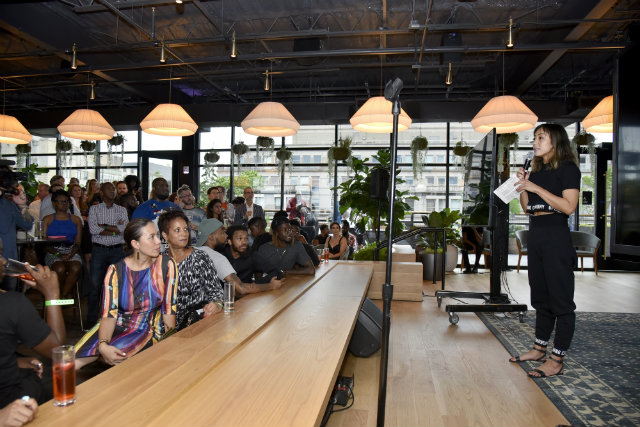 Katherine Lo addresses guests at a preview for Eaton D.C. (Photo by Getty Images, courtesy of Eaton Workshop)
It seems that Eaton D.C. is leaving much of the work of creating a social justice-focused space to the businesses and creatives who will hopefully fill its co-working space, Eaton House. “Eaton House is a dynamic take on the working club for a global tribe of innovators, activists, progressive thinkers and creatives,” the website says. “We encourage grassroots projects and artistic expression, and believe that hanging out with fellow dreamers and doers is the best path toward a more utopian society.”
To become part of such a group, one must apply to the Eaton House Selection Committee, which considers which causes one supports and “what kind of revolution” one would start, and what would bring it about: “a song, a book, a drug, etc.”
Rates for the space, which will open October 1, may raise eyebrows among the activist, artist, and nonprofit set Eaton D.C. is targeting. Its memberships range from $400 to $800 a month for individuals, while two- to six-person office rates range from $1800 to $4,500 a month—comparable with commercial rates for coworking spaces. Eaton House’s amenities include a 50-seat professional screening room, cafe, wellness center access, and preferred rates for guests. (Standard hotel room rates begin at $199 a night.)
(After publication, an Eaton D.C. representative told DCist that Eaton House will offer reduced rates for activists and artists, but said specifics and rates are still being finalized.)
There appears no set criteria when it comes to selecting artists for its residency program, a separate effort from the co-working space. But generally, Lo says, the artists should reflect Eaton D.C.’s broader philosophy of intersectionality, which emphasizes that all forms of oppression are interrelated.
“Gender is related to race, to the environment … so we actually take a holistic view toward activism,” she said. “We would love for our spaces to support artists and activists who are working on projects that we really believe in, but maybe they just need that final support or push to get the project done.”
Eaton D.C. hopes to be a bohemian enclave, not unlike the converted bars, garages, and rowhouses where local D.C. artists practice their craft today. But those grungier spaces born out of grassroots movements, like Uptown Art House in Cleveland Park and Hole in the Sky in Northeast D.C., are fast becoming an endangered species as gentrification closes in around them.
Developers pushed Union Arts, the DIY collective that once hosted concerts and artists, out of its space in 2016. Its former director, Luke Stewart, has been looking for a new venue ever since, but is skeptical of the trend led by places like The Line and Eaton D.C.
“You’re using the movement as a selling point and ultimately will undermine the movement of social justice and the possibility of grassroots, organically-made art,” he said. “It looks like people are trying to make some compromise between corporate development and the arts. In my mind, any artist who involves themselves in that shows the kind of artist they are, they allow themselves to be utilized by corporate machines.”
Eaton D.C. certainly doesn’t look much like those DIY arts spaces around D.C. The lobby is bright and airy. Mid-century modern lines guide the mahogany-colored walls and an army of potted palms greets visitors near the check-in desk. Baltimore artist Zoe Charlton’s mosaic covers the wall behind the stage on the rooftop. It’s unclear how beatniks, the East Village, and Vietnam War protests, as an Eaton release claims, inspired a space that appears so firmly rooted in the minimalist design that has been repeated in a thousand coffee shops across the country.
Still, some artists are firmly on board. The launch party in early August also hosted Baltimore rapper Tt The Artist and her forthcoming documentary, “Dark City.” As she hopped on the narrow stage, Tt’s backup dancers moonwalked behind her over a cornflower blue rug that would have looked at home in a Mount Pleasant group house.
“A lot of people come from different parts of the world to hotels to experience a city, so I feel like it’s a genius idea because you naturally get this diverse range of people coming to a space,” Tt said. “I think if they keep going at this pace, it could change the dynamics of certain things and how we think of social work and safe spaces.”
This post has been updated to clarify details about the Eaton House co-working space.