 Mikaela Lefrak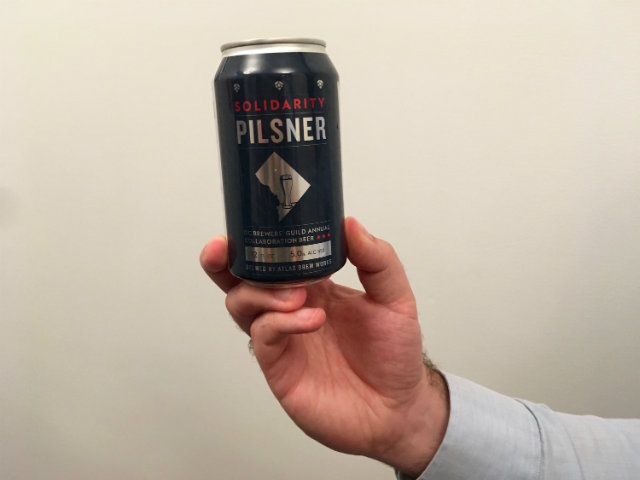
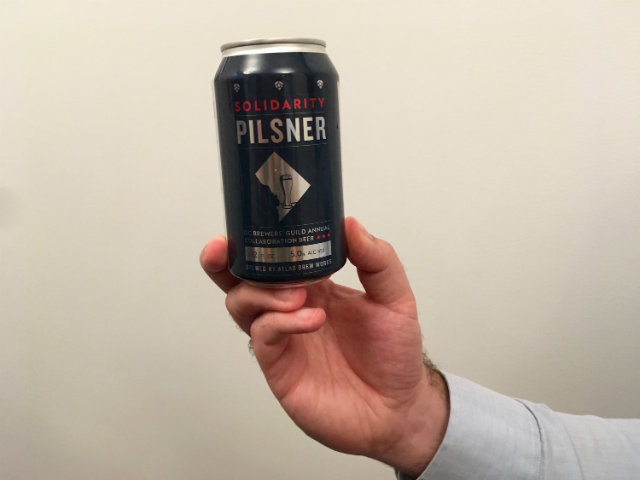 The Atlas Brew Works’ Solidarity Pilsner can, designed by Andy Sides, is one of the beer designs currently on display at the Brewmaster’s Castle in Dupont Circle. (Photo by Mikaela Lefrak/WAMU)
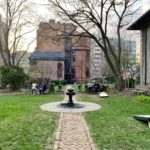
If you walk down New Hampshire Avenue Northwest near O Street, you’ll see office buildings, row houses, and a hulking, chocolate brown brick mansion. This is Heurich House, also known as the Brewmaster’s Castle.
The residence-turned-museum is steeped in the history of beer brewing in the nation’s capital. It’s also the site of a new exhibition celebrating the labels and logos of D.C.’s craft breweries.
The small exhibit is housed inside the mansion’s recently renovated carriage house, which the museum has repurposed as a gallery space. A crowd that skewed millennial and tattooed packed itself in on Tuesday night for a panel discussion featuring some of the exhibit’s artists. Brightest Young Things hosted the event as part of D.C. Beer Week.
It was a vibrant crowd for a museum that often goes unnoticed by Dupont Circle’s office workers and young residents.
“Hopefully that’s happening less often now,” said Kim Bender, the museum’s executive director. Bender is also an expert on the house’s history.
“It’s a time capsule from 1894,” she explained as she walked through its conservatory and into the front hall. Visitors can still see many of the mansion’s 30-plus rooms in their original Victorian state, with intricately carved woodwork, iron chandeliers, and hand-painted ceiling canvasses.
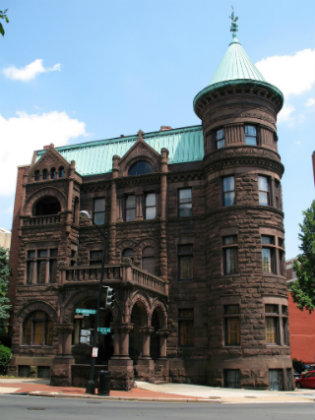 (Photo by Mr.TinDC)
The mansion was built by Christian Heurich (pronounced HIGH-rick), a German immigrant and beer brewer. Heurich earned a fortune from the beer company he founded in 1872: The Chr. Heurich Brewing Co. It soon became the city’s largest non-governmental employer. Heurich operated a massive factory along the Potomac River, where the Kennedy Center now stands.
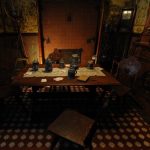
In his mansion’s basement, Heurich built himself a special beer drinking room in honor of the beverage that made him rich. Bender calls it “the original man cave.” She also called Heurich “the first hipster,” because he loved craft beer, sported a well-groomed beard and mustache, and cured meats at home as a hobby.
Heurich decorated his bierstube, or beer-drinking room, with a thick wooden table, like you’d expect to see in an Old World pub. The walls were painted with German drinking idioms: “He who has never been drunk is not a good man;” “There’s room in the smallest chamber for the largest hangover.”
D.C.’s beer industry took a big hit during Prohibition. Heurich’s company survived, but many others didn’t. By the time the Chr. Heurich Brewing Co. closed in 1956, there were no other breweries left in the nation’s capital.
Today, things are very different. Dozens of breweries have opened in and around the District in the past decade. And the walls of Heurich’s old carriage house are now decorated with carefully-framed beer labels.
The designs skew modern, digitally-inspired, and colorful – not really Heurich’s style. Still, you can imagine the old brewmaster would have loved to see how vibrant the D.C. beer scene has become again.
“The Art of Beer” runs through Sept. 29.
This story originally appeared on WAMU.