Rachel Kurzius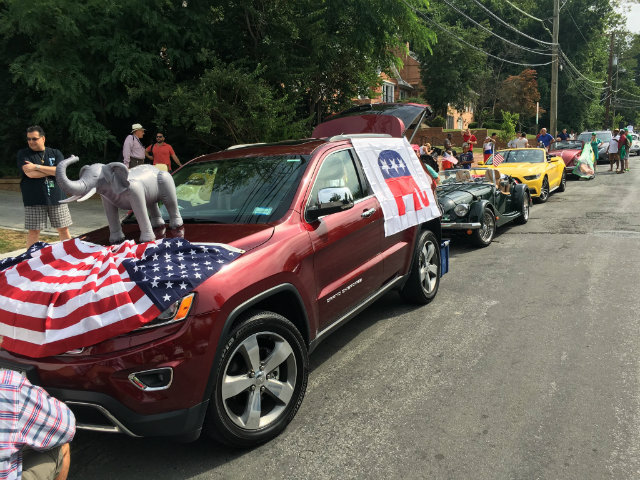
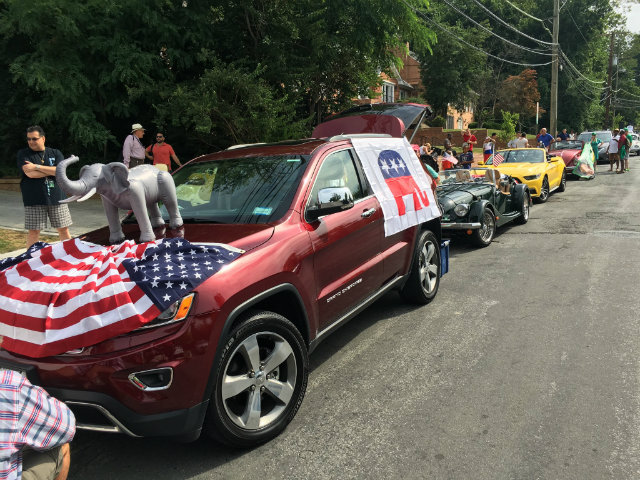 The D.C. GOP “Elephant One” before the annual Palisades Fourth of July Parade. (Photo courtesy of D.C. GOP)
As the D.C. Republican Party fields three candidates this November, the party announced a fundraiser that will feature Sean Spicer, the former press secretary for President Donald Trump.
The September 24 fundraiser has tickets ranging from $150 general admission for an autographed copy of Spicer’s book to $500, which also includes a photo alongside the book. He began his embattled tenure at the dais by lying and shouting at members of the media, and, despite a career in politics that predated Trump, Spicer is now linked closely to the president. A BBC reporter told him he “corrupted discourse for the entire world” earlier during his book tour.
D.C. GOP leadership isn’t concerned that tying the local party to the Trump administration will harm them in a city that leans strongly Democratic, and for which they require significant crossover to win an election.
“Look, Sean has been around this city for a long time. He’s committed to helping grow the party in the District,” says John Fluharty, the executive director of the D.C. GOP. “I suspect that a lot of the folks in that room will have had their own experience with him.”
José Cunningham, the local party chairman, agrees. Because only slightly more than 6 percent of District voters are registered Republicans, “we’re always happy when folks who have a national profile pay attention to us.”
Michael Bekesha, the Republican candidate for the Ward 6 seat on the D.C. Council, says he isn’t sure he’ll attend the fundraiser with Spicer, but he doesn’t object to it. “Like everybody, the D.C. GOP is trying to raise some money and bigger names raise more money,” says Bekesha. “If they use the money they raise to spend money on local issues, that’s a good thing all around.”
In addition to Bekesha, the D.C. GOP is fielding Nelson Rimensnyder in the House of Representatives delegate race against longtime incumbent Eleanor Holmes Norton and Ralph Chittams, Sr. for the At-large council race. There are two At-large seats up for grabs in November, and one of them is reserved for non-Democrats. It’s currently held by Elissa Silverman, an independent.
After Bekesha was the only Republican to compete in the June primary (he won with almost 92 percent of the vote, which equals 661 people), a Washington Post op-ed accused the party of “punk[ing] out.” It said that it was “as if the D.C. GOP has a noncompete clause in its bylaws.”
Cunningham says there were a “number of folks who were considering running … and we’re happy we’ve got some folks now.” He adds that the party knows exactly what it needs to get on the ballot in November, even without competing in a primary.
“You’re not gonna win every race that you run, and we specifically have these three races in mind because we believe we can do extremely well,” says Cunningham. “We think we’ve got a path to winning at least one of these races—there’s no doubt about it.”
While Bekesha admits the numbers for the general election are “daunting”—as of the end of July, Ward 6 has 55,417 Democrats and 7,307 registered Republicans—he takes heart in the results of the 2014 mayoral election. In Ward 6, Mayor Muriel Bowser, a Democrat, beat independent candidate David Catania by 231 votes, and independent Carol Schwartz separately earned 1,653 votes.
“If every single registered Republican [in Ward 6] voted for me, I’d still lose,” he says. “My focus is really to bridge the gap—to not only appeal to registered Republicans but also appeal to registered Independents and Democrats. When you talk about kitchen table issues, the party affiliation doesn’t matter as much on a local level.”
Schwartz and Catania were both elected to the D.C. Council as Republicans (Catania became an independent in 2004), and there haven’t been any GOP councilmembers since Schwartz left office in 2009. The last Republican to win a citywide race was Ashley Carter, who was elected in November 2016 to the D.C. State Board of Education.
Bekesha says he’s “disappointed by the direction the Republican party has taken” on a national level, particularly with respect to social issues, and that’s part of why he’s running. He adds that his wife is a Democrat: “I’m a proud member of a bipartisan marriage that works.”
He moved to D.C. in 2009 after law school for a job with Judicial Watch, a conservative watchdog group, where he still works as an attorney. He thinks a Republican on the D.C. Council would lead to more oversight and accountability. “There’s not much diversity of debate on the council,” he says.
While it’s Bekesha’s first time running for office, Rimensynder has run three campaigns before. He has long argued that D.C. should stop paying federal income taxes to protest taxation without representation.
“As a Republican who believes in Home Rule and voting representation in Congress, I am better able to cooperate and bargain with both sides of the aisle in Congress to advance our cause,” he wrote in his campaign announcement.
Cunningham says that walking down the District streets with Rimensynder, “you can’t imagine the people who recognize him and high-five the guy.”
Chittams, the GOP candidate for the at-large race, garnered media attention after the 2016 election for being a black man in Ward 7 who voted for Trump. He has been active in the local Republican party for decades, and his campaign kickoff event will take place on September 5.
“He’s all about fiscal responsibility and economic viability,” says Cunningham.
Cunningham is hopeful that the influx of young Republicans, both to join the Trump administration and those who work on Capitol Hill, will add momentum to the local party.
“I hear three to four times a week from someone who’s young and decided to register in the District,” says Cunningham, who adds that they want to get involved with the local party.
So how is the D.C. GOP balancing appealing to Trump fans with trying to reach District voters outside the Republican party, among whom the president and the GOP are deeply unpopular?
“I don’t agree that it’s a toxic brand,” says Cunningham. “I’m not so worried about the brand. I’m worried about the issues that face the District of Columbia.”