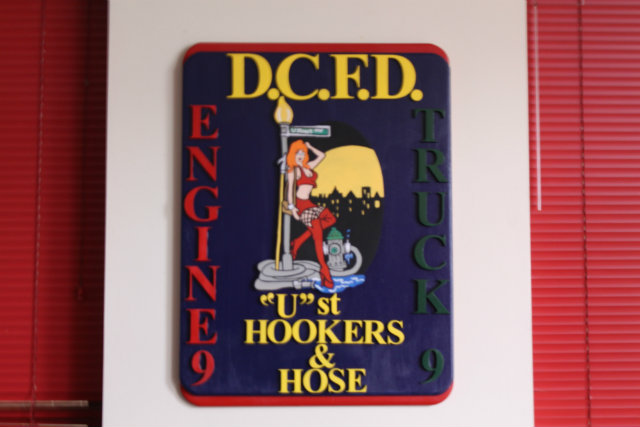
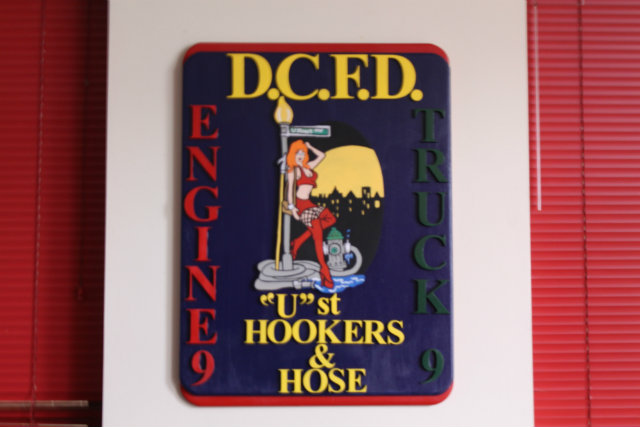
 The “Hookers and Hose” patches from Engine 9 Truck 9. (Photo by Lianna Salva)
By DCist contributor Lianna Salva
Station patches have long been a part of D.C. firefighter culture as a tongue-in-cheek way to create camaraderie and distinguish their unit.
There’s “The Midnight Express” at Engine 16 Tower 3, whose patch has a picture of the Looney Toons character Tasmanian Devil, so named because they are considered one of the busiest stations in the city and work all night.
Engine 28 Truck 14 in Cleveland Park has a “Zoo Keepers” patch with a picture of a buff panda holding a fire hose.
While there’s no official policy, station patches are usually created by a member of the station. Once approved by the rest of the team, the patch is made and distributed to any firefighter in the station that wants it. Sometimes the patches are also sold to the public through the fire station.
But they haven’t all aged well as female firefighters around the country fight gender discrimination.
Look no further than the U Street station, Engine 9 Truck 9, which has four patches. One is a simple design of a red number nine on a black background. Another is a skull with flaming eyes and a tagline that reads “Soul of the City.” A third shows a green number nine with flames, tools, and the tagline “U St. Corridor.” But it’s the “Hookers and Hose” patch that has raised eyebrows.
It shows a woman dressed provocatively in a halter top and short skirt leaning against a lamppost with the text “U St. Hookers and Hose.”
For Engine 9, “Hookers and Hose” is a double entendre. Hoses are used to put out fires with the help of engines, and hooking refers to a technique to find evidence of fire between a ceiling and a roof line.
The patch isn’t just about techniques for putting out fires. It’s also a reference to U Street’s past as a center of prostitution in the District. While most solicitation activity moved elsewhere by the time the patch was created in the late 1990s, it was still something of a joke within the firehouse.
Some neighbors believe that it’s time for the patch at Engine 9 to be retired.
“I get the pun, but I don’t think it’s the most appropriate way to represent the area,” said Shaw resident Jhurney Hairston. “I don’t think they should use it.”
And at this point, they largely don’t. “With how things have changed in the world and in the city, we don’t wear that patch on any fire department uniform,” said Engine 9 Truck 9 Lieutenant Tim Gross. Until February, though, the patch was the station’s profile picture on Facebook.
Firefighting is still largely a man’s world. According to the National Fire Protection Association, only 7.3 percent of firefighters in the U.S. are female. In D.C., that number is slightly higher: 9.2 percent of firefighters are women, according to D.C. Fire and EMS Public Information Officer Vito Maggiolo.
“The fire service is a culture built on networks and it’s a male dominated culture,” said DCFEMS Chief of Staff Amy Mauro, who says the agency has taken steps of late to change that.
Among them, DCFEMS recently finalized a new sexual harassment policy, and has provided sexual harassment training to 1,000 employees, per an order from Mayor Muriel Bowser in December 2017 requiring all city employees to undertake such training.
But even before the updates, the DCFEMS sexual harassment policy already prohibited “the display of sexually suggestive objects.”
Fire station patches are frequently kept to the members of the stations, and are generally approved by the station’s captain.
That was why, when first interviewed about the patch in December of 2017, DCFEMS Diversity Manager and Sexual Harassment Officer Kim McDaniel expressed surprise. No one at the chief’s office knew the patch existed, she said.
The “Hookers and Hose” patch was designed and approved by an Engine 9 captain in the late 1990s, but if it were submitted today, McDaniel said that it would not pass muster. “As a diversity officer, I don’t like it,” she said.
Within a week of learning about the “Hookers and Hose” patch, McDaniel said that the chief’s office examined the official and unofficial station patches of all 33 fire stations in D.C. She said they decided to remove the “Hookers and Hose” patch from the Engine 9 Truck 9 Facebook page and the fire station. The picture of the patch still remains on the Facebook page, though it is no longer the profile picture.
But not everyone is offended. Engine 9 Truck 9 Firefighter and EMT Heather Hardesty, one of three female fighters at the station, finds the patch “hilarious.” Hardesty said that, because the job of a firefighter is physically and emotionally draining, a dark sense of humor is the norm in the fire station.
Hardesty has been at the station for 15 years and is currently in the process of taking the promotions exam to become an officer.
“I don’t expect the department to change for me one bit because I’m expected to do the same job as the men standing out there,” she said.
Still, some DCFEMS officials acknowledge that it’s more difficult for women to become officers.
“When you have a culture and a history of leadership positions being occupied by men … the members coming up through the ranks are more likely to be mentored by associates, friends, family members, people who are already in leadership positions,” Mauro said.
“What we try to do is put women in the same position who may not have that historical association with male leaders in the department to get the same level of access they otherwise wouldn’t have.”
That’s the impetus behind the Empowering Women to Lead initiative, a mentorship program for D.C.’s female firefighters to learn more about the requirements to become officers, which began in 2016.
As part of the initiative, 10 female firefighters from throughout the District went through a one-year rotation throughout various divisions of the department. They also attended lectures and networking events.
Mauro and McDaniel hoped for the highest number of women yet to take and pass the promotions exam which started in April of this year. Results from the exam will be released in October.
In May of this year, Fire Chief Dean promoted two female captains to battalion fire chief, the first women to hold that role in six years according to Mauro.