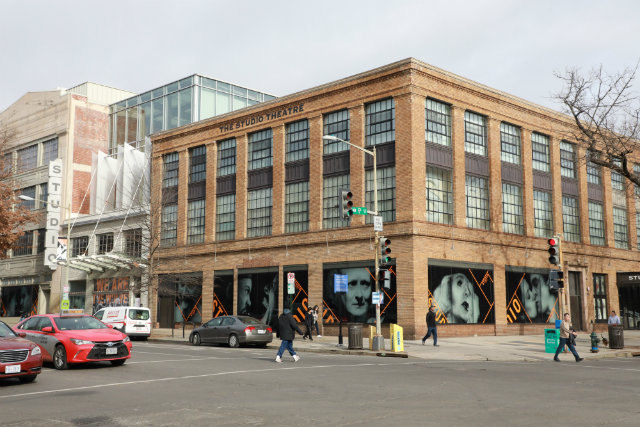
 Studio Theatre celebrates its 40th anniversary this year. (Photo courtesy of Studio Theatre)
When Studio Theatre opened in 1978, D.C.’s theater scene was just germinating: There was Arena Stage and the Lincoln Theatre, but many of today’s standouts hadn’t yet been born. Woolly Mammoth Theatre Company, for example, opened two years later in 1980; Shakespeare Theatre Company in 1986.
Studio Theatre opens its 40th season this week with Steven Levenson’s If I Forget, a D.C.-set family drama. It explores gentrification, the idea of home, and cultural identity, all centered around a piece of property on 14th Street. It’s an example of the kind of understated contemporary work that Studio has made its niche in its 40 years as one of D.C.’s oldest and most prestigious theater companies.
“There’s a certain restless spirit, a sense of not wanting to rest on our laurels,” says David Muse, the company’s artistic director since 2010. “I think for many years, Studio has brought to Washington many of the most outstanding contemporary plays of the day—and there weren’t always a whole lot of theaters in town that were concentrating on that kind of work.”
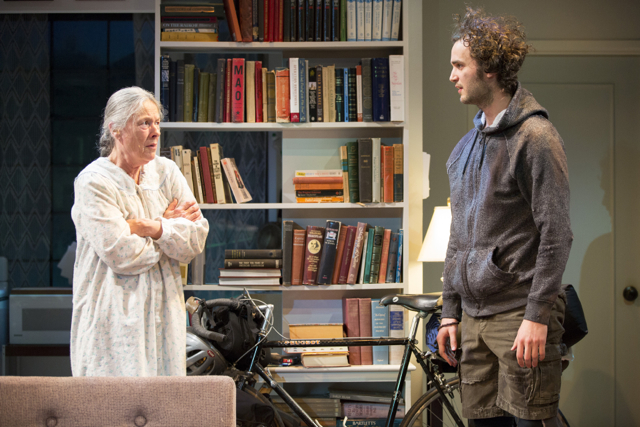 Tana Hicken and Grant Harrison in 2013’s “>”4000 Miles” (Photo by Scott Suchman)
The Building
Founding artistic director Joy Zinoman opened Studio Theatre in 1978 on Rhode Island Ave NW; it moved to a nearby 100-seat theater in 1980, where it remained until 1987. That’s when it opened in its current location at 1501 14th St. NW (Zinoman, who retired in 2010 but remains involved with the theater, was traveling overseas and unavailable for an interview for this article.)
In 2004, the company renovated two adjacent buildings, expanding it into a four-theater enterprise. “The building sort of evolved in pieces, so a lot of our milestones are architectural,” Muse says.
Today, Studio Theatre spans half a city block and houses three fixed-seat theaters—the Mead, Milton, and Metheny—and Stage 4, which can be configured in a variety of ways. That’s where most Studio X shows, which tend to be experimental and immersive, happen. None of the space’s theaters accommodate more than 200 people. Compare that to Woolly Mammoth, which seats 265, and Shakespeare Theatre Company’s smaller Lansburgh Theater, with a capacity of 451. Arena fits 202 patrons in its smallest space; its two larger theaters accommodate 510 and 680 seats.
“You’re very close, so it’s very real on that level,” says director of design Deb Booth, one of the 30-plus full-time employees at Studio. “An audience member is really right on top of everything, so you don’t just fake the scenery. We use a lot of real materials because it’s got to feel right.”
Just like Studio has evolved in the past 40 years, so too has its Logan Circle neighborhood. Booth, who joined the company in 2001, recalls that in the early days, the production team was warned not to walk home alone after shows. “It was still a dicey neighborhood,” she says. “We were told to certainly not walk alone at night, but even day time was a little iffy.” Frequent audience members still like sharing stories about the way they made plans to travel home together after a show, Booth says.
Costume shop manager Brandee Mathies points out that only about four of the businesses that were in the neighborhood when he joined the company in 1997 are still there. “It’s nice seeing 40 years of an institution that’s been around since before this area took off,” he says. “The neighborhood … wasn’t as friendly then, but [Studio] got people to come over to this area to see shows and do something different.”
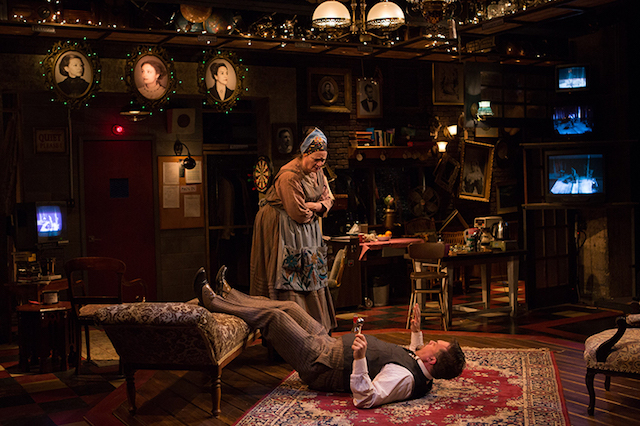 Nancy Robinette and Ryan Rilette starred in 2017’s “No Sisters” at Studio. They also performed in Chekhov’s “Three Sisters,” which played downstairs at the same time. (Photo by Teresa Wood)
The Shows
There are 80-some theater companies in the District, of all sizes, and Booth notes that almost each one has its own niche. When the company is considering shows, the team will often say “that’s more Woolly’s territory,” or “that’s more Signature than what we would do,” she says. Woolly leans toward wacky, over-the-top shows, while Signature leans toward musicals, Shakespeare does the classics, and Arena is the land of big, often Broadway-bound productions.
That leaves Studio with the high-quality contemporary shows. Muse’s tenure as artistic director has only elevated the theater’s standards, Booth says, attempting to articulate “the David Muse aesthetic.”
“It’s very focused and highly detailed, and it’s definitely on the cool side of things,” she says. “But there’s always this human element, and a sort of tension—an emotion that’s trapped or examined in a cool setting.”
Studio produces up to 450 performances of eight to 10 productions each year, all under two umbrellas of programming: The Main Series—which this year includes Molly Smith Metzler’s Cry It Out and Queen of Basel from rising playwright Hilary Bettis—and Studio X, which features bold, often experimental works, like The Fall, written by University of Cape Town student activists.
Even through two artistic directors—Zinoma and Muse—the theater’s approach has remained consistent, which is impressive, says Amy Austin, CEO and president of theatreWashington, an organization that supports D.C.’s local theater community.
“You’ve always gotten these very intimate, contemporary theater experiences,” she says. “Even though David may choose to produce, say, more European work than Joy did, you still have that contemporary flair and richness of the experience.”
When Muse reflects on what makes a Studio show a Studio show, he uses words like “sophistication” and “style.” The company is known for its focus on contemporary works and realism. It’s a place where “you can look to figure out who the most exciting contemporary dramatists are,” Muse says.
None of Studio’s staffers will name a favorite show—it’s like picking a favorite child, they say. But they’re happy to reminisce about some of the most fun, daring productions. Booth describes Privates on Parade, a campy British musical play Studio staged in 2002 about a mostly gay military entertainment group. “We had to do a monsoon on stage—it was literally raining everywhere on stage, and then you had to clean it all up,” she says.
And the first show she worked on in 2002, Hambone by Javon Johnson, took place in a diner. Booth still recalls the grill the performers fried onions on—the whole audience felt like they were in the diner. “I hadn’t done many truly realistic shows at that point,” she says. “It was a lot of fun.”
Muse grows especially animated describing the Studio X performances in Stage 4. He points to 2014’s Murder Ballad, when the company turned the stage into a fully operational dive bar, and audience members could come early to hang out and buy a drink. Another, 2016’s Hand to God, was set in a Texas church basement and featured a “possessed sock puppet,” so attendees could visit a table with craft supplies beforehand to make their own sock puppets.
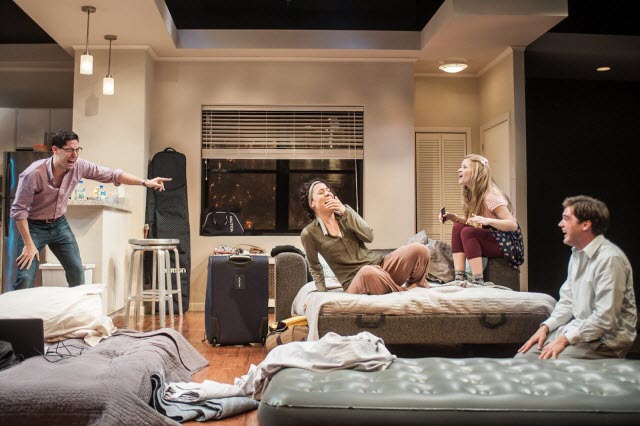 Alex Mandell, Irene Sofia Lucio, Maggie Erwin, and Joe Paulik in “Bad Jews” in 2014. (Photo by Teddy Wolff)
The Legacy
Austin lauds the community and especially the facility Studio has built. “It’s one of my favorite places” to see a show, she says, noting that she and her now-wife went on their first date at Studio. “There’s this real connection to the stage you feel.”
It’s perhaps no wonder, then, that Studio has developed a loyal audience over the years: Booth says it’s not unusual to see season ticket subscribers who have been coming to the theater for 20 or 25 years, paying about $235-$380 per year just for Studio’s works (tickets to each show can range in price from about $20-$90).
In Studio’s next 40 years, there will certainly be more innovation—but don’t expect 500-person theaters.
“One of the unique things about Studio is that as the audience grew, [the founders] continued to build theaters that they kept all the same size,” Muse says. “Almost always, when a theater is on a growth trajectory, they build a larger venue. And Studio just felt like, that’s not what we do. What we do is deliver great drama and give it to people right on their laps.”