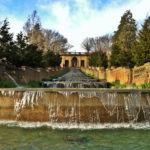
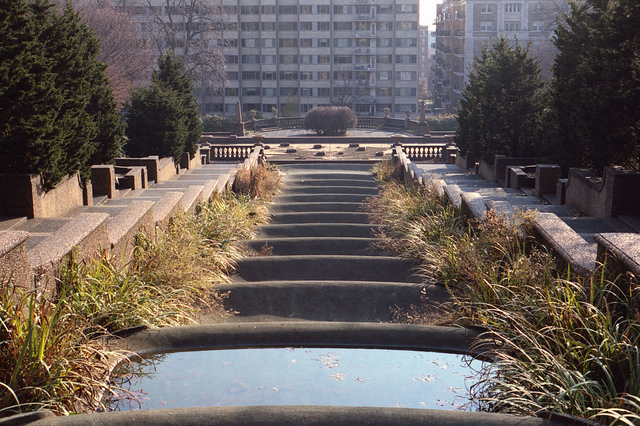
 The dry cascade at Meridian Hill Park. (Photo by Julian Ortiz)
The fountains at Meridian Hill Park are off, again, due to a leak in a pipe that provides water to the cascades. The good news is that work is underway to repair them, but residents are beginning to wonder just how frequently they’ll have to stare at an empty concrete basin.
“It feels like they continually have a challenge with a pump or broken water line,” says Lauren Wolkoff, a resident who has lived near the park for three years. Her best estimate is that the fountains are on for “a month or two” at a time, at most.
The National Park Service, which oversees Meridian Hill Park, also referred to by locals as Malcolm X Park, wouldn’t provide numbers to back up Wolkoff’s claim. But it’s true that the fountains are off very frequently—in recent years, it seems, every summer has had some sort of issue.
Residents “formed a neighborhood fountain watch” to alert NPS when the fountains went dry, The Washington Post reported in 2017. In 2016, a broken pump delayed the opening of the fountains until August—and then was promptly shut off again just days later. And so on.
The latest concern sprung from a leak in the line that supplies water to the fountain, a pipe that actually runs under the historic concrete of the fountain. Contractors responsible for the repair planned on cutting through the fountain, patching the leak, and repairing the historic concrete. But when they located the source of the leak, they also discovered that the leaky pipe is made of cast iron rather than more durable ductile iron.
Rock Creek Park’s deputy superintendent Mike Young tells DCist that the Park Service would like to replace all 90 linear feet of the cast-iron pipe, even though that is adding significantly to the cost and timeline for the project.
“No one wants to revisit this,” he says. “This [repair] is very expensive. The concrete … is historic … so we’re looking to take care of this once and for all.”
Acting Public Affairs Specialist Dana Dierkes adds in an email that the new pipe is expected to last at least 100 years. The park service is “in negotiations with the contractor and expect the work to proceed and be completed in the coming weeks.”
Even before the recent break, the cascades already took up half of the budget for the National Park Service division that maintains Meridian Hill Park, the Post reported in 2016.
That’s not even the end of the fountain’s troubles. The repair work won’t cover the dry fountains at the top of the terrace near the Joan of Arc statue. Those have been off for a while due to a separate waterline break. NPS has a “proposal” in for funding for those repairs, Dierkes says.
The fountains at Meridian Hill Park are a true marvel (again, when they’re on). The Italian-style cascading fountain just south of the Joan of Arc statue (and just south of where, on Sunday afternoons, the famous drum circle gathers) is the longest in North America. The “exposed aggregate” concrete that makes up the fountain uses a then-new technique invented by John Joseph Earley, a builder, and National Institute of Standards and Technology scientist Joseph Pearson.
Earley painstakingly harvested pebbles from the Potomac’s riverbed and sorted them by color and size before adding them to the concrete and scraping off the top layer of concrete as it cured to expose the rock, a technique that earned him the approbation “the man who made concrete beautiful.”
All that beauty means “it’s hard to watch it be in disrepair,” Wolkoff, the nearby resident, says.
The fountains at Meridian Hill Park are of course not the only D.C. fountain that has had problems in recent years.
The Columbus Fountain outside Union Station needs $10 million before it can be turned on. The Andrew W. Mellon Fountain near the National Gallery of Art was dry for eight years until NGA successfully petitioned the Park Service to give the gallery control of the fountain. A 2016 investigation by NBC Washington found that 40 percent of the water features maintained by the National Park Service on the Mall were not working because they are too expensive to fix. Fountains maintained by other institutions, such as the Smithsonian, are also often off or dry, as well. For instance, the Delta Solar sculpture near the Air & Space Museum is supposed to sit in a shallow pool. It hasn’t been filled with water since 1995.
It comes down to money. The Park Service told the Post in 2016 that because of budget issues, “every time we have a [discussion about] a new memorial … we will discourage water features.”
NPS has a deferred maintenance list of $11 billion. Rock Creek Park, which covers Meridian Hill Park, has its own deferred maintenance list, totaling nearly $70 million.
Bipartisan groups in both the Senate and House have introduced bills to direct $6.5 billion towards parks maintenance over the next five years, but neither bill has made much progress.
For now, neighbors of Meridian Hill Park may have to resolve themselves to the idea that the fountains will be dry for a little longer. Soon, it’ll be cold enough that NPS will have to empty the fountains for winter.