Jacob Fenston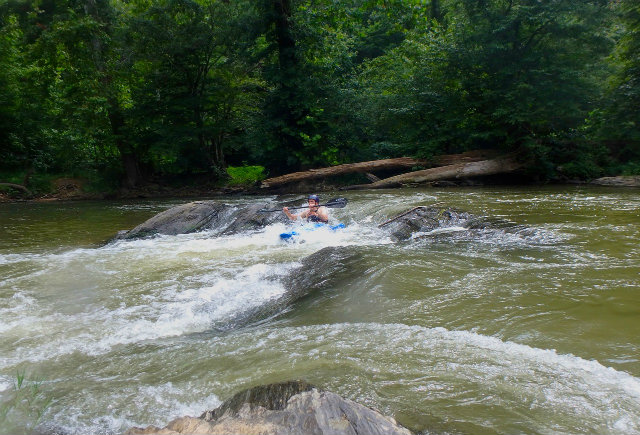
 Canoers on the GW Canal. (Photo courtesy of the Canoe Cruisers)
Plenty of people are after President Trump. There’s Robert Mueller and his “angry Democrats,” there’s Stormy Daniels and her tell-all book. But the president has yet to face the powerful Washington canoe lobby.
Thursday morning, a local paddling group filed a lawsuit against the Trump administration over a restrictive security zone along the Potomac River adjacent to the Trump National Golf Club in Loudoun County.
“The concern is river access,” says Barbara Brown, chairman of the Canoe Cruisers Association, a local group of about 250 canoers and kayakers, who frequent the Potomac, especially the section near Trump’s golf course.
Since Trump’s inauguration, he has visited the course dozens of times. Each time, the Coast Guard restricts access to the river. In July 2017, the Coast Guard announced a new policy — a permanent security zone, from shore to shore along two miles of the river, allowing a quick closure of the entire section, any time Trump or another high ranking official was at the golf course.
According to the rule published in the federal register at the time, the purpose was “to protect high-ranking United States officials and the public, mitigate potential terrorist acts, and enhance public and U.S. navigable waterway safety and security.”
“The whole thing seems absolutely silly, actually,” says Matt Markoff, who runs Calleva, an outdoor education organization based right across from the golf course, on the Maryland side of the Potomac. “I can completely understand and respect security and the need for security for the president,” says Markoff.
But, he says, it’s pretty apparent his canoe groups of kids are not a threat.
“We’re a human-powered boat, and we’re getting forced off the river like we’re a threat. It just seems so funny, because you can see us coming for a half an hour, and there’s kids singing songs,” Markoff says.
When the new rule went into effect suddenly last summer, there was an outcry from canoers and kayakers. Two weeks later, the Coast Guard announced a change. At a congressional hearing, Coast Guard Commandant Admiral Paul Zunkunft told lawmakers the Coast Guard had listened to paddlers and would make an accommodation.
“As long as they stay to the Maryland side of the Potomac River, they can pass clearly when the security zone is in effect,” Zunkunft said at the hearing.
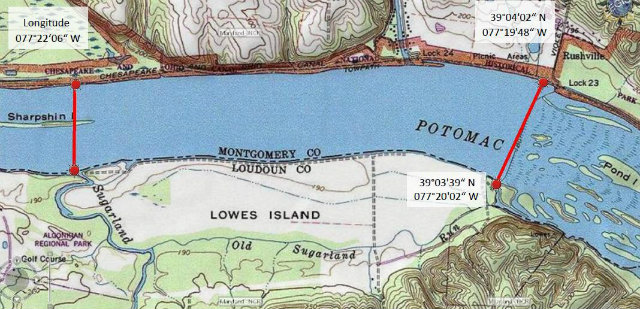 The current security zone put in place by the Coast Guard. (Courtesy of the Canoe Cruisers)
But according to the Canoe Cruisers, access has still been severely curtailed. They’ve had to cancel events and reschedule regular paddles. And, according to Barbara Brown, the Coast Guard has forced people into dangerous situations at Seneca Breaks, just below the security zone.
“We have had multiple instances, some very serious, where the Coast Guard has insisted that the paddlers have had to go over the breaks, which is a whitewater dam,” Brown says.
The lawsuit alleges the Coast Guard didn’t follow proper procedure when rolling out the security zone rule. Democracy Forward, a legal non-profit, is representing Canoe Cruisers.
“They’re required to provide 30-days notice prior to implementation of the rule, and to ensure that the public has an opportunity to provide comments on the proposed rule,” says Nitin Shah is an attorney with Democracy Forward.
Instead, Shah says, the rule was put into effect with no notice, and while there was a post-implementation comment period, the Coast Guard never responded to the comments or revised the rule.
According to the lawsuit, 636 comments were filed, all of them expressing concern with the security zone.
Canoe Cruisers wants the Coast Guard to change the rule, shrinking the security zone to leave free passage on the Maryland side of the river.
“We’re not trying to make trouble,” says Barbara Brown of Canoe Cruisers. “We just want the river to have the access that it should have.”
Matt Markoff, who isn’t part of the lawsuit, says the biggest problem is that there is no notice when there’s a closure. He’ll send boats out, only to have canoes filled with kids forced off the river. “I just hope they return the public land back to the public,” he says.
Previously:
Coast Guard Reverses Course, Says Potomac River Will Be Accessible To Paddlers During Trump’s Golf Outings
Given Trump’s Golf Habits, The Coast Guard Plans To Cut Off Potomac River Access
This story originally appeared on WAMU.