Martin Austermuhle
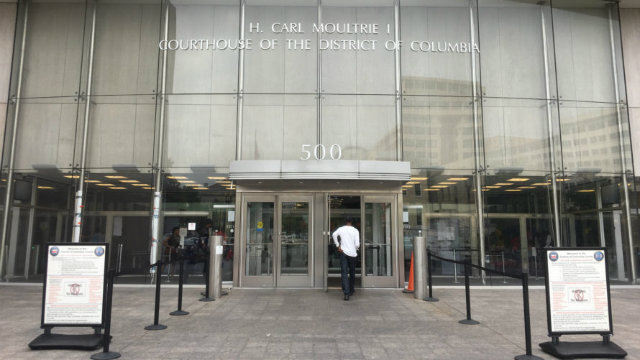 Superior Court is D.C.’s local court, but it is federally funded and operated — and staffed by the U.S. Marshals Service, instead of a sheriff’s office as in many counties in the region and country. (Photo by Martin Austermuhle / WAMU)
When D.C. resident Benjamín Ordoñez was arrested for allegedly stealing $200 and five gold rings out of a bag in a hotel lobby in late August, he could have expected to be charged and quickly released pending a trial — like most people accused of non-violent crimes.
But that never happened. Instead, Ordoñez, a 34-year-old Guatemalan national who has lived in the District for 15 years, was taken into custody at D.C. Superior Court by Immigration and Customs Enforcement and sent to a holding facility in Norfolk, Virginia, where he is awaiting deportation.
That this happened in Washington has angered immigration advocates, who say D.C. — which officials have declared a ‘sanctuary city’ — has fallen short on resisting ICE. But it also highlights a distinct gap in D.C.’s sanctuary’s status that is beyond the city’s control: Superior Court itself.
Although it serves as the District’s local courthouse, Superior Court is funded by the federal government and staffed by the federal U.S. Marshals Service (USMS) — the only such arrangement in the country. Elsewhere, county sheriffs operate in the courts. In many counties in the Washington region, those local sheriffs also limit their cooperation with ICE, especially when it comes to people charged with non-violent offenses.
While under current policy the D.C. police officers who arrested Ordoñez would not have inquired about his immigration status, the federal Marshals at Superior Court can — and do.
“The USMS detains individuals in its physical custody who are wanted on ICE detainers for an ICE agent to respond and take custody of the individual,” said Robert Brandt, the chief deputy of the U.S. Marshals Service at Superior Court, in an email. “This is not a new policy.”
An increase in detentions
Claudia Cubas, the litigation director at the Capital Area Immigrants’ Rights Coalition, says that Brandt is right. But, she adds, the number of D.C. residents being detained has increased in the past two years.
“In 2016, we saw probably no more than 40 residents who reported coming into ICE custody, and some of them did report, ‘I was picked up by U.S. Marshals’ or ‘I was picked up in court,’” said Cubas. “In 2018, we are seeing upwards of 70 people, and we are not even done with the year.”
“I spoke to a gentleman earlier this year who was charged with something as innocuous as disorderly conduct and it was no-papered. That means the prosecutor specifically said they wouldn’t go forward on charging him formally, and he related being picked up by U.S. Marshals,” said Cubas.
The increased enforcement stems from President Trump’s focus on undocumented immigrants. According to its 2017 annual report, as of Trump’s first year in office, the U.S. Marshal Service “began providing ICE with booking data on all foreign-born detainees to better facilitate the identification, detention, and removal of criminal aliens.”
“To meet this data exchange requirement, USMS developed an automated process to securely transmit detainee data real time to ICE,” reads the report. “Since the commencement of this data exchange, the agency has transmitted more than 32,632 records to ICE.”
That data includes data from D.C. Superior Court and every federal court where ICE operates. Brandt said he did not have the specific number of people detained at Superior Court and turned over to ICE.
While in the past, the Marshals and ICE may have not prioritized detaining non-violent offenders like Ordoñez, an ICE official speaking to WAMU on background said the agency “no longer exempts classes or categories of removable aliens from potential enforcement.”
In Ordoñez’s case, his friends say he was caught off guard that a relatively minor crime would land him in ICE custody.
“He was astounded,” said Ayla Bailey, who knows Ordoñez and recently visited him the Norfolk jail where he is being held. “D.C. is supposed to be a sanctuary city, so the fact that he had an ICE detainer and it was honored by the D.C. court and that he was taken away by ICE was a bit of a shock to him.”
A complicated relationship
The murky nuances in how D.C.’s justice system operates — and the bifurcation between local and federal control — in part explains why immigration advocates initially accused D.C. police and Mayor Muriel Bowser for turning Ordoñez over to ICE.
In a letter that so far has been signed by more than 850 people, the advocates said Ordoñez’s detention “goes directly against Mayor Muriel Bowser’s promises that the D.C. police do not cooperate with ICE, and that D.C. is a sanctuary city.” The letter demands that Bowser “fulfill her pledge to make D.C. a sanctuary city by defending our community against ICE and bringing Benjamin back home.”
It’s not the first time they’ve accused Bowser and police of cooperating with ICE: in July, advocates protested the arrest of at least a dozen undocumented D.C. residents, saying Bowser should do more to resist ICE.
But D.C. officials say their hands are tied. They say they are frustrated by the fact that the city’s sanctuary policy stops at the courthouse door, but they concede there’s little they easily can do to change that.
“If you go to just about any other city or state and you look at the court marshals, you look at the supervision system, the prosecution system, and if someone were to follow the lines on the [organizational] chart, it generally leads to someone who was elected by the people,” said Kevin Donahue, D.C.’s deputy mayor for public safety and justice.
“If you come to D.C. and follow the same lines on the org chart, it leads to a national politician that got four percent of the vote in D.C., and that has consequences,” he added, referring to Trump.
Bailey, Ordoñez’s friend, says D.C. should consider taking over its court system from the federal government.
“They should be looking for a way to revive the D.C. system so they can actually honor the spirit of sanctuary if they feel like they can’t now with the current system,” she said.
That’s a laudable goal, says D.C. Council member Charles Allen (D-Ward 6), who chairs the Council’s judiciary committee — but one that’s easier said than done.
“To achieve the control of our judiciary and our courts, it will take years of a process and will take hundreds of millions of dollars to be able to do that. It is absolutely a goal we need to aspire to, but it will also take time,” Allen said. “And the crisis we are seeing is now.”
“A place where there is justice and fairness”?
Cubas has two possible solutions of her own.
“Perhaps for these low-level offenses there’s a way to decriminalize those offenses so they’re just violations, and that way we reduce the involvement of the criminal justice system. Additionally… help those people obtain representation, because once they’re in removal proceedings, those people need lawyers,” she said.
The Bowser administration has given out almost $1.5 million in grants to organizations that provide legal services to immigrants — but that money is not used to help pay for attorneys for residents already detained by ICE and slated for deportation.
In the meantime, both Allen and Donahue say they worry that the Marshals’ cooperation with ICE could raise concerns within the city’s immigrant community.
“The courthouse is supposed to be the place where there is justice and there is fairness, and if you have any part of your community that is afraid to set foot in a courthouse, it’s deeply troubling,” said Allen.
Alhough Ordoñez is accused of theft, Bailey says a possible deportation from the city he has called home — and proudly boasts of its status as a sanctuary city — would be too great a punishment.
“It’s not a situation that I want to see anyone in, much less for an alleged crime that is a misdemeanor and becomes a reason to uproot someone’s entire life and potentially deport them from the community they have spent their entire adult life in,” she said.
“He has made family here,” she added. “To have him deported, for me, is profoundly impactful.”
This story originally appeared on WAMU.