Martin Austermuhle
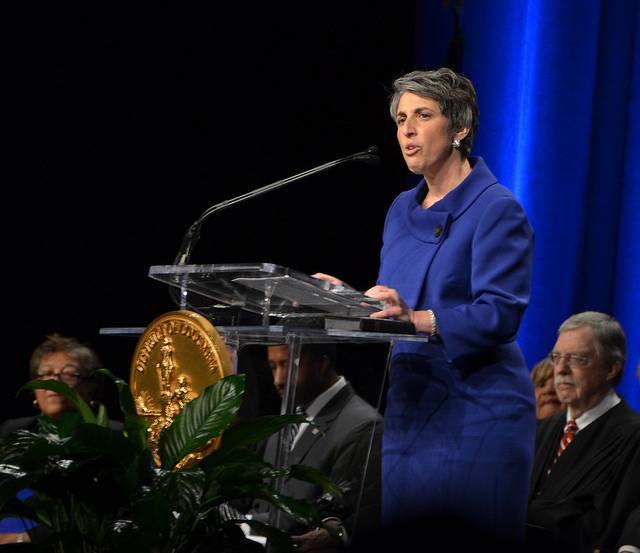 At-large Councilmember Elissa Silverman at her swearing-in ceremony in 2015. (Photo by Adam Fagen)
D.C. Mayor Muriel Bowser said Friday that she chose to endorse Dionne Reeder, who is challenging incumbent Council member Elissa Silverman (I-At Large), because Silverman is not “collaborative” and has used D.C. as a “petri dish” for laws pushed by national groups.
The criticisms made on WAMU 88.5’s “The Politics Hour” mark Bowser’s first public comments since she decided this week to throw her weight behind Reeder, a businesswoman who owns the restaurant Cheers at the Big Chair in Ward 8.
Bowser hosted a private fundraiser for Reeder on Thursday evening, who according to an August fundraising report was down to $4,500 in campaign funds.
“The big thing we have to focus on is making sure candidates can demonstrate they have an open mind on the issues, that they are collaborative, and that are D.C.-focused, really focused on how every penny that we spend of taxpayer funds are improving the lives of D.C. residents,” said Bowser on qualities she said she looked for in Council candidates, “especially an At-large member.”
This is the first time Bowser has endorsed a challenger in a Council race. And even when she openly supported incumbents, more often than not they have failed to win their own races. In 2016, Vincent Orange (D-At Large), Yvette Alexander (D-Ward 7) and LaRuby May (D-Ward 8) all lost to challengers, despite having Bowser’s backing.
And before she decided to endorse Reeder, Bowser and many in the business community had actually thrown their support behind S. Kathryn Allen, a former D.C. government official. But Allen’s campaign imploded earlier this month because thousands of signatures it had submitted to get on the November ballot were found to have been fraudulent.
In an interview with WAMU after the show aired, Silverman rejected Bowser’s claims that she isn’t collaborative or open-minded. Silverman pointed to her position on Initiative 77, which was approved by voters in June and increases the minimum wage paid to tipped workers to $15 by 2026. Bowser opposes the initiative, and a majority of the Council’s members are considering repealing the initiative. But Silverman said she has kept an open mind about it all along.
“I have taken from the start a position that I had concerned about the implementation timelines,” said Silverman. “No one can put me in a box on the initiative because I want to make sure workers are paid fairly but I heard the concerns from restaurant workers.”
Bowser also took aim at the paid family leave law Silverman helped write and was passed by the Council in late 2016, saying that it was pushed by national groups seeking to use the city as a “petri dish” for their causes.
“We have to be careful when national groups come into D.C. to move national legislation to demonstrate to the rest of the world that it can be passed,” said Bowser. “In many cases, that can be a good thing. Sometimes that puts us out on the cutting edge little bit too far. In the case of paid family leave… what is problematic is that the legislation that the Council passed requires us to send $150 million to Maryland and Virginia residents.”
That refers to the fact that the paid family leave law — which is funded by a 0.62 percent payroll tax on private employers — applies to any worker in the city, whether or not they live here.
Reeder has also been critical of the paid family leave program, which takes effect in 2020.
But Silverman said the paid leave proves that she is collaborative and open to debate — she said the measure was discussed over the course of two years, and passed the Council with a super-majority of votes. And she said that no one used D.C. as a petri dish for national causes.
“We are one of only three countries that does not have a paid leave. And given that there is dysfunction at the federal level, states are looking at implementing paid leave because they know there’s a benefit,” she said.
Silverman also says that D.C. can’t avoid taxing local employers to pay for the program, since the Congress prohibits the city from directly taxing commuters. And she says that for all the complaints about the paid family leave program, no workable alternatives have been presented.
“What is the alternative?” she asked. “Because we’ve had three years to look at alternatives.”
In an interview after appearing on “The Politics Hour,” Bowser did not identify what alternative paid leave program she would support for D.C.
Bowser said that her decision to back Reeder was not about whether she liked or disliked Silverman, who she did not refer to by name — “Like in politics is irrelevant,” she said — but instead came down to the values of collaboration and open-mindedness.
“I think I have an obligation to let people know that I think that’s missing,” she said.
But Silverman rejects any claim that she’s failed to work with Bowser during her first term. As for pushing back on the mayor or asking questions of her administration’s officials, Silverman says it’s never personal.
“I don’t think that I am disagreeable. I disagree, but am not disagreeable,” she said. “It is an unfair characterization the mayor makes.”
Other than Silverman and Reeder, the ballot for two At-large seats on the Council also includes Democratic incumbent Anita Bonds, Republican Ralph Chittams, David Schwartzman from the Statehood Green Party, and independent Rustin Lewis. Voters get to choose two candidates.
This story first appeared on WAMU.