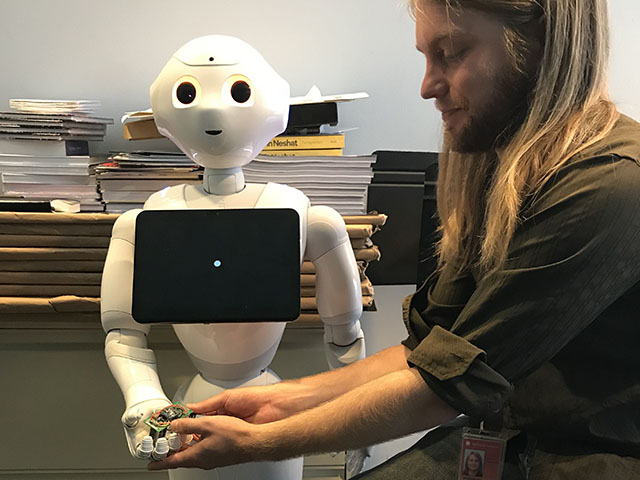
 Ian McDermott (right) demonstrates the sensor with which Pepper the robot will translate art into music (Pat Padua)
Adorable robot overlords launched a benign takeover of the Smithsonian campus in April. Called Pepper, these four-foot, big-eyed exemplars of artificial intelligence, donated by San Francisco tech company Softbank Robotics, were rolled out at six museums to help provide basic information, encourage visitors to engage with art, and even dance.
Kristi Delich, deputy director of the Office of Visitor Services at the Smithsonian is happy with the increased attendance surrounding the robot launch. She also explains that, while the Peppers have performed their duties as programmed, they have provided some surprises as well. “There’s this whole other level of capability … that we discover in Pepper every day.”
Part of that next level is making music.
Ian McDermott, an ArtLab educator at the Hirshhorn who’s taken the lead on the Pepper program, demonstrated this capability, which will be unveiled on September 22 during Technology Family Day at the Smithsonian American Art Museum.
Visitors will engage with SAAM collections with the help of Pepper, who will make electronic music that is literally fueled by art.
How does this work?
McDermott has programmed Pepper to hold a sensor in its hand, which the robot will run over a tablet built into its electronic torso. The tablet will display items from the museum collection and transform the color data into a number value, send that data through a modular synthesizer system, and voila: music.
“The sound inevitably will reflect in some capacity the painting itself,” McDermott says. “It becomes a communication between me and the robot and other people’s emotions.”
Emotions?
Pepper can detect five emotions: anger, happiness, neutrality, sadness, and surprise. Most of which I exhibited during the demonstration.
Pepper can also make pretty decent music. McDermott notes that the musical variables are set by him, including a basic pulsing signal that he describes as “pretty crude.” Testing a handful of wildly different images, which McDermott called up on a laptop and scanned with Pepper’s sensor, the musical difference wasn’t that jarring from artist to artist:
Mark Rothko: On top of the basic looping pulse, Pepper emitted a contented drone as suits the meditative nature of the work. When the sensor passed among different Rothkos with different color values, the speed and timbre of that drone subtly shifted.
Jackson Pollock: The musical segue was subtle; the drone became more booming, and was not at all the chaotic free-form music one might expect from a musical interpretation of Jack the Dripper.
Thomas Kinkade (my request): McDermott called up a relatively dark image from the Painter of Light.This didn’t seem to faze Pepper, whose music added a few melancholy notes and what I heard as a slight raspberry, which suggests that this artificial intelligence has the capability of critical judgement as much as data interpretation.
The musical programming leans toward ambient. “Because you’re working with such an organic thing that you can’t totally predict. Ambient is an easy route that you can control to sound decent and not make everybody want to leave the room.”
I don’t know about you, but I’d be happy to attend a concert performed by an army of Peppers. Yet they raise certain questions. With the Smithsonian American Art Museum hosting work by artist Trevor Paglen, whose photographs of the National Security Agency and other government institutions addresses our culture of surveillance, is it perhaps ironic intelligent robots, however benevolent and cuddly, have descended upon Washington? Isn’t a robot that can read our emotions kind of next level weird?
“Definitely,” says McDermott. “To me, being deeper in, technically it’s a bit worrying in some ways…it can be used for bad!” Which is why McDermott focuses Pepper functionality on artistic applications, which, as he explains it, “are morally and ethically neutral. Arguably.”
“You sound very dystopian today,” says Allison Peck, Smithsonian director of external affairs and partnerships, who facilitated the demonstration and addressed my concerns. But if smart robots must be part of out dystopia, let them be Peppers.
See a demonstration of Pepper’s music at Technology Family Day, Saturday, September 22 from 11:30 a.m-3:00 p.m. at the Smithsonian American Art Museum, 8th and F Streets, NW. Free.