Martin Austermuhle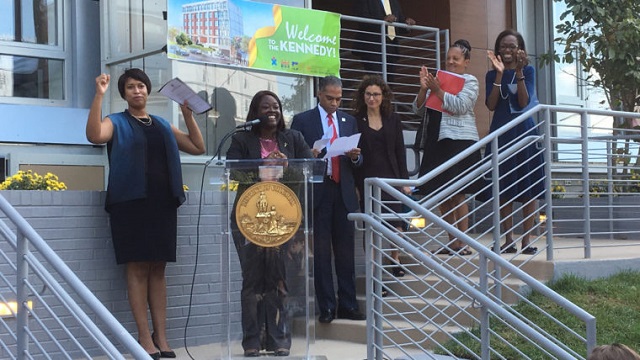
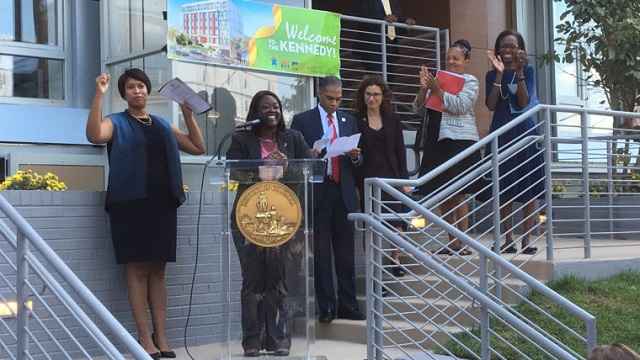 Mayor Muriel Bowser standing alongside Markita Abbott, who was homeless and lived at D.C. General, at the ribbon-cutting for The Kennedy, a new 45-unit family homeless shelter. (Photo by Martin Austermuhle)
D.C. Mayor Muriel Bowser on Wednesday cut the ribbon on the first of six family homeless shelters being built to replace D.C. General. The long-troubled shelter will be closed this fall as part of Bowser’s efforts to reform the city’s homeless services.
“We all agreed that homelessness in our city is not just a one-ward issue, is it? It’s not just Ward 2, it’s not just Ward 7, it’s not just Ward 8, it is an all-eight-wards issues, and it requires an all-eight-wards solution,” she said to a large crowd outside The Kennedy, the new shelter in Ward 4.
“I advanced an eight-ward strategy where we would produce short-term family housing facilities like this where families that are experiencing emergencies could find housing and support to get back on their feet,” she added.
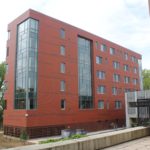
Today @MayorBowser cuts the ribbon on the first replacement homeless shelter for D.C. General, which will close this fall. All told, six shelters being built, with 3 set to open this year. Here is the Ward 4 shelter today, and in July 2017. pic.twitter.com/FXb1L18FIo
— Martin Austermuhle (@maustermuhle) September 26, 2018
World of difference
The Kennedy — which will house as many as 45 families — is the first of the new shelters Bowser first proposed in 2016 to replace D.C. General, a former hospital that was repurposed over a decade ago to house up to 270 families at a time. Over the years, it became a magnet for criticism from homeless advocates, who said it was too big and too institutional to adequately address the needs of the families inside it. D.C. General was where Relisha Rudd, who was eight years old at the time, lived before she was abducted by a janitor. She has yet to be found.
During a tour of the new shelter on Wednesday morning — a $14 million renovation of a former medical building just off of Kennedy Street NW — city officials said their goal was to create smaller, more manageable facilities that would help families facing housing emergencies cycle through the system more quickly.
“It is a world of difference in terms of the feel,” said Laura Zeilinger, the director of the Department of Human Services, as she walked through the brightly colored and well-furnished units where families will live as they look for a permanent home.
“The dignity of this place can’t even be compared to what it feels like to be in D.C. General,” Zeilinger said. “You walk in and you feel like this a place that is designed to provide this service and this support, and it’s a place where I can be safe, I can relax and also be about the thing that will help me get back on my feet. Because of that, families will have a much quicker, more successful transition to permanency.”
City officials say they have made gains in addressing the number of homeless families, which grew steadily from 2011 through 2016. Since then, that number has decreased almost 40 percent. This year, 924 families in the District are experiencing homelessness.
I just got a tour of the new Ward 4 shelter, which has 45 units. All brand new interior, very much has a look of a new apartment building. Shared bathrooms on each floor, though bigger units have private bathrooms. pic.twitter.com/pAxsczDQkz
— Martin Austermuhle (@maustermuhle) September 26, 2018
Zeilinger says she hopes families will have an average stay of 90 days before they move on to more permanent housing; the current length-of-stay in D.C. General is almost double that. Each of the six new shelters — two more will open this year, and three more open next fall — will be staffed by a different non-profit agency that will function as a contractor for the city.
As for D.C. General, Bowser told the D.C. Council that she plans to close the shelter by late October, after which it will be demolished. She said that since the city stopped placing families there in May, 98 have been moved into permanent or semi-permanent housing options. As of last Friday, 59 families remained at D.C. General.
Critics concerned about speed of rehousing, demolition
While many homeless advocates say they support Bowser’s broader goal to close D.C. General, they also say they believe she is rushing to do it. They worry that only three of the six planned replacement shelters will be ready this year. They also say the city is pushing too many families into rapid rehousing, a program in which rent is heavily subsidized for a year, though it can be extended. Some advocates say that the city’s high housing costs means families are unlikely to be able to afford rent once the subsidy ends, and potentially end up homeless again.
According to D.C. officials, of the 98 families that were moved out of D.C. General since June, 58 were put into rapid rehousing, while only six were given more permanent affordable housing options. The remaining families were served through a variety of other District programs.
Homeless advocates also been critical of Bowser’s plan to demolish an old building near the D.C. General shelter this week, even after lead was found there over the summer. City officials say the lead has been remediated and deconstruction will begin this week, but the advocates say any toxins could pose a risk to the families still at D.C. General.
“We’d like to suggest that any remaining families at D.C. General be offered a transfer to [the Ward 4] shelter before the demolition of Building 9,” tweeted the Washington Legal Clinic for the Homeless.
A milestone
But on Wednesday morning, the mood at The Kennedy was one of celebration, with city officials showing off the shelter’s new rooms, common areas, playground and half-court basketball court, and bathrooms — 18 shared, and nine private ones attached to two-room suites. Markita Abbott, who lived at D.C. General with her son after they became homeless, was one of the first people in the building.
“It brings me great pride and honor to know that families moving forward will have a beautiful and well-constructed building to help provide for them and help them get back on their feet,” she said.
And that the shelter feels more like an apartment building is part of the goal, said Zeilinger.
“The assumption that people need an uncomfortable space in order to be motivated to leave is based on ignorance of what the experience is when families are without a place to live,” she said. “Everybody wants their own place for themselves and their children. It’s about being supported to be able to achieve that goal.”
This story first appeared on WAMU.