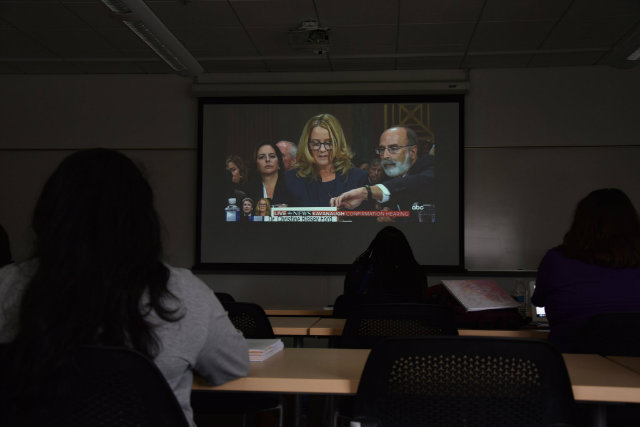
 (Photo by Meg Anderson)
By Gabe Bullard, Mikaela Lefrak, Meg Anderson, Tyrone Turner, and Patrick Madden
There wasn’t any doubt about what was Topic A in the Department of Housing and Urban Development Thursday. The staff got an email about it in the middle of the workday. So many of them were watching the Senate Judiciary Committee’s hearing on the sexual misconduct charges against Supreme Court Nominee Brett Kavanaugh that HUD’s network was having trouble handling the load.
It wasn’t just HUD employees watching, and it wasn’t just HUD’s network that was overloaded in Washington on Thursday. Across the region, in offices and classrooms, in homes miles from the Capitol and on the steps of the Supreme Court, locals followed the hearing.
This was national news, but it had special resonance locally. Both Kavanaugh and Christine Blasey Ford, the California professor accusing the nominee of misconduct, grew up here. The allegations against Kavanaugh reflect the culture of the area’s elite private schools in the 1980s. The locations mentioned in the testimony are familiar. And Ford’s allegations, Kavanaugh’s past, and the process that brought them to the hearing divided the locals watching as much as it divided the senators in the committee room.
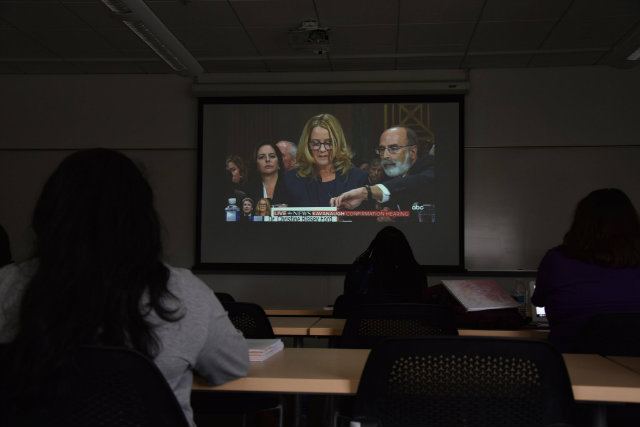
“I understand, like, yes, she was traumatized as a teenager, but it shouldn’t have took her that long to speak up,” said 22-year-old Nya Younger, a student at Trinity Washington University, as the hearing began.
Younger watched Ford’s testimony with her classmates in the all-female undergraduate program at this small Catholic university in Northeast Washington, where around 90 percent of the students are black or Latina, and most are low-income.
Another student, sophomore Fatima Fofama, thought it wasn’t fair that some people were questioning Blasey Ford’s credibility, but not Kavanaugh’s.
“Is it because of his social status? Is it because he’s a male? What is it? So if she’s over there, missing out on work, then he should be placed in the same situation,” Fofama said.
The women discussed how wealth and class may have played a role in the alleged assault. One student said that may have allowed Kavanaugh to feel like he didn’t have to follow the same rules others in society do have to follow. Ford and Kavanaugh both attended private high schools in the Maryland suburbs of D.C.: Ford at Holton-Arms in Bethesda and Kavanaugh at Georgetown Prep in North Bethesda. None of the students in the room, about half of whom grew up in D.C., attended private school. But they’ve all had experiences like the one Blasey Ford described, or they know people who did.
“My fists were clenched under my desk. I was seriously trying not to get up and yell, that’s how much pain I was in,” said student Vanessa Perry. “It was reminiscent of when my friends told me about when they were assaulted, when I got calls at night, like hey, I have to talk to you, something happened and I need to tell you.”
As the senators took a break, Younger, who was at first skeptical about why Ford only recently came forward with allegations that Kavanaugh assaulted her at a party, said she had come to feel differently.
“I’m now more sensitive to the situation,” she said. “It opened my eyes.”
About a dozen miles to the west, outside a coffee shop in McLean, Virginia, David Stanmyer said he understands why people may be “dubious” toward Kavanaugh after Dr. Ford’s testimony, but he thinks the nominee is “innocent.”
“I heard [Dr. Ford’s] testimony,” Stanmyer said. “There’s no proof, no witnesses.”
McLean is in Virginia’s 10th Congressional District, home to one of the most-closely watched contests in the country, where Republican incumbent Barbara Comstock is hoping to fend off Democratic challenger Jennifer Wexton. And Stanmyer’s confidence in the GOP’s court pick likely isn’t welcome news to Democrats who want to make the 10th part of a blue wave they’re hoping for in November.
But not everyone at the coffee shop was thinking in terms of politics. Ford’s testimony continued an ongoing national conversation about sexual harassment and sexual violence. Eighteen-year-old Grace Kugler said putting this issues in the spotlight is important, but she worries the setting — and the fight over Kavanaugh’s nomination — will politicize these topics.
“It’s not really a political issue,” Kugler said. “It’s a matter of human safety.”
Stories of sexual assault and harassment can be triggering for survivors of attacks. The allegations against Kavanaugh have inspired many survivors to share their stories, while many others silently relive traumatic memories. One D.C.-area rape crisis hotline reported a “significant” spike in calls throughout the day.
“All of the conversation around sexual violence and the climate that we are living in, particularly around the high profile sexual assault cases, has definitely prompted an increase to our hotline and has impacted survivors across the country,” says Indira M. Henard, the executive director for the D.C. Rape Crisis Center.
(The number for the D.C. Rape Crisis Center is 202-333-7273 and the National Sexual Assault Hotline is 1-800-656-4673.)
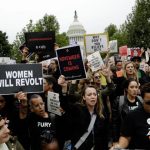
Outside the Supreme Court and the U.S. Capitol, one group came out to show their support for the nominee and at least five separate groups came out to protest against Kavanaugh.
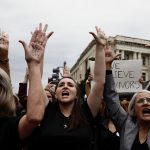
Some wrote “believe women” on their palms. Others wore t-shirts saying, “I am a survivor.”
This was the message of many protesters outside the Supreme Court during the hearing. Some wrote “believe women” on their palms. Others wore t-shirts saying, “I am a survivor.”
A group chanted, “I believed Anita then. I believe Christine now,” referencing Anita Hill’s accusations of sexual harassment against Supreme Court Justice Clarence Thomas during his confirmation hearings in the early 1990s.
Nearly 60 people, including three leaders of the Women’s March on Washington, were arrested for sitting in the road near the Supreme Court.
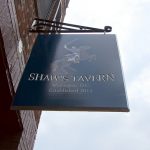
Others in the area, however, regretted how they commented on the hearing. Last year, hearings with fired FBI Director James Comey drew big lines for watch parties at local bars and restaurants. Thursday, Shaw’s Tavern tweeted that it was offering bottomless mimosas during the Kavanaugh hearing, then deleted the tweet and apologized for advertising a drink special given the role of alcohol in the allegations against Kavanaugh.
The hearing ended shortly before 7:00, just in time for a rainy commute after a day of lower productivity in offices where workers stayed glued to their livestreams. But there will be a reason to tune in Friday. As of Thursday night, a committee vote on Kavanaugh’s nomination was scheduled for 9:30 a.m.
How You’re Feeling
We’ve been hearing from people who are following the across the region. Please share your story, as well.
How Washington has been reacting to the Ford-Kavanaugh hearings