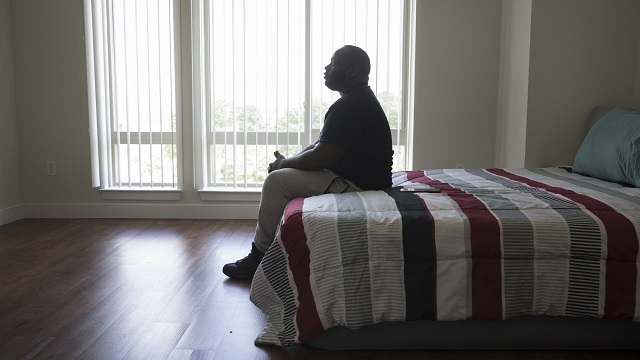
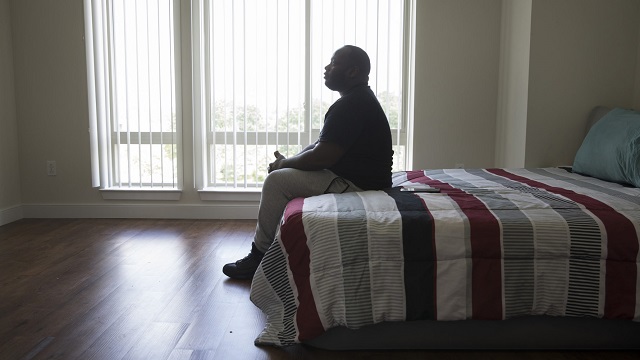
 “We have one life to live, and that’s what pushed me to come out and choose the road of happiness,” Fosque says. “It’s not worth it to hold on to a lot of hurt.” Fosque is the first person to graduate from a housing program aimed at LGBTQ youth in D.C. (Tyrone Turner / WAMU)
It’s six months after moving day, and Tyreem Fosque’s small apartment in Northeast Washington is only now starting to feel complete.
“This is my humble studio,” Fosque says during a quick tour over the summer, at the three-month mark. “Living space, kitchen, storage closet, washer and dryer, and this is my bathroom.”
An open box near the bathroom sink was left unpacked. Two folding chairs in the corner of the main room took the place of a sofa. His neatly-made bed, topped with a colorful comforter, sat next to a large window overlooking the city.
The move was a long time coming, Fosque says. The 25-year-old, who identifies as a gay man, describes growing up in an abusive home with five other siblings. After his parents split up, Fosque says the children were left in the care of their father, who eventually chose to offer them up for adoption. For years, the six kids were in and out of foster care.
Meanwhile, Fosque says, his siblings teased him for being gay.
“I liked boys, and they saw that,” Fosque says. “They would call me a faggot, beat me up, all types of bitches and things like that…sissy…”
After coming out to family and friends when he was 19, Fosque says he was kicked out of his oldest brother’s home, where he was staying at the time.
Finding a home in the midst of chaos
After he left his brother’s home, Fosque says he was forced to sleep in a friend’s car. During the day, he stored his belongings in Metro stations, and washed up for work inside fast-food restrooms. Despite the chaos, Fosque says he did his best to hold down odd jobs, while getting further skills training through a Job Corps program in Maryland.
During that time, Fosque was one of the nearly 2 million young people who experience homelessness in the United States every year. Forty percent of those youth identify as LGBTQ, according to a 2012 study conducted by the Williams Institute at UCLA Law.
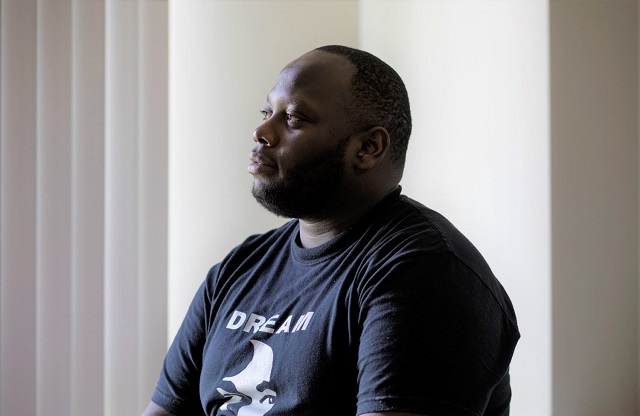 “We have one life to live, and that’s what pushed me to come out and choose the road of happiness,” Fosque says. “It’s not worth it to hold on to a lot of hurt.” Fosque is the first person to graduate from a housing program aimed at LGBTQ youth in D.C. (Photo by Tyrone Turner / WAMU)
The study’s other findings are equally alarming: 46 percent of homeless LGBTQ youth ran away because of family rejection of their sexual orientation or gender identity; 43 percent were forced out by parents, and 32 percent faced physical, emotional or sexual abuse at home.
According to the nonprofit organization Supporting and Mentoring Youth Advocates and Leaders (SMYAL), nearly half of homeless youth in the District identify as LGBTQ. When SMYAL opened the doors of its new housing program in the District in 2017, it aimed to address the growing number of LGBTQ youth living on the streets.
“Most of the young people that we work with in our drop-in center, we have not met most of their parents,” says Adalphie Johnson, SMYAL’s programs director. SMYAL’s services benefited more than 2,500 local LGBTQ youth in 2017, according to Johnson.
A home for LGBTQ youth
SMYAL has supported LGBTQ youth across the Washington region for more than 30 years, many of whom are people of color. With 24-hour on-call staff, SMYAL offers services like after-school programs, life skills courses, mental health counseling and job training.
Through a partnership with the D.C. Department of Human Services, SMYAL expanded its housing program to support 12 people at a time. Fosque was a part of the first cohort, and earlier this year, became the first to graduate from the program offered to LGBTQ youth between the ages of 18 and 24. They can stay in SMYAL housing for up to two years while they work toward living independently.
After just a few months of residency, Fosque obtained a full-time security job with the U.S. Postal Inspection Service. And, after 14 months, he became the proud tenant of the roughly 400-square-foot apartment.
Still, SMYAL continues to be a resource Fosque could turn to, even recently providing him with some furniture and other decorative pieces for his home.
“[Fosque] is one of the most amazing self-advocates I’ve ever met,” says Jorge Membreño, SMYAL’s director of youth housing. “He knows what he wants, and he knows how he’s going to get it, and he’s not scared to reach out to the people around him to say, ‘Will you help me do this?’”
Membreño has a background in mental health therapy and social work. He sees first-hand how difficult it can be for these youth to move past trauma in their lives. It can be so hard, Membreño says, that they sometimes lose motivation.
“I tell all my residents, the things that you’re tackling are a mountain of pebbles,” Membreño says. “You’re pulling out one pebble at a time, until you can really tackle all of this.”
Fosque may now have a roof over his head, but the family relationships he holds dear are still strained. He credits SMYAL for keeping him focused on what’s important.
“At the end of the day I know my self-worth, and I know that I deserve to be loved, no matter what, unconditionally from my family,” Fosque says. “It’s just, it takes time. It takes a lot of time.”
This story was first published on WAMU.