Natalie Delgadillo
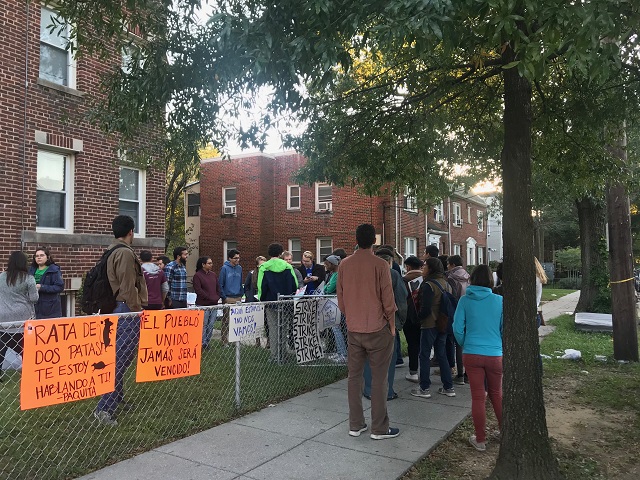 (Photo by Natalie Delgadillo)
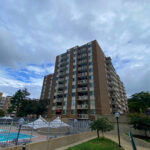
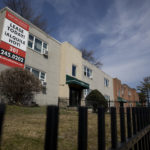
At 1320 Nicholson Street NW, residents say bedbugs keep them awake at night. Mice and roaches are a regular presence, scuttling across old carpeting inside of cramped units. The roof is so waterlogged that the top-floor ceilings look swollen and stretched, like a piece of cloth straining to hold weight. Mold is growing in unreachable crevices: behind radiators, on bathroom ceilings, inside of door hinges.
Residents at the Brightwood Park apartment building were reaching the end of their rope, says Citlalli Velasquez, a tenant organizer at the Latino Economic Development Center, an advocacy organization that helps organize tenants across the city. So, as of October 1, 16 units have stopped paying their landlord rent. Instead of writing their checks to SCF Management, the building’s management company, they’re placing each payment into an escrow account managed by LEDC. (This is often done during rent strikes to help ensure residents don’t end up evicted).
LEDC is also managing a nearby rent strike at 5320 Eighth Street NW, where tenants have dealt with waterlogged living conditions, a fire, and a boiler pipe explosion, and another—now ended—rent strike at 315-325 Franklin Street NE. The strikes are part of the non-profit’s experiment with using the tactic to preserve affordable housing, says Rob Wohl, a tenant organizing manager at LEDC.
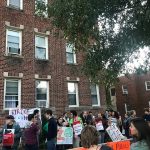
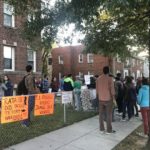
On Friday, residents at 1320 Nicholson held their first rally in support of the rent strike, chanting and playing music outside their building. Residents spoke about the conditions they say they’re experiencing, describing leaky roofs and mold that they fear is giving their children respiratory problems; rat, roach, and bedbug infestations; and a lack of properly functioning appliances.
Chants started pic.twitter.com/4flZQU5RNd
— Natalie Delgadillo (@ndelgadillo07) October 12, 2018
Yessika Chicas, who has lived in the building for about six years, says she decided to join the rent strike because she has asked SCF and her landlord, Michael Lesesne, to fix several problems in her unit to no avail. Meanwhile, she says the rent for the studio apartment she shares with her three children increased from $777 to $850 per month.
Chicas says she regularly deals with vermin in her apartment, but by far the worst problem is the leaking ceiling and the mold. The entire ceiling in her small apartment looks swollen with water damage, and one corner in her kitchen—where she says much of the water leaks out—appears to be especially damaged. The ceiling in her bathroom is covered in black stains that she believes are made of mold.
One tenant, Yésika Chicas, let me inside her apartment. Some photos of her bathroom, which she says is the worst part of her place: pic.twitter.com/VCxKgYIOdl
— Natalie Delgadillo (@ndelgadillo07) October 12, 2018
She also says her roof leaks really badly from a corner in the kitchen. The whole ceiling looks swollen. pic.twitter.com/b1XyYmPKJb
— Natalie Delgadillo (@ndelgadillo07) October 12, 2018
“There are a lot of animals, the ceiling is leaking water,” Chicas says in Spanish. “The owners have to maintain the units and the building, and they’re not completing their part.”
Her complaints echo those of several other tenants who spoke at the rally: bedbugs, leaking roofs, mold, peeling paint, malfunctioning appliances, and toilets held together with duct tape.
A representative for SCF Management says the tenants’ claims are untrue, and the company works to swiftly resolve maintenance issues. The representative declined to give further comment. SCF is also currently being sued by the D.C. Attorney General for similar problems at a property the company managed in Columbia Heights. That property is currently in receivership, with serious remediations taking place throughout, according to the AG’s office.
Organized rent strikes are increasingly common across the country in expensive urban markets, but they are still fairly rare in D.C., according to Wohl. He says LEDC has recently started experimenting with rent strikes in an effort try to improve conditions in buildings across the city and preserve the city’s dwindling stock of affordable housing. Before their efforts in Brightwood Park, the last organized rent strike he remembers happened in 2010 at Marbury Plaza in Southeast, where more than 100 tenants organized a rent strike after a mother and her toddler were killed in a laundry room explosion.
“More tenants are organizing to confront their landlords, because they’re becoming more desperate,” Wohl says. “I wouldn’t say there’s a trend toward more rent strikes [here] yet, but I think they will probably become more common.”
The rent strike is also a way of trying to preserve the affordable housing at 1320 Nicholson. Wohl, Velasquez, and the tenants themselves believe the landlord isn’t making fixes in an effort to push out low-income tenants in rent-controlled units so he can rent them out to new tenants at more expensive prices. Demanding remediation keeps them in their units, meaning the landlord has to keep his units at an affordable price—crucial in a city that is rapidly losing affordable housing units.
The controversy at 1320 Nicholson started in 2013, when Lesesne filed for a “hardship petition” with the city. Hardship petitions allow landlords to increase rents on rent-controlled apartments if they’re not making at least a 12 percent profit.
Lesesne was allowed to conditionally raise rents while the petition was being considered, and rents at 1320 Nicholson spiked sharply, according to tenants and LEDC. With the help of lawyers, tenants got the petition overturned in court based on problems with the application, and Lesesne was ordered to pay back the money in extra rent he had been collecting. All that money has recently been paid back, according to Velasquez, and now the owner is trying again to raise rents (the increase would bring the rent up to what rent control would have allowed if the owner had raised rents for each of the past two years, when he was paying rent credits back to the tenants.)
On June 19, tenants at 1320 sent SCF a notice that they would refuse to pay rent increases set to begin on August 1, according to a dated letter that LEDC shared with DCist.
“In addition to the many violations which exist in individual apartments, we continue to experience leaks through ceilings, broken windows, damage to walls and floors, missing carbon monoxide detectors in all units, plumbing and pest issues and have endured several days without hot water. Additionally, routine maintenance is not being conducted in a timely fashion,” the letter reads. It also says that tenants would be willing to pay legal rent increases if the building is brought up to code and maintenance is conducted in a timely manner.
Velasquez says that SCF enforced the rent hike without addressing the problems at these tenants’ apartments.
On August 31, tenants sent another letter to SCF, reiterating the problems in the units and threatening a rent strike in 30 days if the problems went unaddressed. The month of September passed by with no comprehensive fixes from the management company, according to Velasquez and LEDC.
So residents decided to take action. They say they’re unwilling to withstand the conditions of their units for any longer, and they’ll only pay an increase when things are fixed.
This kind of strategy can seem especially risky to the immigrant communities that make up the majority of the tenants on Nicholson Street. But because of the conditions they’re living in, Velasquez says, it’s become worth it.
“Tenants are doing this out of necessity,” Velasquez says. “It’s a pretty risky thing to do, but they really want to see these changes, and are really angry that the landlord has the audacity to raise rent with all these problems.”