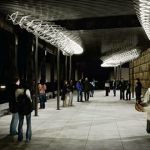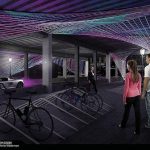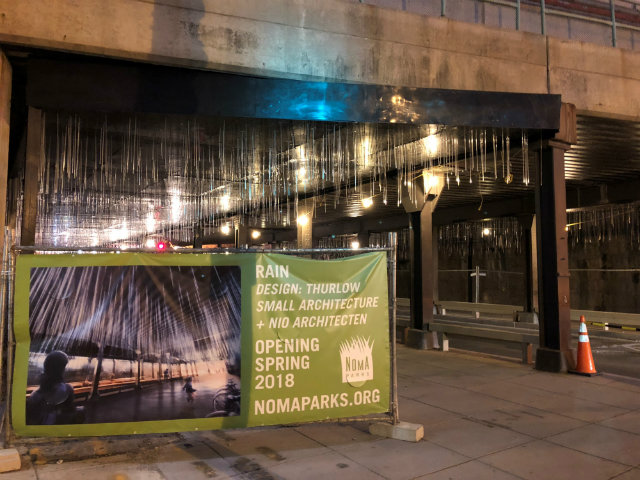
 Originally slated to be completed in spring 2018, the ribbon cutting for “Rain” is now scheduled for Thursday. (Photo by Edward Russell)
By DCist contributor Edward Russell
The NoMa Parks Foundation is ready to officially turn on the 4,000 light rods hung in the M Street NE underpass on Thursday evening.
The 6:30 p.m. ribbon cutting for Rain marks the completion of the first of four long-delayed light installations planned by NoMa Parks in the underpasses on K Street, L Street, M Street, and Florida Avenue under the Amtrak tracks to Union Station in Northeast. First announced in 2014, the works are part of the NoMa Business Improvement District’s broader efforts to beautify the booming neighborhood.
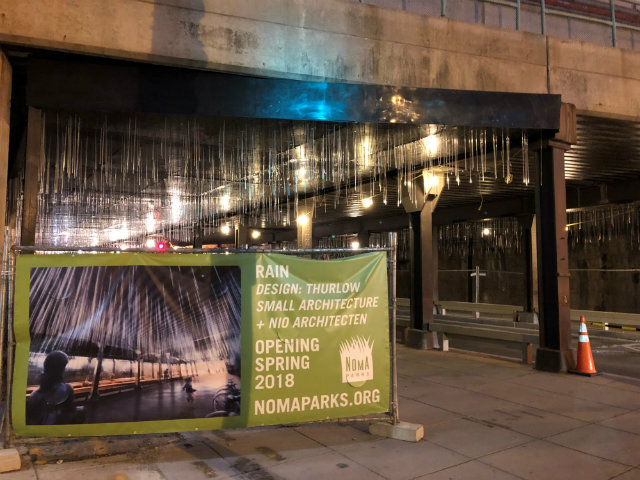
Rain, designed by Thurlow Small Architecture + NIO architects, includes LED light rods hung from the ceiling of the underpass in a series of vaults. The lights will stay on around the clock and will respond to activity in the underpass: For example, “waves” move through the space in increasing or decreasing intensity based on the number of vehicles passing through. They are connected to the city’s power grid, like street lights.
Andrew Thurlow, a partner at Thurlow Small and a lead designer of Rain, in 2015 described the installation as bridging the two distinct sides of NoMa, the old rowhouses to the east of the underpass and the new development to the west.
“How can lighting act as a condition to start to begin to bridge the two scales of these neighborhoods?” he said at a community meeting. “This particular portal, this tunnel space, could act as that connective tissue … you can start bridging neighborhoods in this way.”
While intended as a bridge, Rain has also proven divisive. Earlier this year, the District cleared a number of people experiencing homelessness who had taken up residence in underpasses in NoMa for the construction, a move that sparked complaints by some advocates and ultimately proved unsuccessful, as residents returned.
“When we started these projects there were a couple chronically homeless individuals who were living in the underpasses and were not willing to accept services or housing vouchers,” says Robin-Eve Jasper, president of NoMa BID.
Since the early 2000s, D.C. has made significant progress in reducing its population of chronically homeless residents, which is defined as being homeless for at least one year or four times in the past three years and having a mental or physical disability. But there are still more than 1,500 people in D.C. who fit that description on the streets, according to the 2018 point-in-time count.
“We desperately need to simply give them homes and if not homes, welcoming shelters,” says Robb Dooling, a neighborhood resident and candidate for the local ANC. “It may be more politically popular to install shiny artworks, but we need to do the right thing first.”
The day before the ribbon cutting, the M Street underpass had one tent dweller. Meanwhile, an encampment remains in the L Street underpass.
Delays have also plagued the lighting installations. Both Rain on M Street and Lightweave by Future Cities Lab on L Street were due for completion by the end of 2015 after being selected earlier that year. A series of issues—including attempting to value-engineer Rain’s LED rods and delays getting approval from Amtrak to work on the ceiling of the underpass—repeatedly pushed that date back.
“The complexity of the M Street underpass, where we really built an underpass within an underpass with the big superstructure to support all of the lights and wiring—we weren’t prepared for some of the complexity of that,” says Jasper. “In the Amtrak approval process is one place that showed up, another place was the long duration that the underpass needed to be closed.”
Work on Rain was moving forward in earnest by April, with installation all but complete by August.
The “Rain” in NoMa, but does it stay mainly in the plain? ? Officially opening in the M Street underpass in the coming weeks: https://t.co/4kW2QVfDII @NoMaBID @ggwash @nioarchitecten pic.twitter.com/BIASYvkRvD
— Edward Russell (@e_russell) August 29, 2018
Installation of Lightweave, which Jasper says is in storage and ready to be installed, is expected to begin shortly and take around three months. “It’s clusters of architectural, sculptural bent metal and LED lights that are installed on poles, almost like a regular street light,” she says.
Selection of works for the K Street and Florida Avenue underpasses is still on hold, though NoMa plans to apply lessons learned when they move forward, says Jasper.
NoMa’s underpass installations may stand out as unique in D.C. for some time. The Georgetown BID includes “artistic installations and lighting” installations under the Whitehurst Freeway in its 15-year plan but has no timeline for the idea.
This story has been updated to correct the description of the way lights are activated in the installation.