Rachel Kurzius
Mayor Muriel Bower became D.C.’s first reelected mayor since 2002 and the first woman to ever earn a second term as the city executive. And yet she still lost on Election Day.
Bowser threw her political weight behind a challenge to defeat independent At-Large Councilmember Elissa Silverman, but the incumbent still sailed to victory.
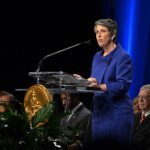
In her victory speech, Silverman thanked her “people-powered campaign.” She beat Dionne Reeder to retain the non-Democratic at-large council seat in the closest citywide election in D.C. this cycle, and one which became a referendum on the mayor’s clout. In a year where Bowser has faced no competition during either the primary or general election, her unprecedentedly public involvement in the at-large race meant that its outcome would reflect on her ability to marshall her influence to the candidate of her choosing.
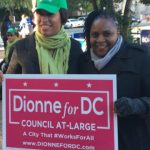
And the candidate of her choosing, Reeder, conceded less than three hours after the polls closed, with 14.4 percent of the vote to Silverman’s 26.6 percent, with all precincts reporting. Silverman bested Reeder in all of the wards except 7 and 8. (Democratic incumbent Anita Bonds won more than both of them for the other at-large seat up for grabs, earning almost 44.4 percent. More people left the second slot blank than voted for Silverman.)
“It was important for the mayor to take a stand on principle,” says Bowser’s campaign manager, Bill Lightfoot. “And that’s what she did. She made Reeder a viable candidate.”
After the dust settled on Election Day, Bowser insisted that her meddling in the at-large race wouldn’t impact her ability to work with councilmembers. “I have a great relationship with the council,” she said at a press conference on Wednesday.
On Wednesday, Silverman told DCist that she is coordinating a get-together with Bowser and looks forward to discussing paid family leave with her, as well as the tenor of the at-large race.
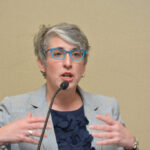
“I want to have a frank conversation with the mayor but I would caution her from trying to sweep things under the rug,” says Silverman. “I want to talk to the mayor about the tone of divisiveness that was woven throughout her involvement in the campaign,” she says, specifically calling out the idea that because she was raised in Baltimore, she wouldn’t be able to represent D.C. “If you choose to live in Washington, you’re a Washingtonian. That doesn’t mean we don’t have different experiences, but different experiences bring about a richness that will make our city richer and stronger.”
Bowser said on Wednesday that she endorsed Reeder in late September because she thought her experience and approach to governing was the best fit for the seat. She quickly worked to tighten up the race: encouraging donors to support Reeder, holding a get-out-the-vote rally with Bonds and Reeder as featured guests, and headlining fundraisers for the challenger. Reeder’s campaign coffers quickly saw the impact.
But for some Reeder allies, Bowser didn’t do enough. Her actions were “half-assed,” says Chuck Thies, a political consultant and once-time advisor to former mayor Vincent Gray who criticizes the current mayor daily.
“There’s a lot more the mayor could and should have done,” he says, from hosting rallies, to doing television interviews and talking up Reeder, to a citywide robo-call. He even takes issue with the rollout of Bowser’s endorsement of Reeder. “It was a private event and the media was barred from attending—that makes no sense whatsoever,” he says. “You want to scream that from the rooftops, but instead, they did it under the cover of dark.”
Lightfoot declined to “second-guess campaign strategy.”
But at least one Reeder supporter says Bowser did the right amount for the challenger, even if it didn’t net her a victory. Mark Lee, a Washington Blade columnist small business advocate who endorsed Reeder.
“What the mayor did was simply say, ‘I can vouch for this woman, I hope you’ll take a look at her,'” says Lee. “I think that is a quite reasonable position to take, and it mitigates some of the criticisms that have been lobbed that the mayor was heavy-handed in her support.”
There are also questions about how much sway the mayoral nod has for an at-large seat. A September poll funded by the Silverman campaign found that a majority of people—52 percent—didn’t think a Bowser endorsement would impact their vote.
There is personal history between Bowser and Silverman, too. Bowser supporters have called Silverman “divisive,” and the incumbent pushed for one of the mayor’s allies, Josh Lopez, to resign from the D.C. Housing Authority Board after hosting a rally where a speaker referred to Silverman, a Jew, as “fake Jew” and called Jews “termites.” He ultimately did step down, and became a full-throated advocate on behalf of Reeder during the general election.
Bowser’s first choice for the non-Democratic seat wasn’t Reeder, but S. Kathryn Allen, a former city official whose campaign was co-chaired by former mayor Anthony Williams and former councilmember David Catania. About a week after Allen was booted off the ballot in September for fraudulent signatures in her nominating petitions, Bowser publicly endorsed Reeder. This marked the first time in recent memory a sitting mayor publicly endorsed a challenger over an incumbent.
Still, there are signs that the mayor’s failed bid on behalf of Reeder may reverberate during her next term. Washington Post columnist Colbert King wrote on Twitter before results came in that Bowser’s “sharp elbow intervention converted mild political opponents to political enemies. Regardless of outcome, it will haunt her for 4 years.”
This story has been updated with comment from Mayor Muriel Bowser and At-large Councilmember Elissa Silverman.