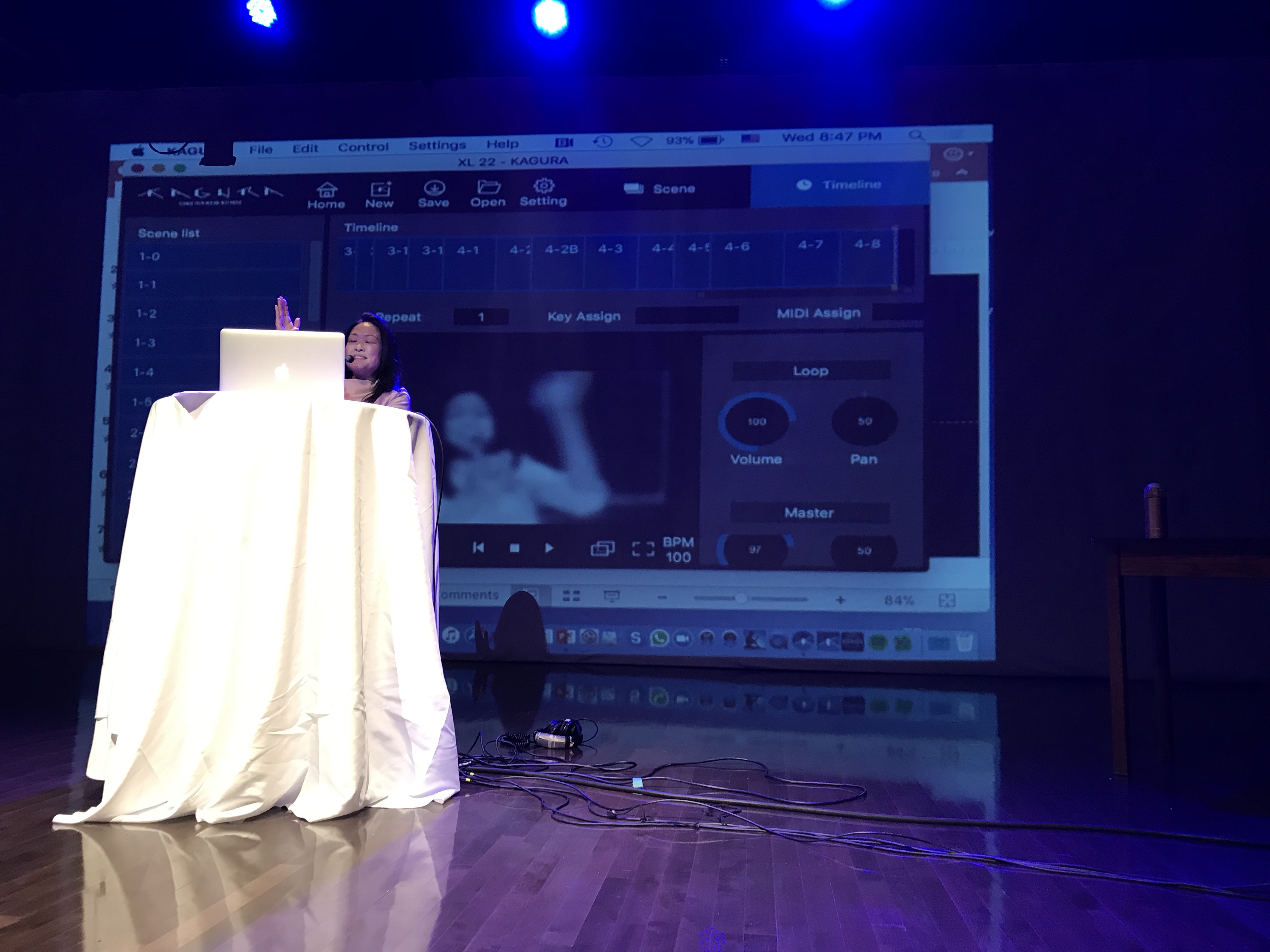
Yoko K. Sen waits patiently behind her laptop and audio mixing equipment as people trickle into the dance studio space at Joe’s Movement Emporium in Mount Rainier, Maryland, on a recent Wednesday. Sen was preparing a soundscape to accompany a yoga class.
“I usually don’t like the music played at yoga classes,” says Sen, 38. “So I decided, why not create the music myself?”
While participants stretch in downward dog and warrior poses, Sen loops sounds of ocean waves and layers on tracks of wispy vocals and cellos. Her music is soothing and ethereal. She looks almost ghostly in a white tunic, backlit by blue and white stage lights.
After the final stretches of the yoga class, Sen moves her equipment onto a table into the middle of the stage, and brings up a sound program called Kagura. Using the laptop’s camera sensor, Kagura matches movements to certain tones visualized with abstract shapes on the screen. Sen demonstrates by dancing around, and creating an electronic melody with her body.
Though reminiscent of performance art, Sen plans to use this technology to change the way patients experience medical care in the hospital. She is the founder of SenSound, a company that aims to alleviate suffering through transforming sound design in hospitals. A patient might use the sensors to play soothing music for themselves while lying immobile in a hospital bed, or a patient’s family could set a melodic jingle to ring whenever nurses enter in and out of the room.
Sen is drawing on her own experiences stuck in medical institutions. In 2012, her life was interrupted by health complications, keeping her in and out of the hospital for a couple of years. As she sat in waiting rooms and hospital beds, Sen couldn’t help but notice the cacophony of hospital noises all around her: the beeps from the heart monitor, the ice machine in the hallway, the alarms from machines in other rooms.
“I was shocked by how loud it was … so many different beeps ringing at the same time, some of them dissonant,” Sen says. “And as a musician I thought, does it really have to be this way?”
When Sen recovered in 2015, she founded SenSound. The company works with dozens of hospital systems across the country through the Experience Lab at the Advisory Board, an organization that works on improving the healthcare experience.
Sen’s approach is twofold. First, she looks at the entire hospital soundscape to understand what noise is necessary, and what is causing patients distress. At Sibley Memorial Hospital in Northwest D.C., she created a patient survey with questions like, “Please walk me through all the sounds you have heard staying in this room. What is the most disturbing sound to you? How did it make you feel?”
“Some patients are disturbed by the moaning in the halls, the sound of IV drips,” Sen says.“Others find that total silence in the evening is too scary. It reminds them of death.”
Sen also works with designers to look at the physical space of the hospitals. They zero in on everything causing extra noise, including the sound of keycards buzzing in and out of wards, slams of heavy doors, and blaring TV monitors in waiting rooms. The data gets compiled into a map that architects and planners can use to better design quiet space.
One major sonic disturbance in hospitals that patients and clinicians complain about is the constant beeping of medical machines and monitors. Patients told Sen that the repetitive beeps made them feel anxious, afraid that their body was doing something wrong. Clinicians also suffer from alarm fatigue—burnout from all the visual and sonic stimulation in the hospital—and often stop responding to alarms with urgency.
Medtronic, a medical device company, approached Sen and asked her to come up with 10 new tones for homecare products, particularly a bedside heart monitor that patients bring home with them from the hospital.
“Why can’t we at least make these alarms on key?” Sen says with a laugh.
Sen’s work has received support from organizations and hospitals across the country, but she calls D.C. home. She’s a fellow at the Halcyon Incubator in Georgetown, and works closely with Sibley Memorial Hospital.
In 2016, Sen partnered with the Sibley Innovation Hub—an in-hospital team of designers, engineers, and technologists—to create a space for patients and clinicians to relax. She came up with the Tranquility Room. Antoinette Solnik, a nurse practitioner at Sibley and yoga teacher (she taught the class with Sen at Joe’s Movement Emporium) showed me the room on a tour of the hospital. “A nurse friend of mine who delivers babies every day, she comes into this room at the beginning of her shift, to set good intentions for the day,” Solnik says.
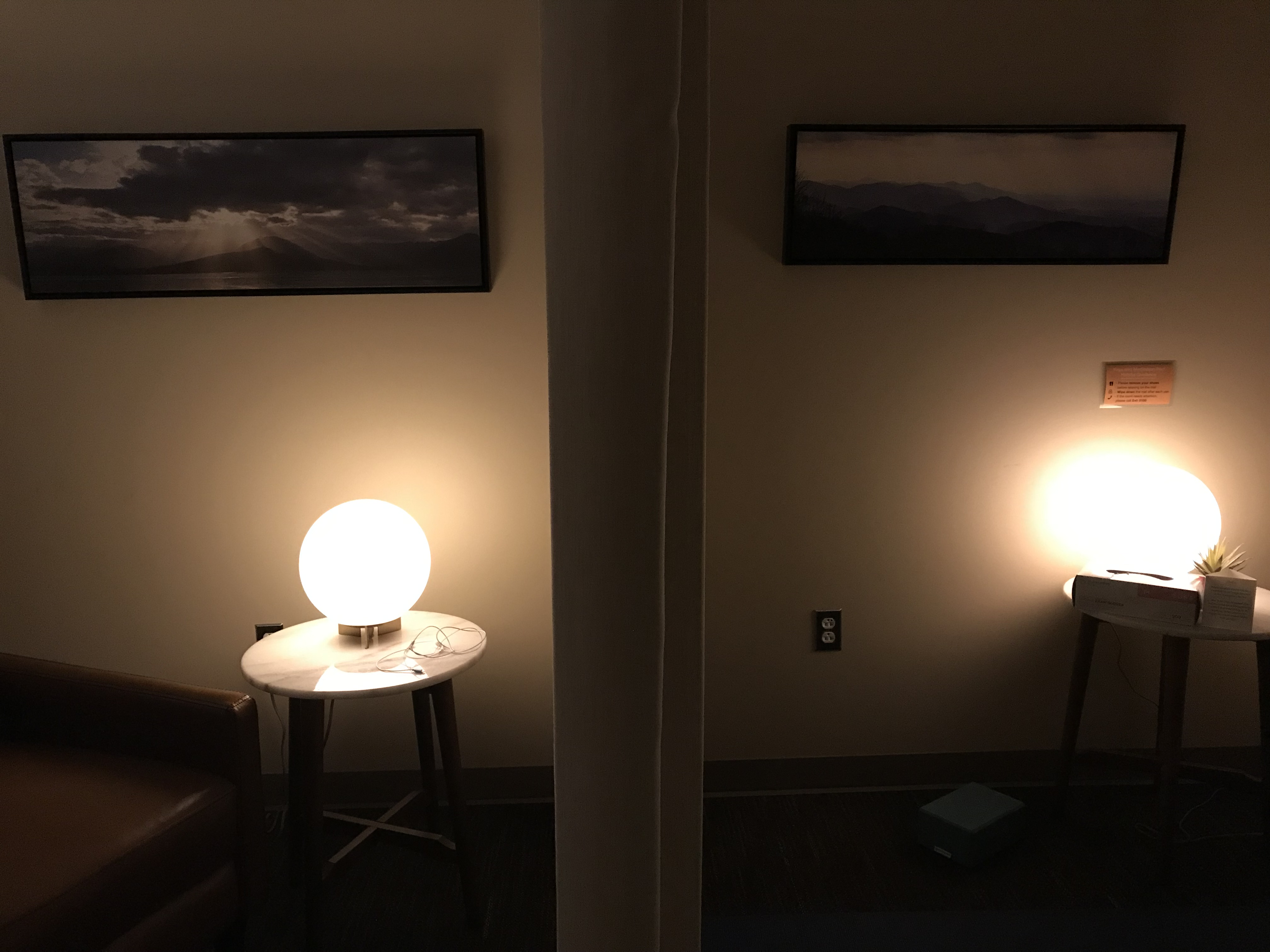
The room, about the size of a large office, is dimly lit, and decorated with minimal, earth-toned wall art. Linen fabric divides the room into six private stations, where patients and clinicians can practice yoga, meditate, or just sit quietly. Sen composed a soundscape of ambient music that plays on a small stereo system in the room.
Solnik connects with Sen’s mission. “Yoko opened up my world as a nurse practitioner,” she says.“She takes her background in music and helps communicate to us how it can aid in healing.”
Sen does not remember when she became interested in music. “My mother says I asked for piano lessons when I was three years old,” she says. The piano teacher suggested they wait until Sen turned five, but Sen insisted on starting immediately.
After she moved from Japan to the United States in 1999, Sen lived the life of a musician. She toured the country with the electronic band “Dust Galaxy,” recorded solo albums, and collaborated with other musicians. In fact, Sen was required to be a musician; after her solo album 012906 won a series of awards in 2006, she was granted an O visa for foreigners with “extraordinary abilities in the sciences, arts, education, business, or athletics.” The Department of Homeland Security requires those with O visas to practice their ability as a full-time job, and thus Sen became a full-time musician.
Music, Sen says, is her first and preferred language. “I think music allows for more nuance than the specificity of words, of the English language,” she says. In her work, Sen often thinks about the relationship between the body and sound, using music as an expression of the things we physically feel but can’t verbally communicate.
“Beethoven says that music is the mediator between the sensual and the spiritual life,” Sen says. “I want my work help make that bridge between physicality and emotion.”
Through her work, Sen hopes to pave the road for more artists to work with hospitals and the healthcare system. “There’s space for visual art, performance art, not just music,” Sen says. While she juggles a new project working with medical device companies, Sen hopes to get back to take on more artist-in-residence opportunities to experiment with music and sound.
Back at Joe’s Movement Emporium, Sen wraps up her presentation with Kagura, the computer program that matches people’s movement with sounds. Everyone in the audience had a turn playing around with the program; most people wave their arms with abandon, making peaceful music despite their spastic movements.
One teenage girl, however, comes up to the screen, and, like a ballerina, moves her arms with a slow precision. It looks like the music is almost emanating from her arms, not the computer speakers. For a moment, her body and the music were one and the same, neither one a distraction to the other. Sen watches with wide eyes, and smiles when the teenage girl produces one more note with the flourish of her hand.
“Without her movement, her grace,” Sen says, “there would’ve been no music.”