Four times a day, each and every weekday, a choreographed dance of the streets happens across the District. A number of lanes of traffic, and in some cases entire roadways, change direction for the duration of rush hour.
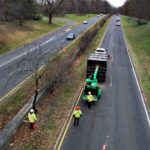
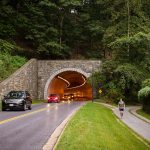
One of the most vivid examples is the complex reversal of half of Rock Creek Parkway, south of Connecticut Avenue. In the morning, the process begins around 6:45 a.m. as officers with the U.S. Park Police move north from the Lincoln Memorial. At each northbound on-ramp, they place wooden barricades to prevent drivers from entering. By 9:15 a.m., they work their way south, this time to remove the barricades.
On a recent rainy afternoon, I stood along the southbound entrance to the parkway off P Street NW and watched the process play out. Traffic signs indicated that the changeover time would begin at 3:45 p.m. At exactly 3:43 p.m., an officer placed wooden barricades that blocked any new southbound traffic. At 3:47 p.m., I spotted the last car heading southbound. At 3:49 p.m., a Park Police motorcycle officer, driving southbound, pulled over and blocked the onramp with his bike as he verified that all of the barricades were in place. He then exited the parkway and at 3:57 p.m., the first vehicle crossed the double yellow line into what, only 10 minutes earlier, had been oncoming traffic.
In a 1998 piece in the City Paper, Jake Tapper wrote about harrowing encounters the Park Police have had with commuters who take the lane switches into their own hands. It was not uncommon for officers to narrowly avoid, and sometimes have, collisions with drivers who crossed the yellow line too early. Tapper spoke with Park Police Lt. Robert Kass, then head of the department’s motorcycle unit:
“When you’re changing [the direction], people still come by the barricades,” he says. “People—believe it or not—just ignore them. People will actually get out of the car—after an officer puts a barricade out there—and move it. They say their watch is right, and the officer’s is wrong.” Kass has trouble understanding the mind-sets of these aggressive drivers. After all, he says, “these aren’t criminals, they’re just commuters and tourists.”
The Park Police did not respond to repeated inquiries about the current safety record of the lane switchover. Needless to say it’s a labor intensive procedure to ensure that all goes safely.
Full-roadway reversals like Rock Creek Parkway are relatively rare in the United States. Reversible lanes are more common, though usually limited to bottleneck areas, such as bridges and tunnels.
Elsewhere in the District, according to District Department of Transportation, there are five roadways with lanes that shift during rush hour:
- Independence Avenue between 3rd SW and 2nd SE
- 16th Street NW between Irving and Arkansas
- Connecticut Ave NW between Woodley and Legation
- Canal Road NW between the Chain Bridge and Reservoir Rd
- 17th street NW between N and K
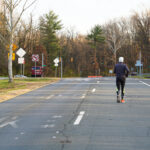
On these roads, one or more lanes will switch direction to add capacity inbound to downtown in the mornings and outbound to the suburbs in the evening. These streets are marked with two sets of double-yellow lines, one solid and one dashed. The dashed lines are to be followed during the rush hour periods when the lanes are reversed. This can be confusing to drivers who are unfamiliar (or even familiar) with the process.
Unlike Rock Creek Parkway, the process for District streets is automatic. Lane direction changes are indicated by lighted signs that are turned on automatically by a timer (7-9:30 a.m. in the morning rush, and 4-6:30 p.m. in the evening), according to Lauren Stephens, spokeswoman from the District Department of Transportation. Drivers are trusted to figure it out on the fly, and there is no pilot car or police presence to clear the way.
While the signs do automatically kick in to direct drivers, there are still concerns for safety. DDOT was unable to provide DCist with any data regarding crashes in the city’s reversible lanes.
Perhaps the loudest debate has been over the reversible lane on Connecticut Avenue. Some nearby residents are taking up a campaign asking DDOT to study the possible removal of the lane and addition of a bike path. A petition promoted on Greater Greater Washington calls for a “new vision” for the road. “All anyone needs to do is watch the chaos at Connecticut and Porter at around 5:30 or 6 p.m. to see that the reversible lanes are the source of much potential danger,” reads one comment.
A May 2011 paper in the ITE Journal, a publication of the Institute of Transportation Engineers, focused on the operation of D.C.’s reversible lanes. The authors studied data on Connecticut Avenue and found that after controlling for other factors, the crash rate was higher during the reversible operations, especially head-on and sideswipe collisions.
Worries over safety go even farther back.
“Stand on almost any corner along Connecticut — I’ve done my viewing from Connecticut and Ordway — and you’ll see cars plowing through red lights at high speeds,” reads one resident’s 2006 open letter to then-Mayor Adrian Fenty in the Washington Post. “We Cleveland Parkers have all seen drivers play chicken around the time the lane shifts occur, and we’ve seen drivers in the wrong lane at the wrong time because they don’t know what’s going on.”
The lanes’ opponents might soon get their way. Mayor Muriel Bowser recently floated a series of initiatives to bolster her struggling Vision Zero initiative, which aims to eliminate traffic fatalities by 2024. On the proposed list: “eliminate Connecticut Avenue reversible lane.”