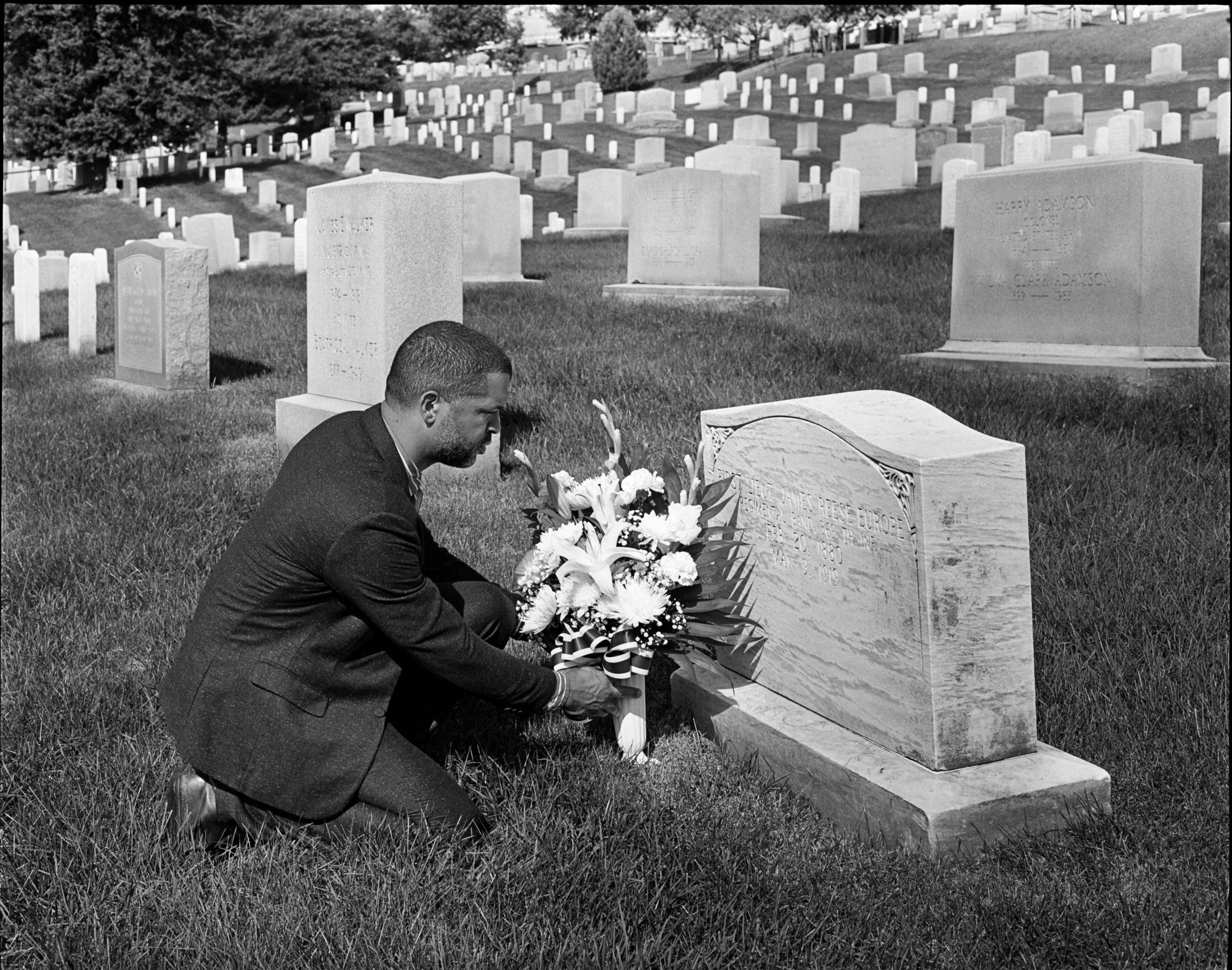
Jason Moran, the Kennedy Center’s artistic director for jazz, has a history of paying tribute to the genre’s titans, notably honoring pianists Thelonious Monk and Fats Waller. Moran is now set to premiere a new piece, The Absence of Ruin, which honors a lesser-known, but no less pivotal figure to jazz’s development: James Reese Europe.
Though he is an obscure figure to all but the most ardent music aficionados and historians, Europe’s life story is worthy of being made into a movie. He served in World War I with the 369th Infantry Regiment, affectionately known as the Harlem Hellfighters, which traveled throughout the front during that bloody conflict. During the war, he led the military band, and is credited with introducing jazz to the continent that also bears his name.
“He’s unlike any musician any of us know today,” says Moran, speaking of Europe. “He’s excelling in his craft and he’s also sacrificing his entire body, and the bodies of people he’s able to convince to sign up to join this military band.”
That accomplishment alone should lend Europe’s name some prominence, but it comes after a series of other impressive feats. He formed the Clef Club in 1910, which was not only a performing arts organization, but also became a de facto union for African American musicians in New York. Europe believed that while African American musicians should learn and study European music, their culture was rich enough to develop its own musical vocabulary. His efforts bore fruit in 1912, when Europe led the Clef Club’s symphony orchestra in the historic “A Concert of Negro Music” at Carnegie Hall—the first time early jazz was performed in the historic venue.
Europe’s light burned bright, but also short. He was killed in 1919 at age 39, dying of wounds suffered during an altercation with his own drummer.
“It’s a very tragic end and it’s part of what I think has led to his name being un-discussed in relationship to jazz history, just as much as we talk about Duke Ellington,” says Moran.
Moran’s first introduction to Europe was through the jazz elder, Randy Weston, who passed away earlier this year at age 92.
“He said in his distinct voice, ‘I want to tell you about James Reese Europe,’” Moran recalls, describing a meeting with Weston that took place about seven years ago. “He began just talking about him, talking about his importance, his love for him, his activism, his music, his ambition.”
The Absence of Ruin explores multiple themes, including Europe’s biography and legacy, the impact of war on art, and the circumstances that allow for an important individual to be erased from history. Very few recordings exist of Europe’s work, but his scores are available. These sources served as Moran’s starting points, along with an unpublished biography of Europe by one of his collaborators, Noble Sissle, which sits in the Library of Congress. Moran did not write new material for the performance, instead focusing on Europe’s compositions or the work of other composers that Europe’s ensembles would have played. He did rearrange some of the songs to reflect styles that grew out of this period to influence contemporary music. The concert also incorporates a visual component: a film directed by John Akomfrah (The March) with cinematography by Oscar nominee Bradford Young (Selma, Arrival).
“We’re exhuming [Europe] during the concert and then we lay him back into the grave,” says Moran. “We’re about to have a nice celebration of who he was and who those fighters were who fought alongside him in World War I, and then we put them all back into the ground with honor.”
James Reese Europe and The Harlem Hellfighters: The Absence of Ruin, takes place on Saturday, December 8 in the Kennedy Center’s Eisenhower Theater. 8 p.m. $29-$69.