December marks the federal deadline for states across the country to release their new school rating systems, designed to bring transparency to measures of school quality. Both Maryland and D.C. released new websites this week. Officials in both jurisdictions chose to use a five-star system to rate schools, with five being the highest score and one the lowest.
Most D.C. and Maryland schools were three stars, however more Maryland schools skewed toward four-and-five stars.
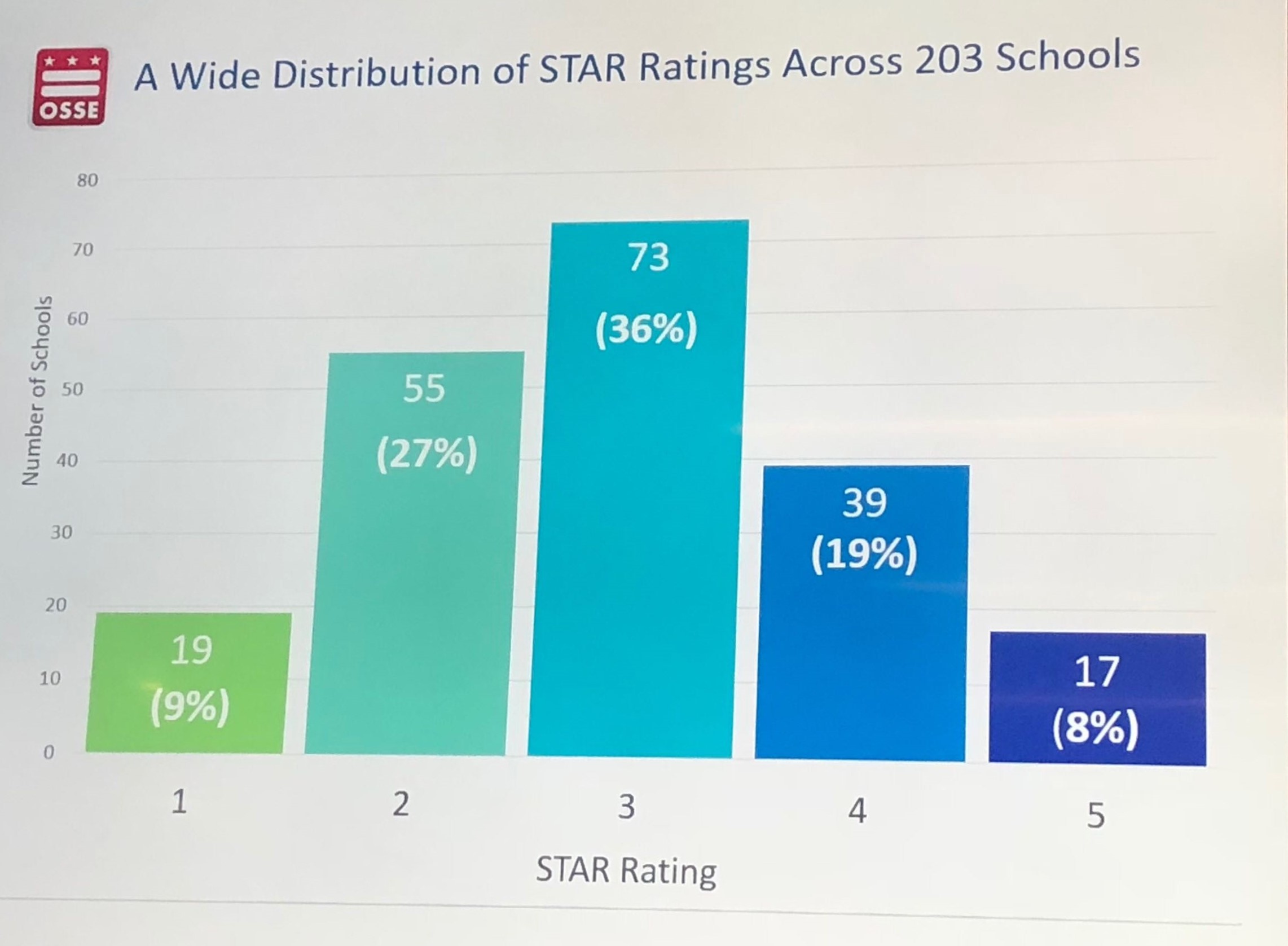
D.C. schools’ star distribution, released December 2018.Jenny Abamu / WAMU
The new websites allow parents to see how their schools and districts fare against others using detailed indicators that capture things like test scores, graduation rates, attendance, and improvement on tests over time. Both D.C. and Maryland weigh the indicators to create a summative five-star scale for each school.
D.C. State Superintendent Hanseul Kang opened a press briefing ahead of the ratings release on Thursday night by announcing that her office was proud that every ward in the district had at least one four-star school.
However, Kang’s tone was much more solemn when questioned about the distribution of one-star schools—many appeared packed in Ward 8, which had effectively become a five-star school desert. Ward 7 also lacked schools with 5-star ratings.
“We know that every school has ongoing areas for improvement. Similarly, in schools of every rating, we know that there are strengths that we should spotlight and support,” Kang said.
What Will Districts Do Now That The Ratings Are Out?
Public officials in both Maryland and D.C. say the new rating system will shed light on district performance and will be a starting point for discussions on how to improve troubled schools. But it is clear from the data that some geographic areas will have more work to do than others.
In Maryland, Prince George’s, Anne Arundel and Baltimore counties along with Baltimore City had significant numbers of one-and-two star schools. In D.C., the bulk of one-star schools resides in Ward 8.
Maryland education officials said in a release that the rankings “can help parents and stakeholders ask questions of school and district leaders, especially about their plans to improve the results.”

Maryland schools star distribution by district.Maryland State Department of Education
Maryland state officials are leaving it up to district leaders to respond to the school ratings.
D.C. officials have already began to make contingency plans for schools with low ratings.
Over the next three years, D.C. will invest $11 million of federal money in 10 schools (the federal grant money was given to 30 schools in years past). State Superintendent Kang said her office hopes by concentrating the funds in a smaller group of schools, the schools will have more resources to implement a new approaches to improve.
But during Thursday’s press briefing, D.C. officials were reluctant to say how parents could respond when faced with few quality school options.
Kang noted that her office was going trying to help schools improve, but wouldn’t say how she thought parents should respond to the ratings—whether they should speak directly to school leaders or transfer their children to other schools.
Paul Kihn, the D.C. deputy mayor of education, said if parents see that their children’s schools are not performing well, they should engage in conversations with school leaders to learn more about their plans to turn things around.
“What we are planning on doing is taking a hard look at the schools that received the lowest ratings and deploying a set of evidence-based interventions to ensure those schools are on a path to improvement,” said Kihn.
“This is going to be an opportunity for families, students and school communities to get together and determine what is the path forward for improvement,” he said.
Where Do Parents Fit In This Process?
Families will be expected to learn and act on the information they receive based on what Kihn outlined as a next step, something experts say has not always been so successful in the past.
“One of the things that we have learned is simply publishing a website and putting information out there is not enough. If you build it, they won’t necessarily come,” said Sam Oliverio, chief strategy officer for Great Schools, a non-profit group that ranks schools nationwide.
Great Schools has been publishing information on school quality for more than 20 years. Many real estate websites like Redfin, Zillow and Trulia use data from Great Schools to pitch home purchases to potential buyers.
“You need to take active steps to distribute information to parents who won’t necessarily be seeking it on their own,” said Oliverio.
“You need to understand where parents are going for information and meet them in those places,” she continued. “That might be through their social networks. It often quite frankly is through Google. That takes very intentional outreach.”
The D.C. State Superintendent’s office is planning to host a school fair where parents will be guided through the new ranking website. They also plan to host “office hours” around the city so families can get their questions about the new star ratings answered.
If schools don’t show improvement after three years, the office says it plans to convene a panel of community members to evaluate different options and make recommendations directly to their office.
This story was originally published on WAMU.