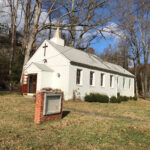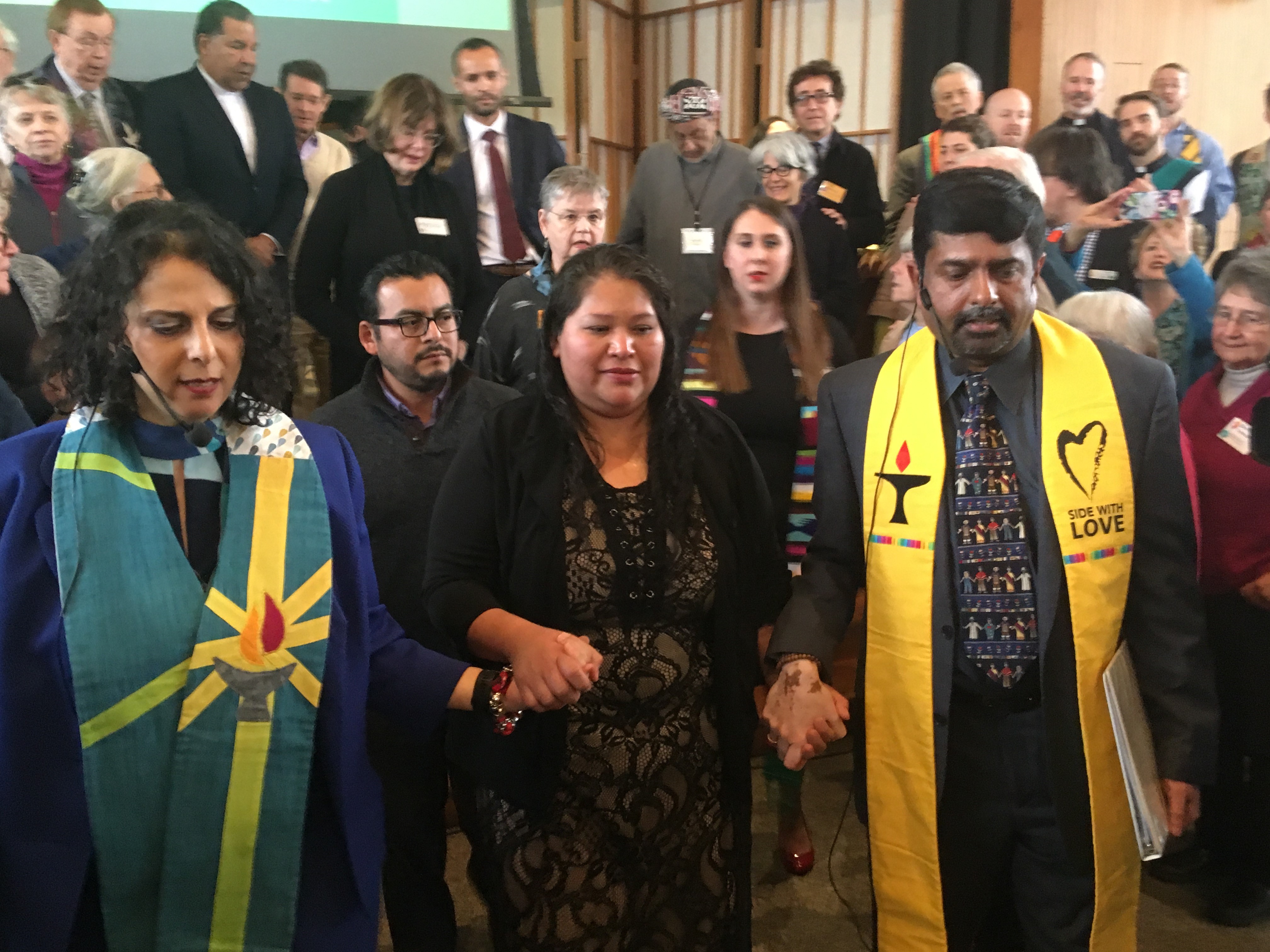
On Monday evening, Rosa Gutiérrez Lopez, a 40-year old Fredericksburg resident facing deportation, contemplated leaving her three children and getting on a flight to El Salvador, the country she fled in 2005. Instead, she decided to enter the Cedar Lane Unitarian Universalist Church in Bethesda, where she will live for the foreseeable future.
“The reason why I took sanctuary is because I love my children and do not want to leave my country,” Gutiérrez, speaking through an interpreter, told a crowd of hundreds on Wednesday in the chapel of the church. “I want to fight from here.”
This is the first publicized instance of a Maryland church offering sanctuary to an immigrant facing deportation, according to Omar Angel Perez, lead organizer for the DMV Sanctuary Congregations Network, a group of 60 D.C.-area churches that have pledged to shelter immigrants. Immigration and Customs Enforcement has a “sensitive locations” policy that prevents officers from making arrests in places like schools, hospitals, and houses of worship, and immigrants in cities across the country have taken refuge in churches to avoid imminent deportation.
“We are here to bear witness that the immigration policies of this country are immoral,” said Alvin Herring, executive director of Faith in Action, a national umbrella group that encompasses the DMV sanctuary network. At Wednesday’s event, faith leaders from Jewish, Muslim, and Christian denominations declared an urgent need for individuals to actively resist the Trump administration’s deportation agenda.
“We change it with our bodies,” said Herring. “That is why we are here today.”
Since the founding of the Sanctuary Congregations Network in March of 2017, Perez says, the group has stopped a dozen deportations. Gutiérrez’s case is similar to many other undocumented people who, despite having orders of deportation, were previously considered low-priority by ICE under the Obama administration. These immigrants often attended annual check-ins with ICE without issue.
For Gutiérrez, all that changed in 2017, when ICE gave her an ankle monitor and asked her to come back every two weeks, according to Perez. At a recent check-in, Gutiérrez was ordered to self-deport, Perez said. Gutiérrez came to the United States in December 2005, seeking asylum from her native El Salvador, where her lawyer says members of her family have been killed by gang violence.
Her asylum case languished as she struggled to navigate the legal system, and she was ordered deported in 2006. Previous lawyers were successful in filing stays of deportation, but in 2017, Gutiérrez’s motion was denied and ICE began pursuing her more aggressively. This year, Gutiérrez re-opened her asylum case, and Héctor Pérez-Casillas, her lawyer, is hoping a judge will reconsider due to the danger of returning to El Salvador.
“She is still fleeing violence,” Pérez-Casillas told reporters in the chapel. “It’s well known that the gangs impose their rule to family members, it’s not just the one person that they target,” he added.
Gutiérrez described fleeing a mob of violent men in El Salvador, a “group of guys that were chasing me to hurt me…I was afraid for my life,” she said. Gutiérrez’s children—ages 6, 9, and 11—were all born in the United States and have never been to El Salvador.
“This happened very quickly,” Cedar Lane Assistant Minister Katie Romano Griffin told DCist. Romano Griffin learned late Sunday evening that ICE officials ordered Gutiérrez to self-deport, a tactic that commonly precedes detention for those who do not comply, and the congregation jumped into action.
Romano Griffin stressed the importance of declaring the decision publicly. “We are a public sanctuary because we are not hiding anything,” she said. “I don’t think that would accomplish anything. One of the first steps we did was notify DHS and ICE.” Romano Griffin says she sent emails and letters to ICE but got no response.
ICE has not replied to a request for comment.
Gutiérrez will have her own private living space within the church, a forested 6-acre site, according to Romano Griffin. “We have an apartment we created that’s private and has a private restroom so it can be as home-y as possible,” she says.
Gutiérrez says she’s not sure how long she will stay at the church, but is hopeful that she will be allowed to stay in the United States.
“I will fight my case from here and I will be here until the time comes for a judge to review my case,” she said. Her children are in the care of her pastor in Fredericksburg and will be able to visit, she said at the event on Wednesday.
Herring and other ministers pledged that this was only the beginning of the faith community’s resistance to ICE’s expanded reach under Trump.
“The country will need to know that we stand between them and deportation,” Herring said.