Rachel Kurzius
Most religions have mourning periods with varying lengths, depending on one’s relationship to the deceased. But my cursory look through sacred texts found nothing on how long zoos and zoo-goers should remain bereaved over the death of a beloved prehensile-tailed porcupine.
The Smithsonian National Zoo euthanized nine-year-old Clark in March after he developed tracheitis, leaving behind his mating partner, Bess, and their four porcupettes: Charlotte, now in Tampa; Chloe, who lives in Little Rock; Rico, currently in Baltimore; and the youngest, Beatrix, who resides in D.C. in the same enclosure as her mother.
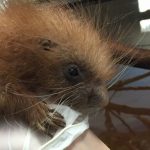
The zoo just brought in a new porcupine to mate with Bess and/or Beatrix (scandalous!). His name is Quillbur.
“It’s not that Clark can ever, ever possibly be replaced,” says Maria Montgomery, an animal keeper at the zoo who works closely with the prehensile-tailed porcupines. Still, Quillbur is “our new breeding male … He is going to be a very busy fellow.”
But not quite yet. Quillbur, who arrived two weeks before Thanksgiving from upstate New York, isn’t sexually mature. He’s currently being housed separately from Bess and Beatrix, and keepers are waiting to introduce them until they have an active interest in breeding. They’re expecting that to happen around spring 2019.
The prehensile-tailed porcupines, native to South America, aren’t the most dramatic in the Small Mammal House. Even the prospect of a male bedding both a mother and her daughter isn’t that big of a deal to the 7-pound creatures, which are not monogamous in the wild, says Montgomery.
Bess and Beatrix haven’t officially met Quillbur yet, but Montgomery suspects they’re aware of him. “They’re both a couple of exhibits away from each other. You’ve seen their noses—I’m sure they’re picking up that there’s a porcupine close by.”
Keepers are still deciding how the meet-cute between the porcupines will go down. They may introduce Quillbur to Bess and Beatrix at the same time, but are currently leaning against that idea, per Montgomery, in favor of one-on-one meetings. Are they preparing anything special for the introduction? “We don’t set the mood,” says Montgomery. “He’s going to go and naturally breed with either female.”
Because porcupines are nocturnal, keepers generally aren’t around when the creatures actually mate, so humans instead look for signs of what occurred. What kind of clues? “Semen plugs” in the enclosure, says Montgomery, or, sometimes, when copulating, males “may miss and sometimes the glass gets kind of dirty, so even though we have to clean it up, it’s a good indication for us whether something’s happened.”
Clark used to urinate on Bess before breeding (“When Clark would get excited, sometimes he would urinate—it could be considered a sexual behavior,” says Montgomery), but it’s not clear whether Quillbur will do that, too. There’s also the question of whether Bess can still reproduce, given her age.
Until Quillbur goes through puberty, keepers are focusing on training. The first task is getting him to go in and out of his crate by using a series of rewards. “He is pretty friendly,” says Montgomery. “As soon as he sees us, he thinks, ‘I think corn may be coming, maybe a couple of nuts, this is fantastic.’ He’s pretty outgoing, but he does not like to be touched, especially in the same way Clark did.” After Quillbur masters the crate, keepers are hoping to teach him to step on the scale. If he’s really adept, he may even become a demo animal.
Keepers have had a lot of success with the prehensile-tailed porcupines—they’ve been able to train Bess to submit to an ultrasound and to hold for a radiograph. “Bess is fantastic,” says Montgomery. “She’s very gentle, very patient. She loves her treats and we can pretty much get Bess to work a lot of behaviors.”
Indeed, the treats are the best way for keepers to teach the porcupines new tricks. “They love bananas, corn, nuts—they’ll work for really small amounts of nuts,” says Montgomery. “A little bit of nut goes a long way.”